

The best tube cutter for shelving, display racks, and scaffolding production is the one that matches your tube envelope, hole and slot accuracy, tail-remnant target, automation level, and destination-market standard. I would not choose by laser power first. I would choose by your real tube data: shape, outside diameter or side size, wall thickness, material grade, stock length, part length, hole geometry, annual volume, and floor-space limit.
If your parts need many holes, slots, end cuts, and notches, a fiber laser tube cutter can combine work that otherwise needs sawing, drilling, punching, and milling. But a cheaper saw or punch may still be the right call if you cut only straight lengths with simple holes and stable high volume.
What should you decide first?
You should decide the application, tube material, production volume, precision need, budget limit, and destination-market compliance before you compare machine models. These points set the machine size, automation level, chuck style, cutting head, and service requirement.
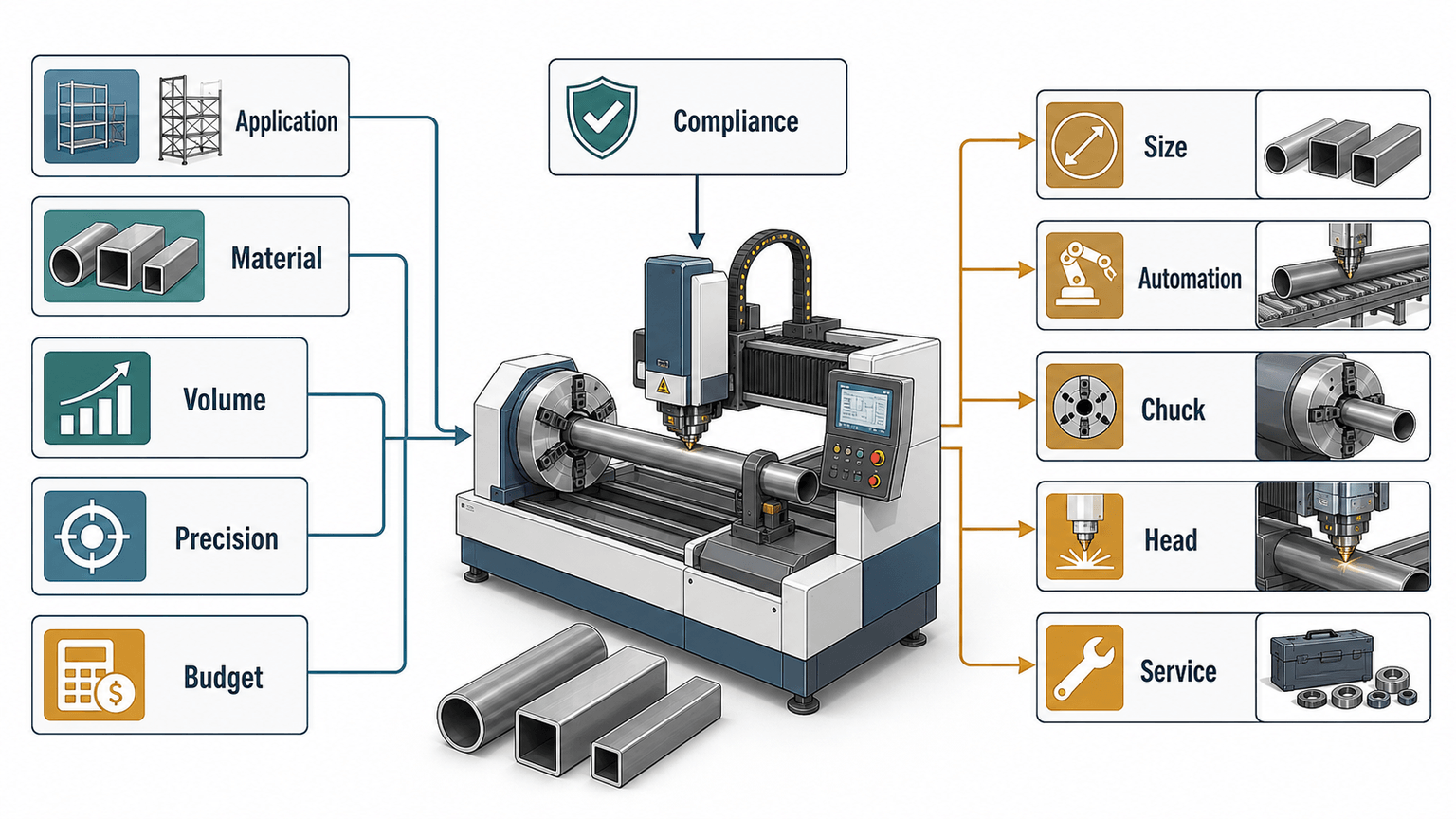
| Factor | Why it matters | How to assess yours |
|---|---|---|
| Application | Shelving, display racks, and scaffolding use different tube shapes, connections, finishes, and tolerance needs. | Group your parts by product family: rack upright, shelf frame, brace, display tube, scaffold component, or coupler-related part. |
| Tube shape and size | The machine must physically handle your round, square, rectangular, oval, channel, angle, or structural profile. | List OD or side size in mm, wall thickness in mm, stock length, and finished part length. |
| Material and finish | Carbon steel, stainless steel, aluminum, galvanized tube, and coated tube behave differently during cutting. | State grade, coating, surface finish, and whether the edge must be weld-ready or appearance-grade. |
| Throughput | Volume decides whether manual loading, automatic loading, or automatic loading and unloading makes sense. | Count parts per shift, tube length per day, and changeovers per week. |
| Precision | Hole position, slot shape, brace length, and end-cut angle affect fit-up and welding time. | Measure the tolerance your assembly really needs, then sample-cut your hardest part. |
| Tail remnant | Shorter tail remnant reduces scrap on repeated production. | Track leftover length per tube today and multiply by your monthly tube consumption. |
| Floor space | Some factories need a compact short-body machine more than maximum capacity. | Mark machine space, loading space, unloading space, gas area, and operator access on your floor plan. |
| Destination market | Standards such as OSHA, ANSI, ASTM, EN, JIS, or GB may affect material and finished product requirements. | Ask your customer which standard applies before you freeze the cutter configuration. |
For U.S. scaffolding, OSHA 29 CFR 1926.451 requires each scaffold and scaffold component to support its own weight plus at least 4 times the maximum intended load applied or transmitted to it. That does not mean a tube cutter makes a scaffold compliant by itself. It means your cut length, hole location, brace fit-up, welding, material, coating, testing, rating, installation, and inspection all have to work together.
For U.S. storage racks, ANSI MH16.1-2023 covers structural design, testing, and utilization of industrial steel storage racks. For boltless shelving, ANSI MH28.2-2022 applies. I treat these as design and product requirements first, then I select the cutter that can repeat the connection geometry your design needs.
Which specs actually matter, and what range do you need?
The specs that matter most are tube range, wall thickness, part accuracy, repeatability, loading automation, tail remnant, profile capability, and service support. Laser power matters, but only after you know the material, wall thickness, edge requirement, and volume.
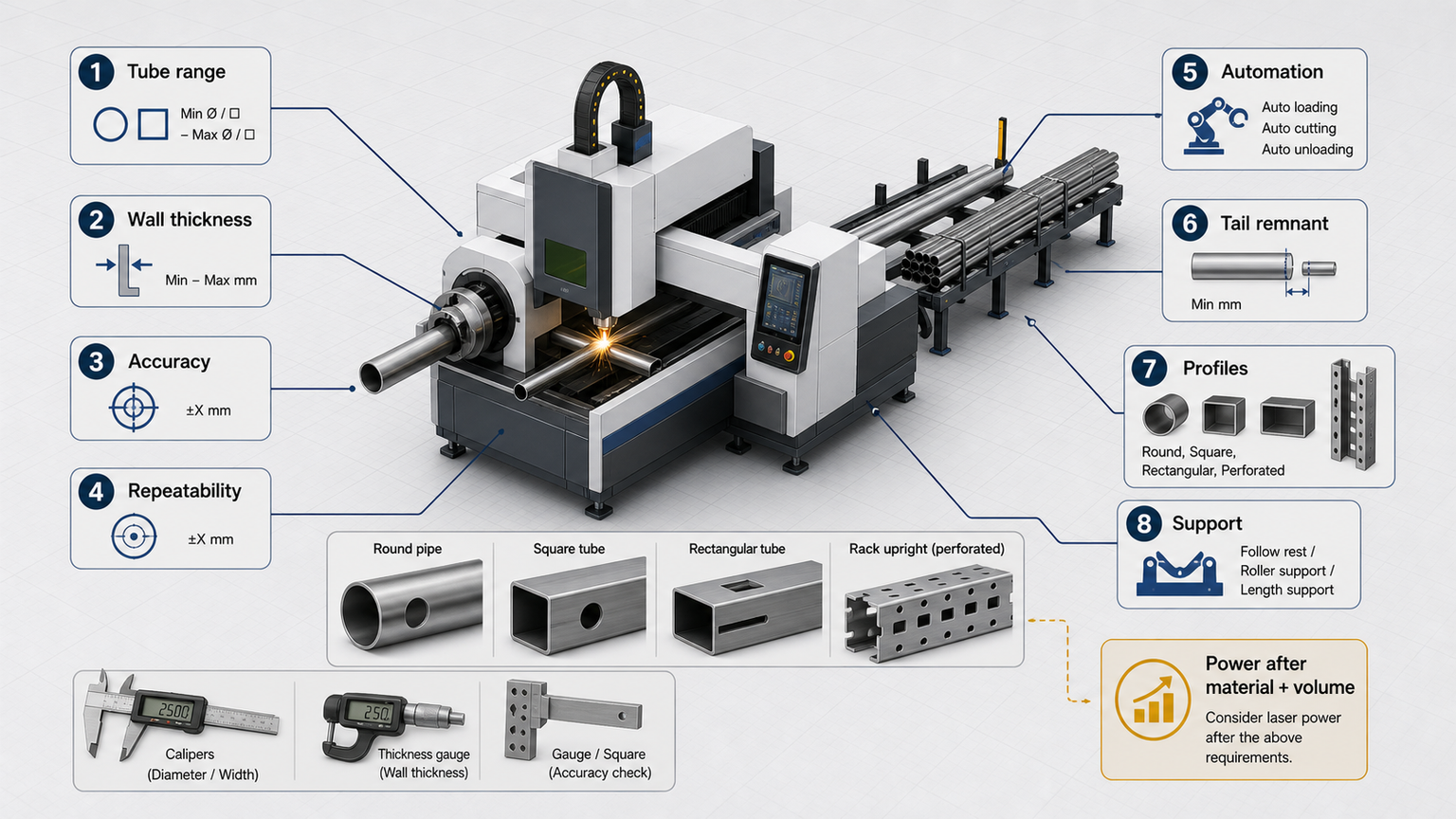
| Spec / parameter | What to look for | Typical range |
|---|---|---|
| Laser power | Match power to material, wall thickness, and throughput target. | BNL Laser tube laser models range from 1500 W to 12000 W by series. |
| Round tube capacity | Confirm minimum and maximum OD. | M Series Φ8–Φ85 mm; Q Series up to φ120 mm or φ165 mm; P-Pro Φ12–Φ300 mm. |
| Square tube capacity | Confirm maximum side size and chuck load. | Q12/Q12Y up to 120×120 mm; Q16/Q16Y up to 165×165 mm. |
| Wall thickness | Match the machine series to thin-wall, general-purpose, or heavier tube. | M Series 0.2–3 mm; P-Pro 1–20 mm. |
| Part length | Confirm both stock length and finished part length. | M Series part length 1–6000 mm; X12Y-2 handles 12-metre long stock. |
| Repeatability | Important for repeated slots, brace holes, and fixture-free assembly. | Q Series repeatability ±0.05 mm. |
| Cutting accuracy | Important for small precision tube and visible assemblies. | M Series ≤±0.1 mm on parts ≤500 mm; ≤±0.2 mm on parts 500–1200 mm. |
| Bevel capability | Needed when the tube end needs weld preparation. | P-Pro bevel angle 0–60° adjustable; angle error ≤±0.1°. |
| Tail remnant | A shorter remnant cuts scrap on repeated tube work. | Q Series Y short-tail models reduce tube remnant to ≥45 mm, compared with ≥80–220 mm standard. |
| Automation | Loading and unloading affect labor cost and shift output. | Q Series automatic loading is available; L-PurePro includes automatic loading and unloading. |
| Footprint | Critical for crowded factories and retrofit layouts. | X12Y footprint is 3.1×1.48×1.4 m. |
| Profile capability | Structural profiles need more than round and square tube handling. | B-NexBeam cuts square, round, rectangular, oval, I-beam, channel, and angle steel. |
For stainless display racks, I usually discuss nitrogen assist gas early because nitrogen gives a clean, oxide-free edge when appearance or welding matters. For carbon steel rack and scaffold parts, oxygen assist can make sense when productivity matters and an oxidized edge is acceptable. I confirm pressure, speed, nozzle, and edge quality through a timed sample cut on your tube, because the right setting depends on material, wall thickness, power, and your finish requirement.
The easiest mistake here is to compare only maximum cutting diameter. A scaffold tube job around EN 39 reference tube size, 48.3 mm OD with 3.2 mm or 4.0 mm specified thickness, may need stable repeated cutting more than a large chuck. A structural rack job may need slot repeatability and low tail scrap more than bevel cutting. A stainless display rack may need appearance and deburring control more than raw speed.
How do you match the option to your use case?
You match the tube cutter by the hardest part you make every week, not by the biggest part you might make once a year. I ask buyers to send the part that causes rework, slow welding, or high scrap, because that part usually tells us which machine belongs on your floor.
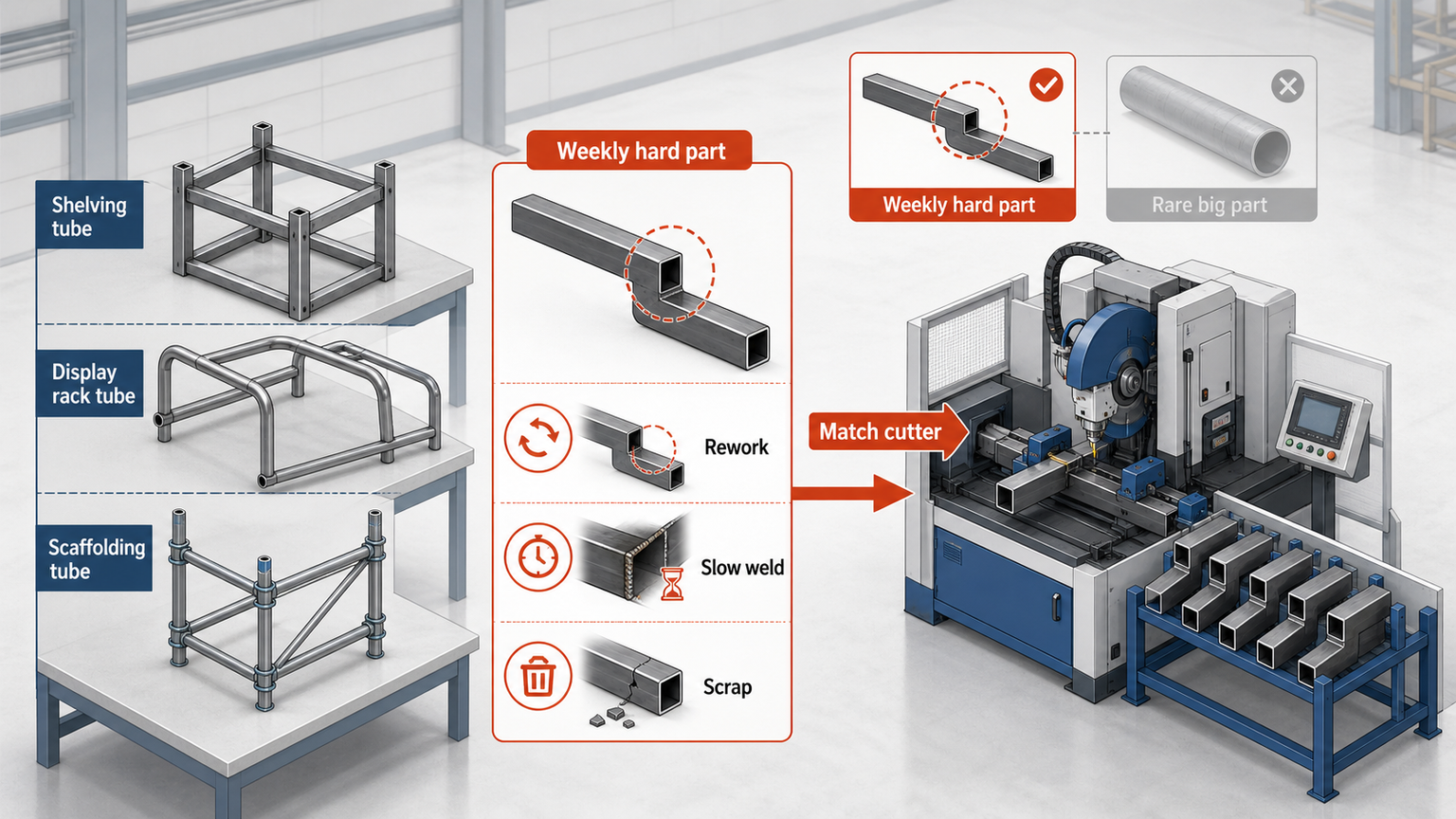
| If your production looks like this | Choose this direction | Why it fits |
|---|---|---|
| Mixed shelving, display rack, furniture, and light structural tube | Q Series Q12/Q12Y/Q16/Q16Y | It gives a broad general-purpose range, 1500–6000 W power options, ±0.05 mm repeatability, and automatic loading availability. |
| You cut many repeated parts and want lower tube remnant | Q Series Y short-tail model | The Y short-tail models reduce remnant to ≥45 mm, compared with ≥80–220 mm standard. |
| You make small-diameter furniture, sanitary ware, motorcycle parts, or thin-wall exhaust tube | M Series M12/M12Y | It handles Φ8–Φ85 mm tube, 0.2–3 mm wall, and small precision parts with stated M Series accuracy figures. |
| You have a crowded floor and mainly cut Φ10–100 mm tube | X12Y | It uses a dual-front-chuck short body, 1500–3000 W power, and a 3.1×1.48×1.4 m footprint. |
| You process 12-metre structural stock | X12Y-2 | It handles 12-metre long stock, so you avoid designing the process around short input lengths. |
| You need to bring cutting to the material | X12Y-3 | It is our mobile/on-site unit. |
| You need weld-prep bevels on exhaust or structural weldments | P-Pro | It cuts 0–60° adjustable bevels, holds angle error ≤±0.1°, and covers Φ12–Φ300 mm tube with 1–20 mm wall. |
| You run high-volume, low-labor tube production | L-PurePro L90–L350 | It combines 1500–12000 W power options with automatic loading and unloading. |
| You cut structural profiles such as I-beam, channel, angle, oval, and rectangular tube | B-NexBeam B90–B350 | Its side-mounted layout supports square, round, rectangular, oval, I-beam, channel, and angle steel. |
For U.S. rack work, ASTM A500/A500M often matters when the buyer specifies carbon steel structural tubing. ASTM A513/A513M-24 matters for electric-resistance-welded carbon and alloy steel mechanical tubing in round, square, rectangular, and special shapes. ASTM A554 matters when stainless mechanical tubing needs appearance, mechanical properties, or corrosion resistance.
For European furniture and display tube, EN 10305-3:2023 can be relevant because it covers welded cold-sized precision tubes, including circular tubes with outside diameter D ≤ 193.7 mm and square or rectangular tubes. For European structural hollow sections, EN 10219-2:2019 gives tolerances, dimensions, and sectional properties for cold-formed welded structural hollow sections. These standards do not choose the machine for you, but they help you describe the tube and tolerance environment correctly.
On my factory floor, I have seen buyers overbuy because they fear missing one future job. Then the machine spends most of its life cutting small simple parts. I prefer a cleaner decision: buy for the work that pays the machine back through daily use, and outsource the rare oversized job until it becomes regular.
What to check before you commit — and on the supplier?
Before you commit, you should check the sample cut, written configuration, service terms, spare parts path, company identity, and standards needed in your market. A real supplier should answer with documents, machine video, sample parts, and clear names, not only sales words.
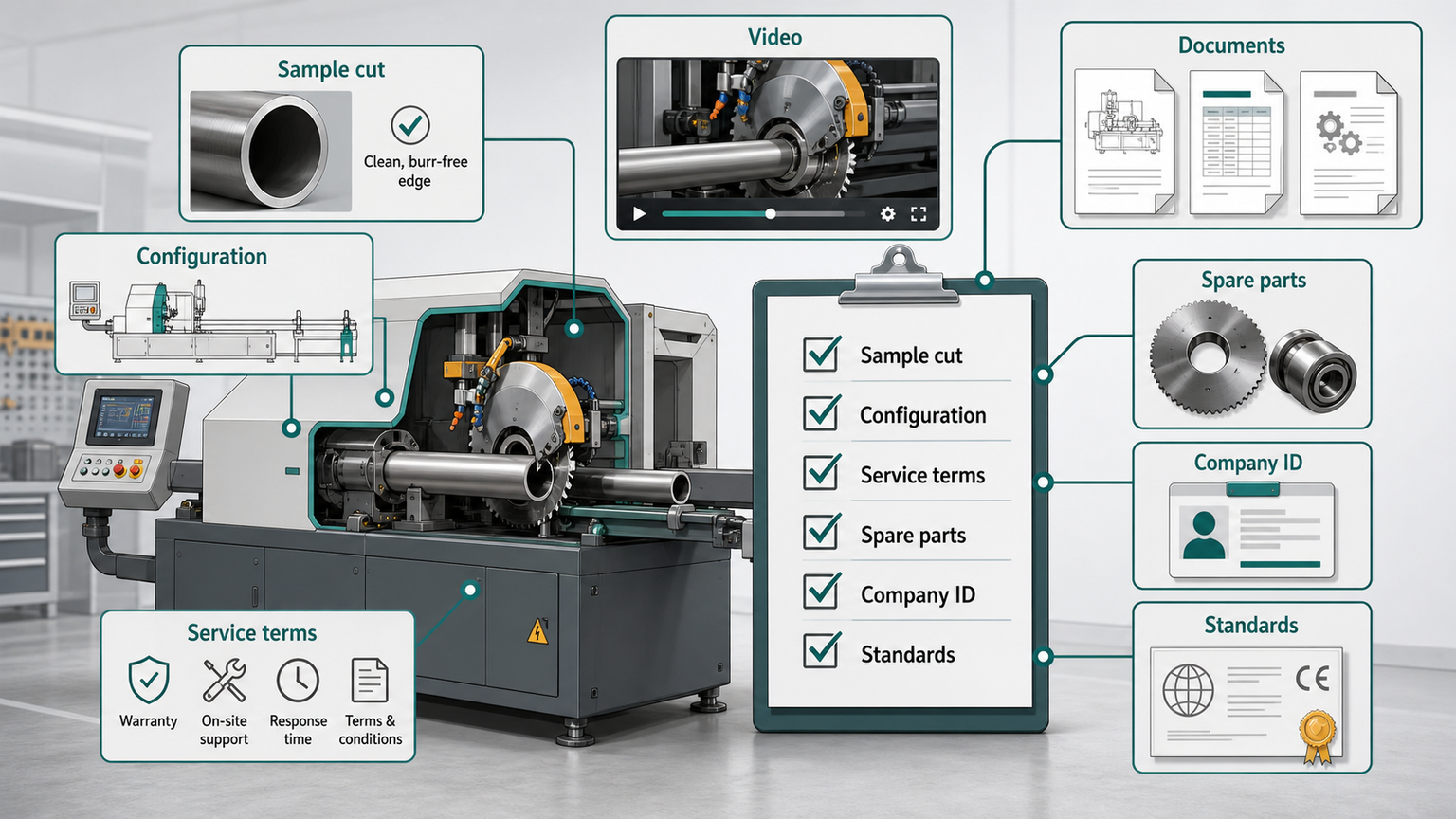
Tube data: Send OD or side size, wall thickness, shape, material grade, coating, stock length, part length, drawings or photos, hole and slot details, and expected volume.
Timed sample cut: Ask us to cut your real tube and return a cycle-time estimate. This tells you more than a brochure speed.
Part quality: Check burr, edge color, hole shape, slot corner quality, cut length, notch fit-up, and weld fixture behavior.
Tail remnant: Ask for the expected remnant on your tube length and part mix. If scrap cost hurts you, compare standard and short-tail options.
Automation level: Decide whether manual loading, automatic loading, or automatic loading and unloading fits your labor cost and shift plan.
After-sales and spare parts: Confirm how you will get nozzles, lenses, sensors, protection mirrors, ceramic rings, and other service parts in your region.
Warranty and service response: Ask for warranty and service-response terms in writing before payment.
Electrical configuration: Our standard build is three-phase 380 V 50 Hz, and we configure voltage and power for your country during the RFQ and confirm it in writing.
Certification and market access: Ask what your destination market requires. Some buyers need documents for local import or product approval systems such as SASO/SABER, ESMA, or SNI, and the requirement depends on the machine, country, and shipment route.
Product standards: Confirm whether your product must follow OSHA, ANSI, ASTM, EN, JIS, GB, or another buyer-specified standard. The tube cutter supports repeatable parts, but your finished shelving, rack, or scaffold still needs proper design, material, welding, coating, testing, rating, installation, and inspection.
Supplier identity: Ask for a live video tour of the Foshan machining, assembly, and test bays. Ask for our ISO certificate during the RFQ, and check that the scope and company name match Foshan Mingzhou Intelligent Equipment Co., Ltd.
Payment name: Pay only the manufacturer’s own corporate account under the same company name. If a supplier asks you to wire money to a different company, walk away.
Public record: Patents are public record. We have 30+ patents and core technologies, and I encourage buyers to check.
Customization: Ask what changes affect chuck selection, loading, unloading, cutting head, voltage, guarding, dust extraction, and software workflow.
We built Easy-Cut control because many tube shops do not have enough CAD-trained operators. The operator can program parts on-screen at the machine, with no CAD step and no separate programmer, so training can drop from weeks to about one day. That matters when your bottleneck is not the laser beam; it is the person who must keep the machine producing good parts every shift.
What mistakes do buyers most often make?
The most common mistake is buying by maximum power or machine size before proving the hardest real part. A tube cutter should solve your production problem, not just look strong on a quotation.
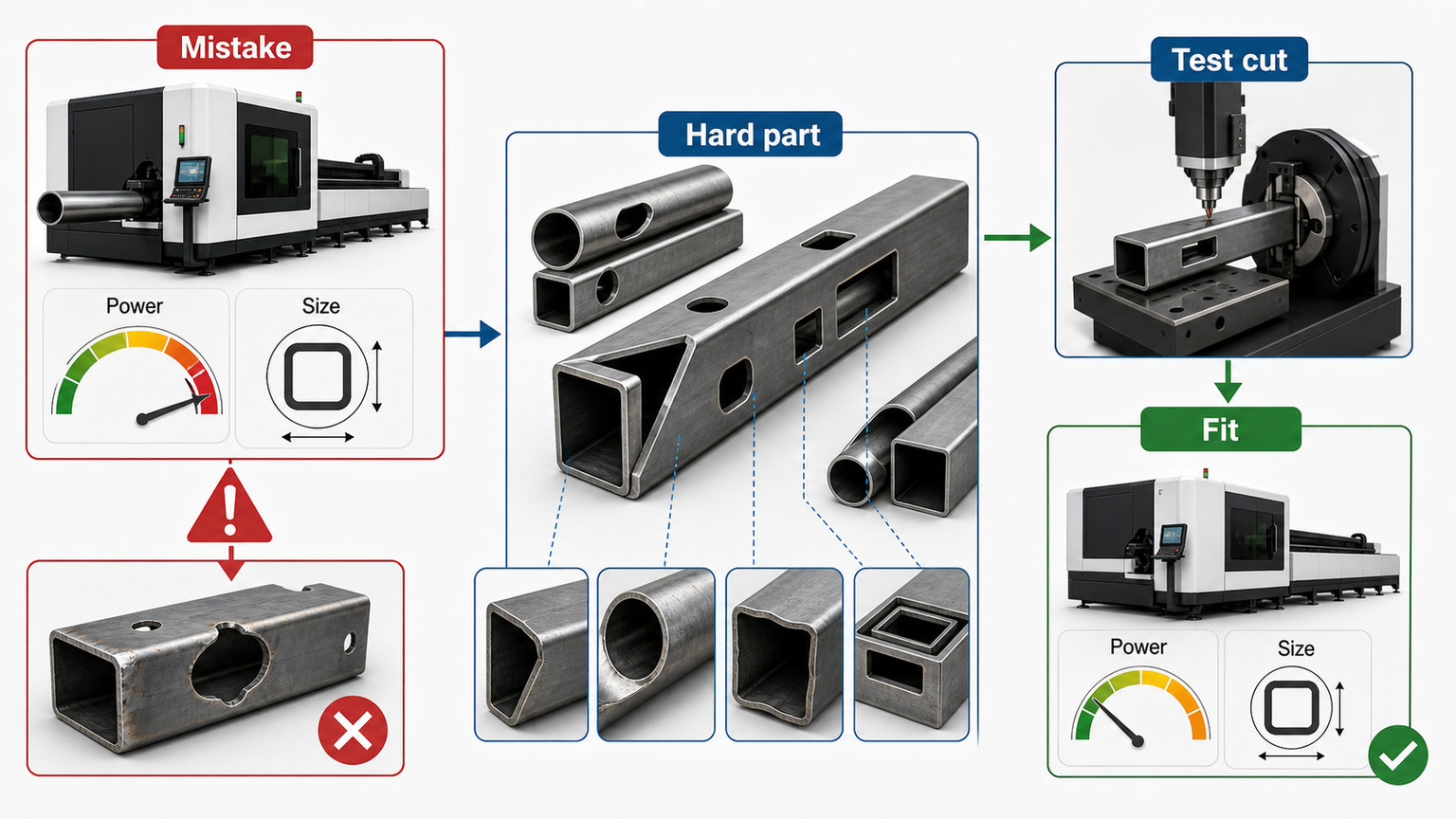
They ignore the connection geometry. Shelving and rack capacity often depends on holes, slots, tabs, braces, and welded joints. A machine that cuts length but cannot repeat connection geometry creates work at welding and assembly.
They forget tail scrap. On repeated tube jobs, leftover length becomes real money. Q Series Y short-tail models reduce tube remnant to ≥45 mm, so I always ask buyers to calculate remnant against monthly tube use.
They treat compliance as a cutter feature. OSHA 29 CFR 1926.452 covers fabricated frame scaffold bracing and alignment, and EN 12811-1 covers access and working scaffold performance and design methods. Cutting accuracy helps consistency, but it does not replace structural design, rated components, or inspection.
They buy automation without checking part mix. Automatic loading helps when your part flow supports it. If you change tube size all day in small batches, the value may come from easier programming and fast setup instead.
They skip the real sample. A brochure cannot show your galvanized coating behavior, stainless edge color, slot quality, or actual cycle time. Send us the tube, and we will cut a free real sample with a cycle-time estimate.
They do not verify the factory. A trading company can show photos. A factory can show machining, assembly, testing, engineers, parts, ISO documents, and a live cut on your tube spec.
Conclusion
Choose the tube cutter by your real tube envelope, part geometry, repeatability need, tail-remnant target, automation plan, and destination-market requirements. A Q Series machine fits many mixed shelving and rack shops, M Series fits small precision tube, X Series fits tight floors or special stock handling, P-Pro fits bevel weldments, L-PurePro fits high-volume low-labor lines, and B-NexBeam fits structural profiles.
Send us one difficult part and your tube data. We will have an engineer review it within one business day, cut a free real sample where needed, and put the configuration, quote, warranty, and service-response terms in writing.
— Eric Liu, General Manager, BNL Laser