

A CNC fiber tube laser is usually the best flexible way to cut gym rack uprights with many bolt holes, elongated slots, notches, and cutoffs, because it handles all those features in one CNC program without dedicated punch tooling. Automatic punching can beat laser on very high-volume, repeated round-hole patterns when the hole diameter and pitch stay fixed. Drilling or milling still fits prototypes, repair work, and very low-volume jobs, but it becomes slow on long upright hole patterns.
What is the best process for gym rack bolt holes and slots?
For mixed gym rack tubing, I usually recommend CNC fiber tube laser first, then compare punching only if the hole pattern repeats at high volume.
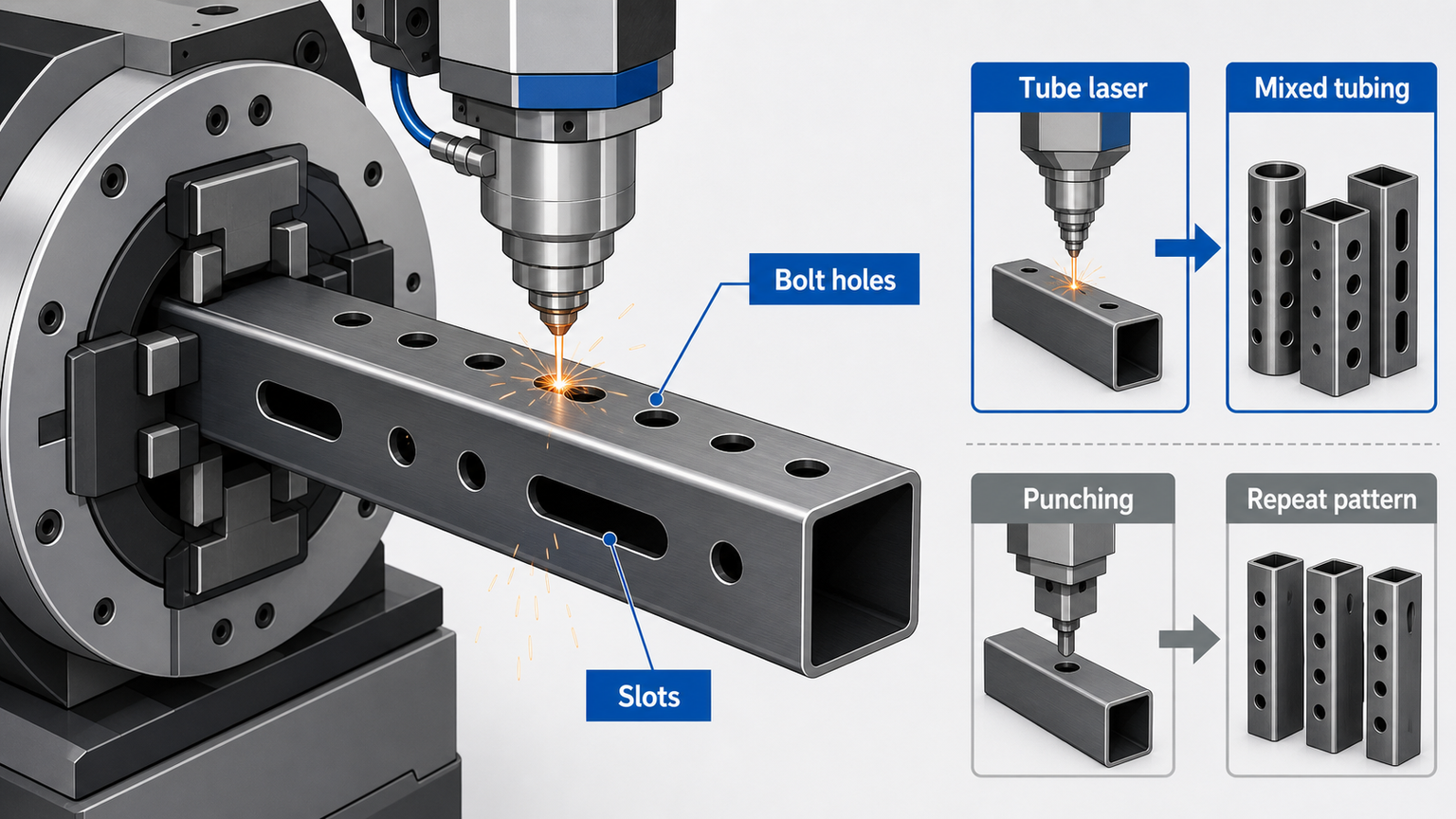
A gym rack upright often needs round holes, long slots, logo cuts, drain holes, miters, and part cutoff. Laser cutting handles simple and complex shapes with quick setup and no contact, which matches TWI’s description of laser cutting benefits.
| Need on gym rack tube | Best-fit process | Why it fits | Main caution |
|---|---|---|---|
| Round holes, slots, notches, logos, cutoffs | CNC fiber tube laser | One CNC program cuts many shapes | Prove edge and cycle time on your tube |
| Fixed round-hole pattern at high volume | Automatic punching | Tooling can make repeated holes fast | Control burr, rollover, and tube deformation |
| Prototype or repair | Drilling / milling | Simple setup for a few pieces | Slow for long hole rows and slots |
Why does hole position matter more than headline cutting speed?
Hole pitch and positional repeatability matter more than headline speed because J-cups, safety pins, and selector parts must line up along the full upright.
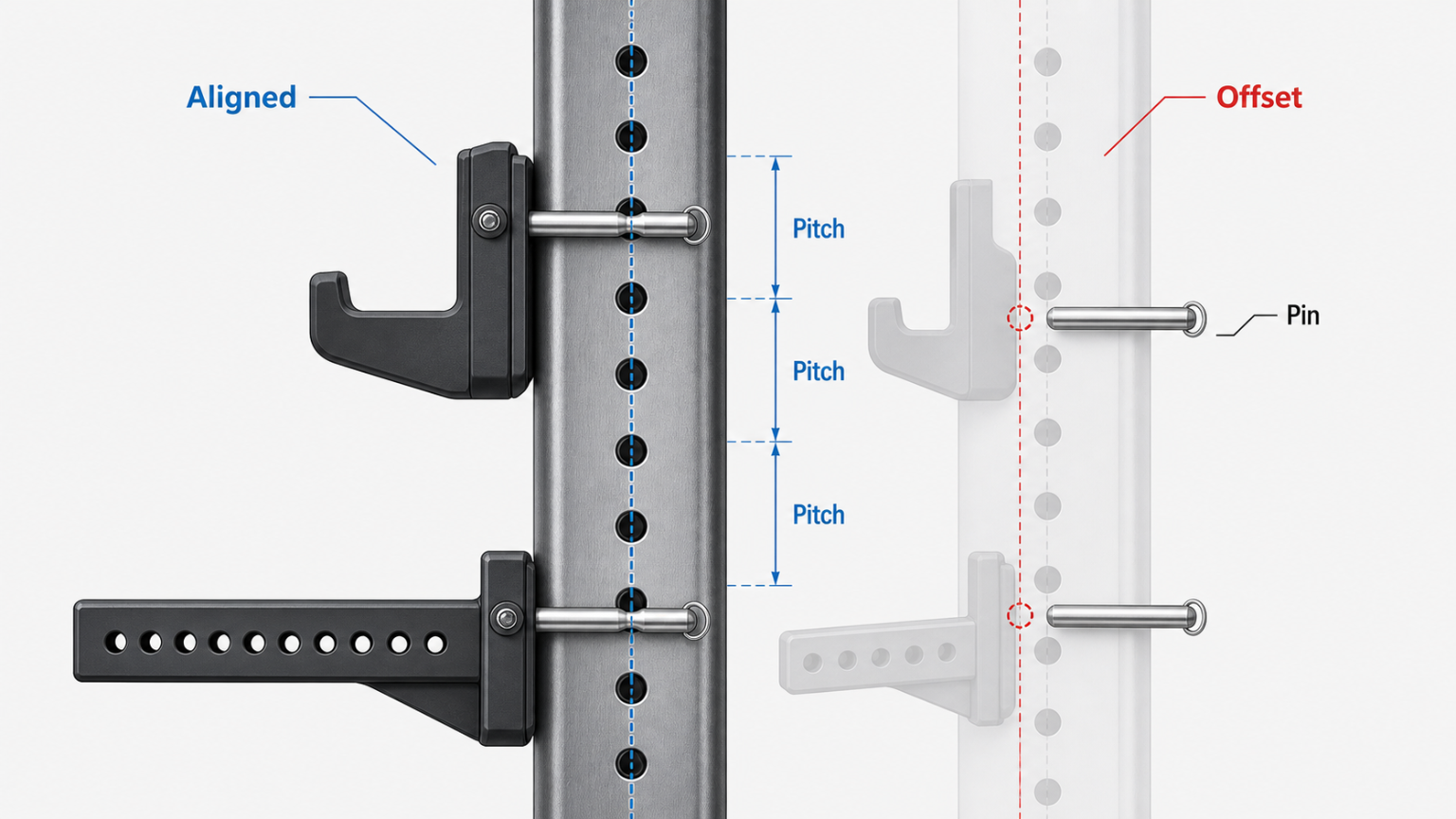
I care about the full pattern, not only one clean hole. ISO 2768-1 supports the same idea in drawing control: size and geometry should not depend on workshop judgment alone. Your drawing should define pitch, hole size, slot length, datum, and inspection method.
For BNL Laser Q Series tube lasers, the reference repeatability is ±0.05 mm. That does not replace your drawing tolerance, but it gives my engineer a starting point when we test your tube.
When is automatic punching better than laser cutting?
Automatic punching can be better when you make the same round-hole pattern in high volume and the hole size, pitch, material, and wall thickness stay stable.
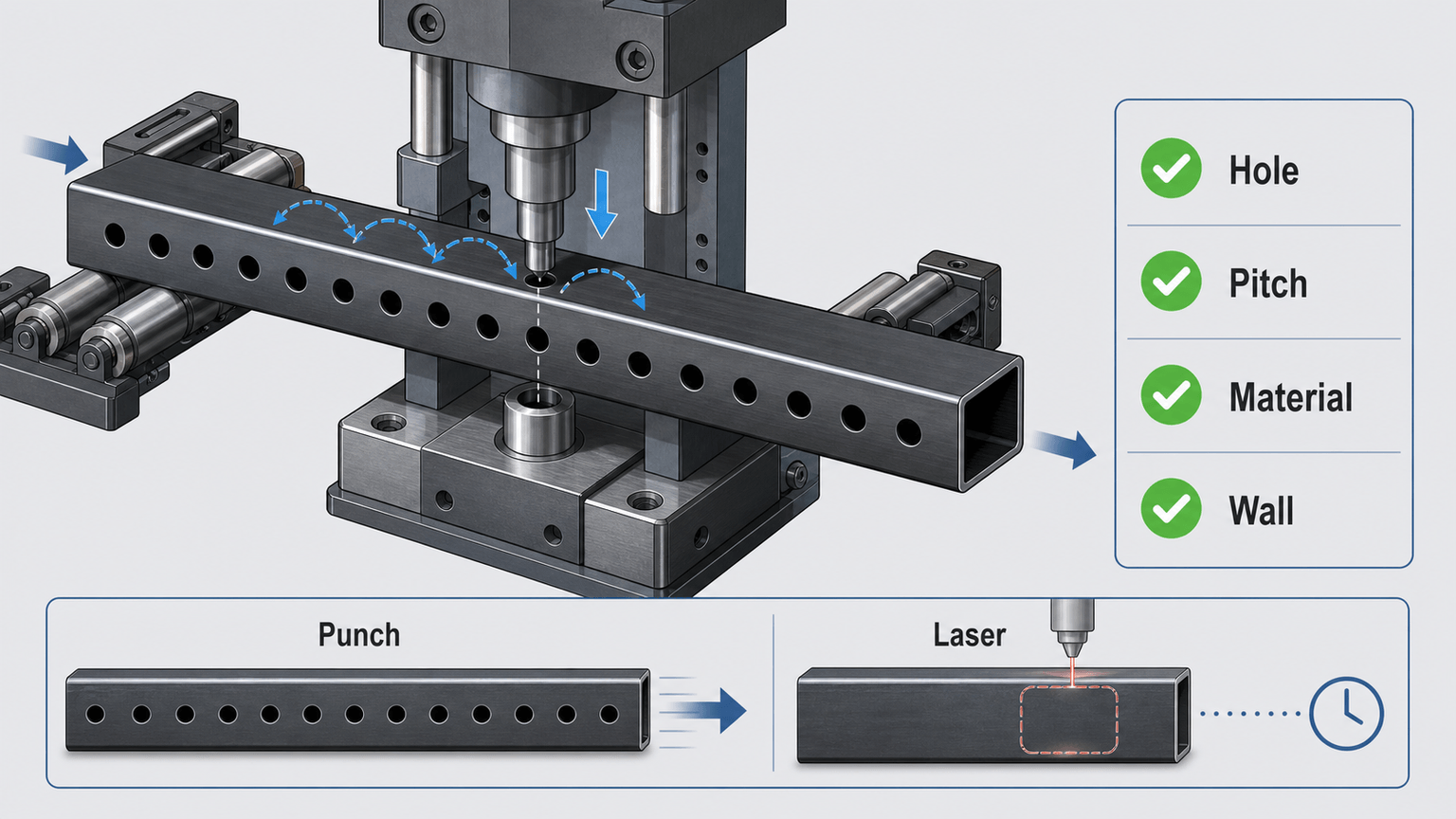
Punching uses mechanical shearing. Hole quality depends on punch-die clearance, tube material, hardness, wall thickness, and tooling condition. A tighter clearance can reduce rollover and burr, but it also raises tooling stress and wear.
Choose punching when your job looks like this:
- Same hole diameter: no frequent size changes.
- Same pitch: no mixed rack series every shift.
- Long production run: enough volume to justify tooling.
- Accepted burr plan: deburring or burr limit is already defined.
- Stable tube supply: material and wall thickness do not change often.
We build automatic punching machines as well as tube lasers, so I do not push laser when punching is the cleaner business case.
When should I use drilling or milling instead?
Drilling or milling fits prototypes, repair parts, and very low-volume gym rack jobs where automation cost does not make sense.
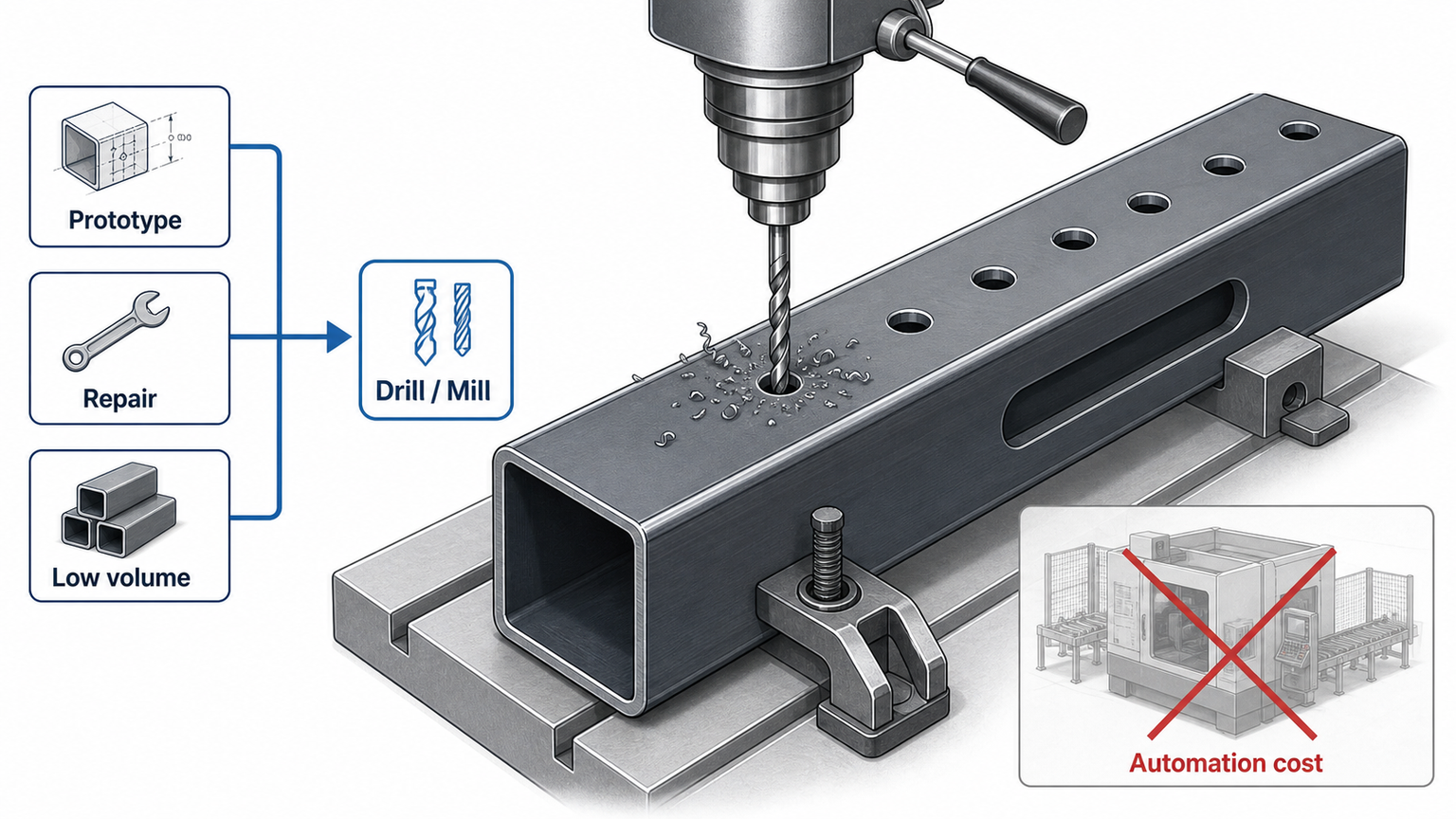
A drill press or mill can make accurate holes if the fixture is good and the operator checks the datum. But on a long upright with many repeated holes, the labor time grows fast. Elongated slots also add steps because you drill, mill, deburr, and inspect.
I would use drilling or milling when you need five test uprights, not when your floor needs stable daily output.
What machine specs should I check for gym rack tube cutting?
You should check tube size range, wall thickness, part length, repeatability, chuck load, remnant length, loading method, and whether the control can run without CAD.
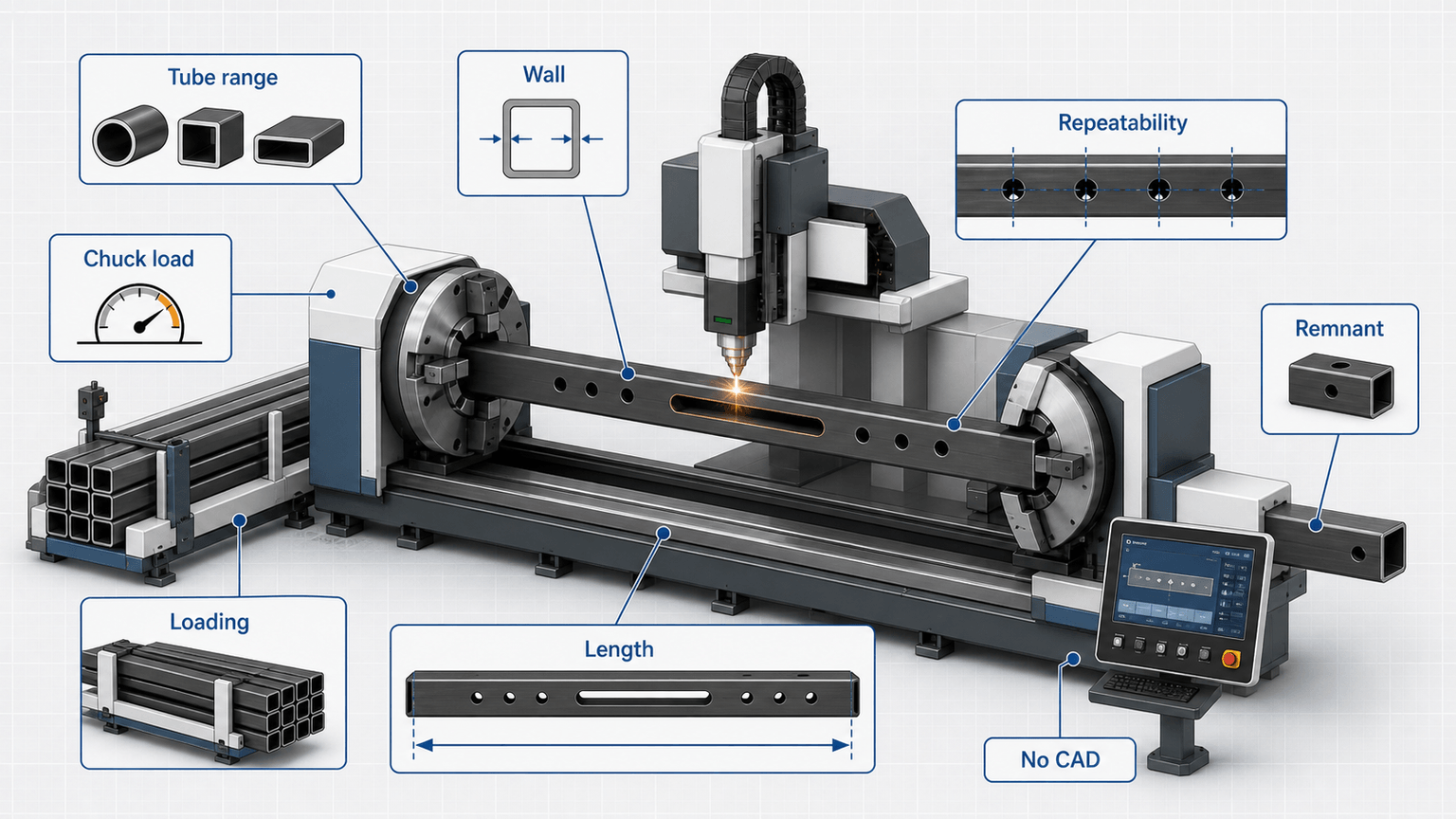
For gym rack tubing, the machine must hold the tube straight, index the pattern, and cut holes without forcing your operator into a long programming chain.
| BNL Laser model | Reference range | Fit for gym rack work |
|---|---|---|
| Q12 / Q12Y | Round φ12-φ120 mm; square up to 120×120 mm; 1500-6000 W; repeatability ±0.05 mm | General rack tube and mixed fabrication |
| Q16 / Q16Y | Round φ8-φ165 mm; square up to 165×165 mm; 1500-6000 W; repeatability ±0.05 mm | Larger upright and structural tube work |
| Q Series Y models | Short-tail remnant ≥45 mm, compared with ≥80-220 mm on standard models | Shops that want to cut leftover waste |
| X12Y | Dual-front-chuck, φ10-100 mm, 1500-3000 W, 3.1×1.48×1.4 m footprint, remnant ≈100 mm | Tight floors and compact production cells |
| B-NexBeam | 1500-12000 W; square, round, rectangular, oval, I-beam, channel, angle steel | Structural profiles and layout-constrained shops |
| P-Pro | φ12-φ300 mm, wall 1-20 mm, 0-60° bevel, angle error ≤±0.1° | Weld-prep bevels and structural weldments |
Our standard build is three-phase 380 V 50 Hz. We configure voltage and power for your country during RFQ and confirm it in writing.
Which standards matter for gym rack tubing and fitness equipment?
You should separate tube material standards, cut-quality standards, fit tolerances, and finished fitness-equipment safety standards.
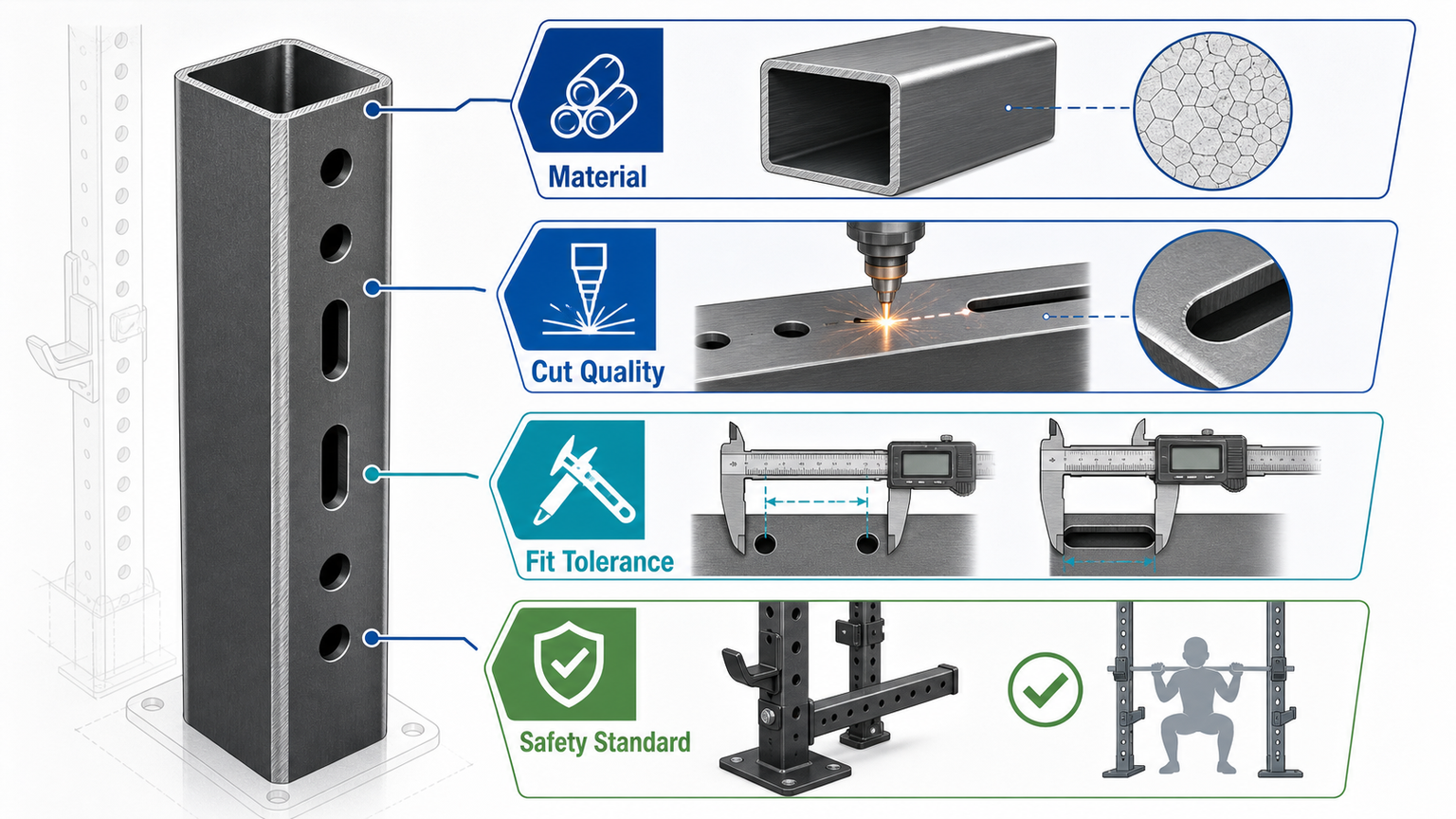
A clean cut part does not automatically make a compliant rack. ASTM F2276-23 covers fitness equipment design and manufacture requirements such as stability, support, edges, moving parts, adjustment and locking means, loading, instructions, and warnings. ISO 20957-1:2024 covers general safety requirements and test methods for indoor stationary training equipment.
| Buyer market | Standard to check | Why it matters |
|---|---|---|
| United States | ASTM A500/A500M | Structural carbon steel round, square, rectangular, and special-shape tubing |
| United States | ASTM F2276-23 | Fitness equipment design and manufacture safety specification |
| United States | ASTM F2216-17a(2025) | Selectorized strength training equipment |
| Europe | EN 10219-2:2019 | Cold-formed welded hollow-section dimensions and tolerances |
| Europe / international | EN ISO 20957-1:2024 / ISO 20957-1:2024 | Stationary training equipment safety requirements and test methods |
| International | ISO 9013:2017 | Thermal-cut quality classification for laser cuts from 0.5 mm to 32 mm when specified |
| International | ISO 2768-1:1989 | General tolerances where individual tolerances are not shown |
| International | ISO 286-1:2010 | Hole and shaft fit system for pins, bushings, and cylindrical features |
| China | GB/T 6728-2025 | Cold forming sectional steel for general structure |
| Japan | JIS G 3466:2025 | Carbon steel square and rectangular tubes for general structure |
For pins and adjustment parts, I tell buyers to check ISO 286-1 if they need a defined hole/shaft fit, not only a general cut tolerance.
What defects should I watch for on rack holes and slots?
You should watch for burr, dross, rollover, heat tint, taper, tube deformation, and hole-position drift.
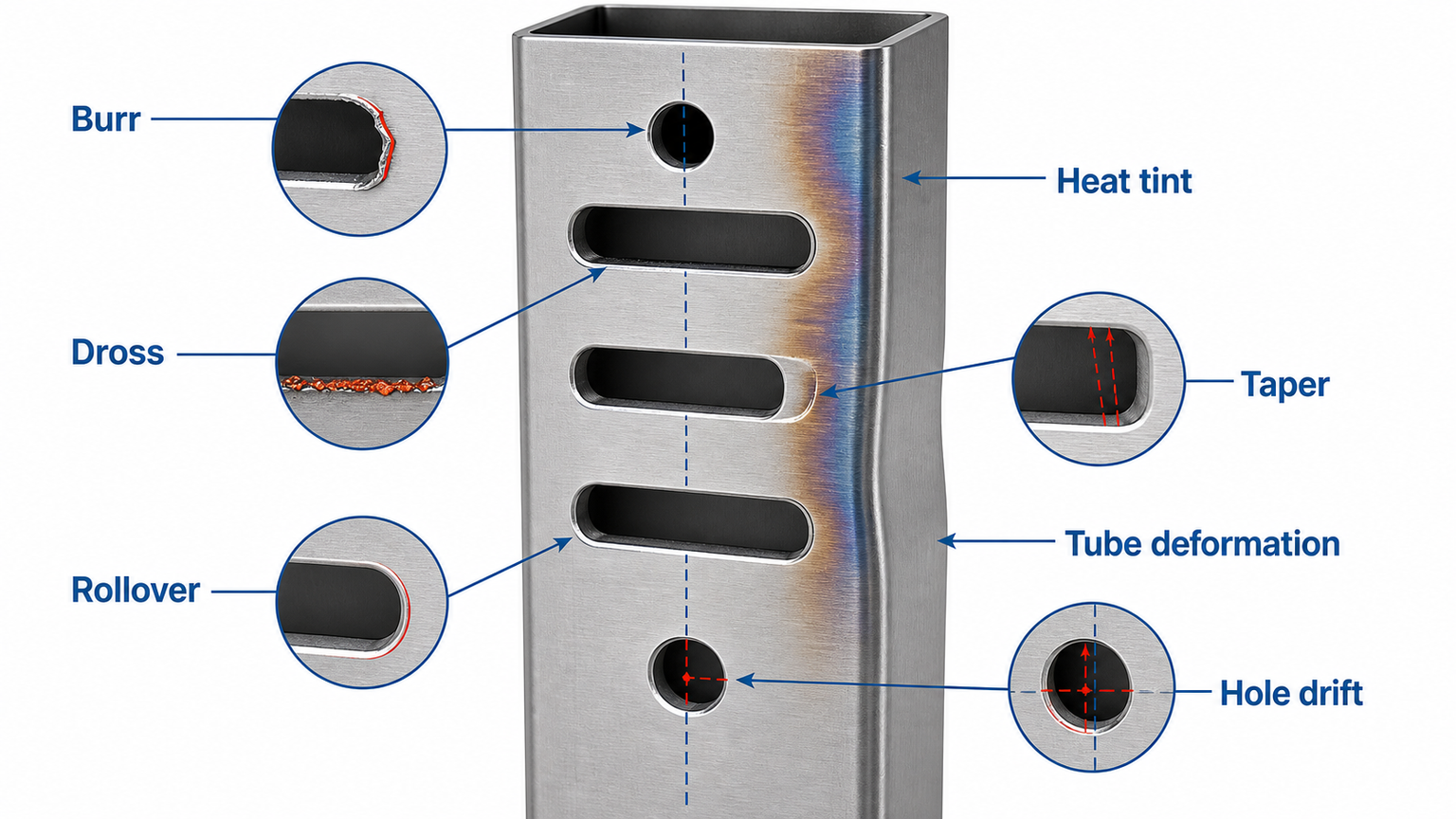
Each process has its own defect pattern. Laser cutting uses a focused beam and assist gas to melt, burn, vaporize, or blow material away. Punching shears the tube wall, so clearance and tooling condition strongly affect the edge.
| Defect | Likely cause | Practical fix |
|---|---|---|
| Burr on punched holes | Clearance, worn tooling, material thickness, hardness | Check punch-die clearance, tooling wear, and deburring plan |
| Rollover on punched holes | Shearing deformation | Adjust clearance and inspect tube support |
| Dross on laser slots | Setup, focus, nozzle, assist gas, material condition | Run a timed sample cut and tune on real tube |
| Heat tint on stainless | Assist gas and heat input | Use the correct gas plan and acceptance standard |
| Hole-position drift | Datum, chucking, tube straightness, program error | Inspect from a fixed datum across the full upright |
| Tube deformation | Clamping, punching force, thin wall, poor support | Check chuck/load support and fixture method |
ISO 9013 can help classify thermal-cut quality when your drawing or purchase document calls it out. I do not treat it as a blanket guarantee; I use it when the buyer specifies it.
How can I compare cost between laser, punching, and drilling?
You should compare cost by finished part, not by machine speed alone.
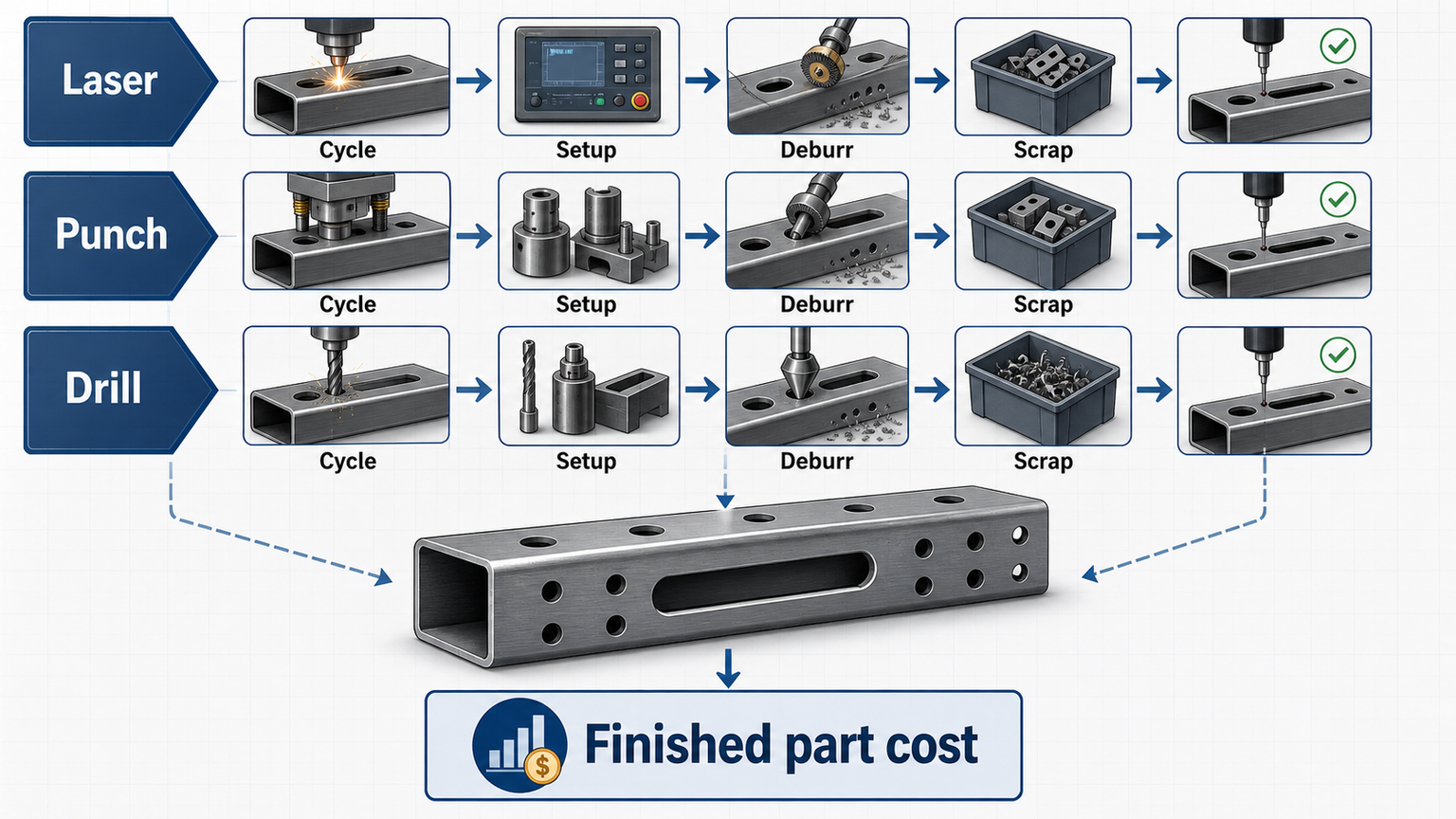
A fast hole-making process can still cost more if it needs tooling, deburring, rework, extra handling, or a skilled programmer. A slower process can still win if it avoids tooling and handles many part types in one shift.
Use this checklist before you buy:
- Count holes, slots, notches, miters, and cutoffs per part.
- List tube size, wall thickness, material grade, and length.
- Define burr limit, coating need, weld need, and inspection method.
- Separate repeated high-volume parts from short-run mixed parts.
- Ask for a timed sample cut on your own tube.
- Calculate labor, scrap, setup, tooling, deburring, and floor space.
At BNL Laser, we cut a free real sample on the buyer’s own material and include a cycle-time estimate. That gives your purchasing team a better number than a brochure speed.
How does drawing-free control help gym rack production?
Drawing-free Easy-Cut control helps when your operator needs to program tube holes and slots on the machine without a CAD step or a separate programmer.
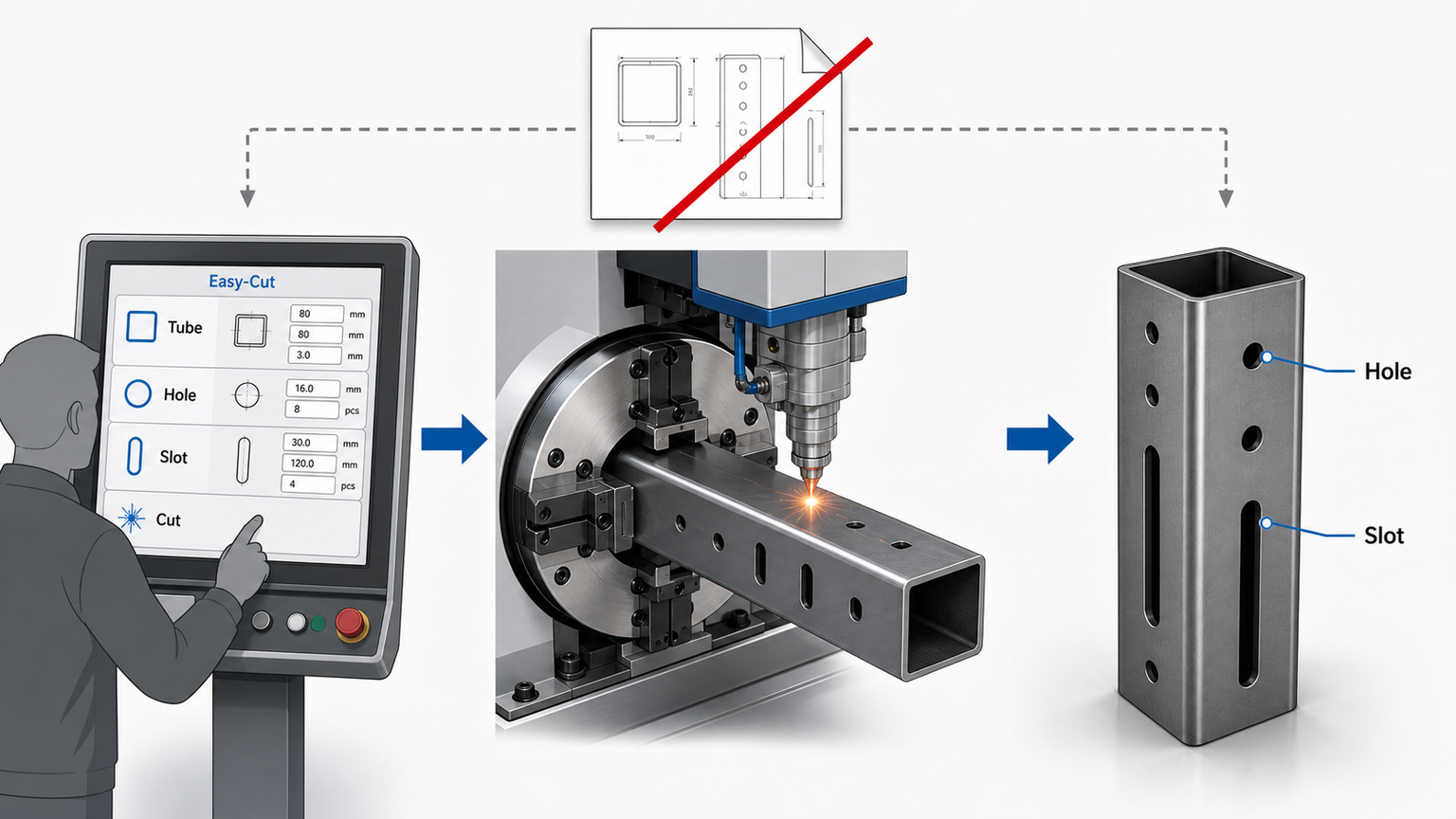
This matters on gym rack work because product families change. One customer may ask for a different upright height, hole pitch, logo cut, or slot shape. If every change waits for an office programmer, the machine becomes dependent on one person.
Our Easy-Cut control reduces operator training from weeks to about one day. I started BNL Laser because I did not want to sell a machine I could not fix myself, so we keep the control practical for the operator standing beside the tube.
How should I verify a tube laser supplier is a real factory?
You should verify the factory by checking the company name, live production floor, ISO certificate scope, public patents, payment account, and a real tube test on camera.
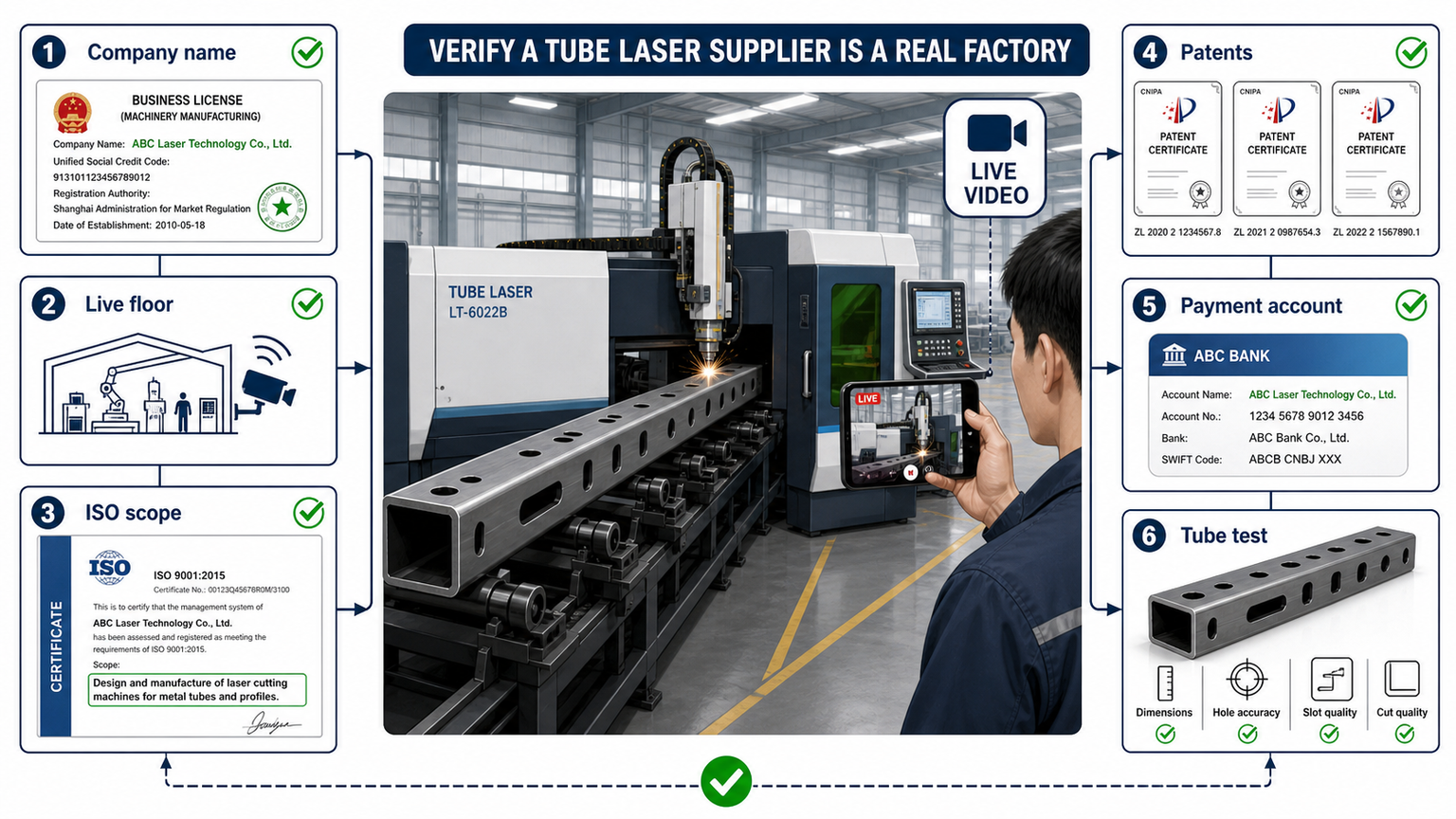
A trading company can speak well and still leave you exposed when service starts. Ask for a live video tour of the Foshan machining, assembly, and test bays. Ask for the ISO certificate and confirm that the company name matches the party you pay: Foshan Mingzhou Intelligent Equipment Co., Ltd.
Before you send money, check these points:
- Factory floor: machining, assembly, and test bays should be visible live.
- Company name: documents and payment account should match Foshan Mingzhou Intelligent Equipment Co., Ltd.
- ISO certificate: ask for the certificate during RFQ and check its scope.
- Patents: BNL Laser has 30+ patents and core technologies on public record.
- Sample test: ask us to run your tube spec on camera during the call.
- Service path: confirm that the service line reaches the engineers who built the machine.
We have 4,000+ customer applications worldwide, but I still prefer a live test over a sales claim.
What should I send for an accurate RFQ?
You should send tube drawings, tube standard, material grade, wall thickness, part length, hole and slot tolerances, batch quantity, and downstream process needs.
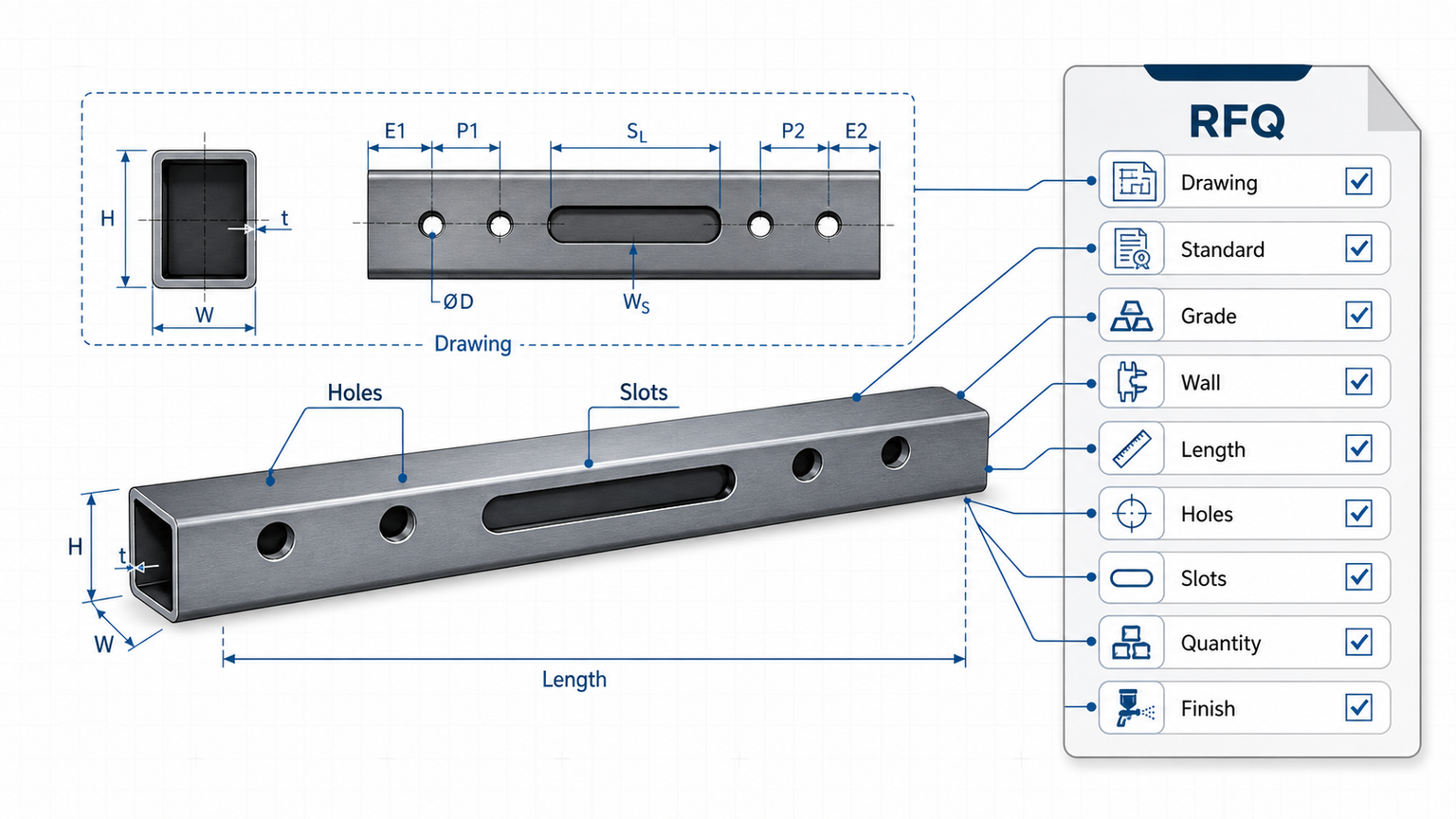
The better your input, the cleaner our answer. My engineer can reply within one business day, but we need enough data to choose between Q Series, X Series, B-NexBeam, P-Pro, L-PurePro, punching, or a combined process.
Send us:
- Tube shape, outside size, wall thickness, and material grade.
- Tube standard, such as ASTM A500/A500M, EN 10219-2, JIS G 3466, or GB/T 6728.
- Drawing with hole size, slot size, pitch, datum, and tolerance.
- Batch size and daily output target.
- Burr, dross, coating, welding, and inspection requirements.
- Factory voltage, floor space, and loading preference.
- Photos or videos of your current process, if you have them.
We then cut a real sample on your material, estimate cycle time, and issue configuration, quote, warranty, and service-response terms in writing.
Conclusion
For gym rack tubing, I start with the part pattern. If you need many accurate bolt holes, elongated slots, notches, and cutoffs across mixed products, CNC fiber tube laser is usually the right first process to test. If your job is one fixed round-hole pattern at very high volume, automatic punching deserves a serious comparison.
Send us your tube data and drawing, and my engineer will help you test the part before you decide.
— Eric Liu, General Manager, BNL Laser