

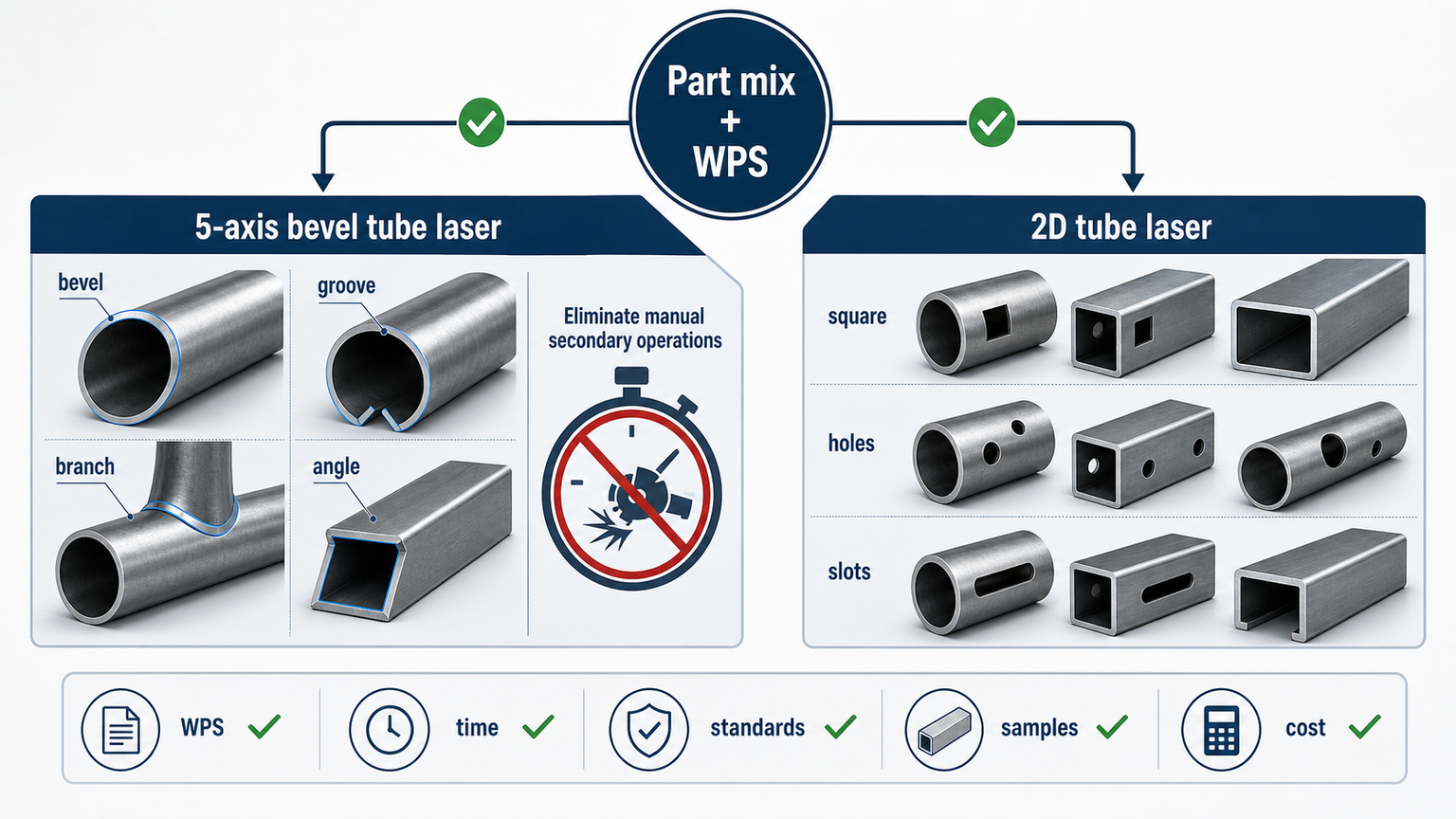
You need a bevel-cutting tube laser only when a meaningful share of your tube parts need bevel, groove, branch-contour, or angled-end weld preparation before welding. If your drawings only call for square cuts, holes, slots, and non-beveled profiles, a straight 2D tube laser may be the simpler and cheaper fit. I would first measure how many parts require weld-prep geometry and how much time your team now spends grinding, milling, sawing, or plasma-prepping those edges.
What should you decide first?
You should decide first whether your WPS or drawing truly requires bevel or groove preparation, because that need drives the machine choice.
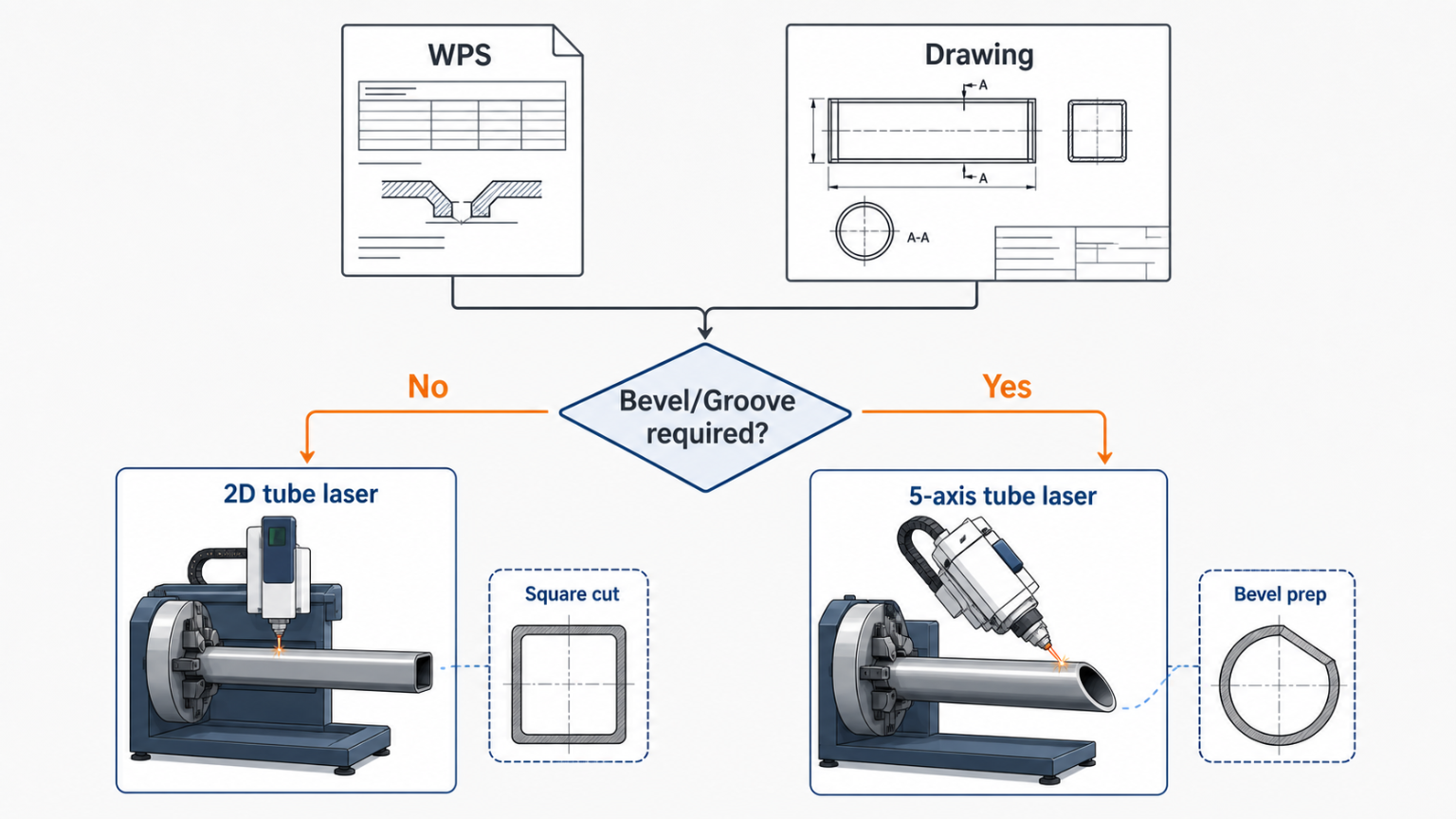
On the factory floor, I see buyers start with the phrase “5-axis” too early. I prefer to start with the part drawing, the Welding Procedure Specification, and the current secondary work. A machine axis count does not pay for itself. Removed manual work does.
| Factor | Why it matters | How to assess yours |
|---|---|---|
| Weld-prep requirement | Bevel-cutting matters when the weld design needs a groove edge, bevel edge, branch contour, or angled tube end. ISO 9692 covers joint preparation concepts for welding and allied processes. | Review the WPS and drawings. Mark each part that needs bevel, groove, branch-contour, or angled-end prep. |
| Part mix | A shop with many simple square cuts should not buy complexity it will not use. | Sort your tube jobs into square-cut parts, hole/slot/profile parts, and weld-prep parts. |
| Manual secondary operation | The strongest business case appears when grinding, milling, sawing, or plasma bevel prep consumes labor and causes variation. | Time the current prep step per part family. Record labor, rework, and queue delay. |
| Tube material and standard | Material standards affect tube dimensions, weld requirements, and inspection expectations. ASTM A500, ASTM A554, ASTM A269/A269M, EN 10210, and EN 10219 are common examples. | Ask the buyer or end customer which tube standard controls the project before RFQ. |
| Weld quality requirement | ISO 5817:2023 uses quality levels B, C, and D for fusion-welded joints, with B as the highest requirement. | Confirm the required weld quality level or structural code before you choose the cutting process. |
| Destination market | US, Europe, Japan, and China projects may reference different welding symbols, tube standards, and qualification systems. | Put the destination market and governing standard in the RFQ. Do not let the supplier guess. |
If a buyer sends me only a tube size and asks, “Do I need 5-axis?” I ask for the weld symbol or WPS. ISO 2553 covers international welding symbols, and US drawings often use ANSI/AWS-based symbols. Those marks tell us more than a sales brochure.
Which specs actually matter, and what range do you need?
The specs that matter are the ones tied to your tube standard, weld-prep geometry, weld quality level, and current secondary-operation cost.
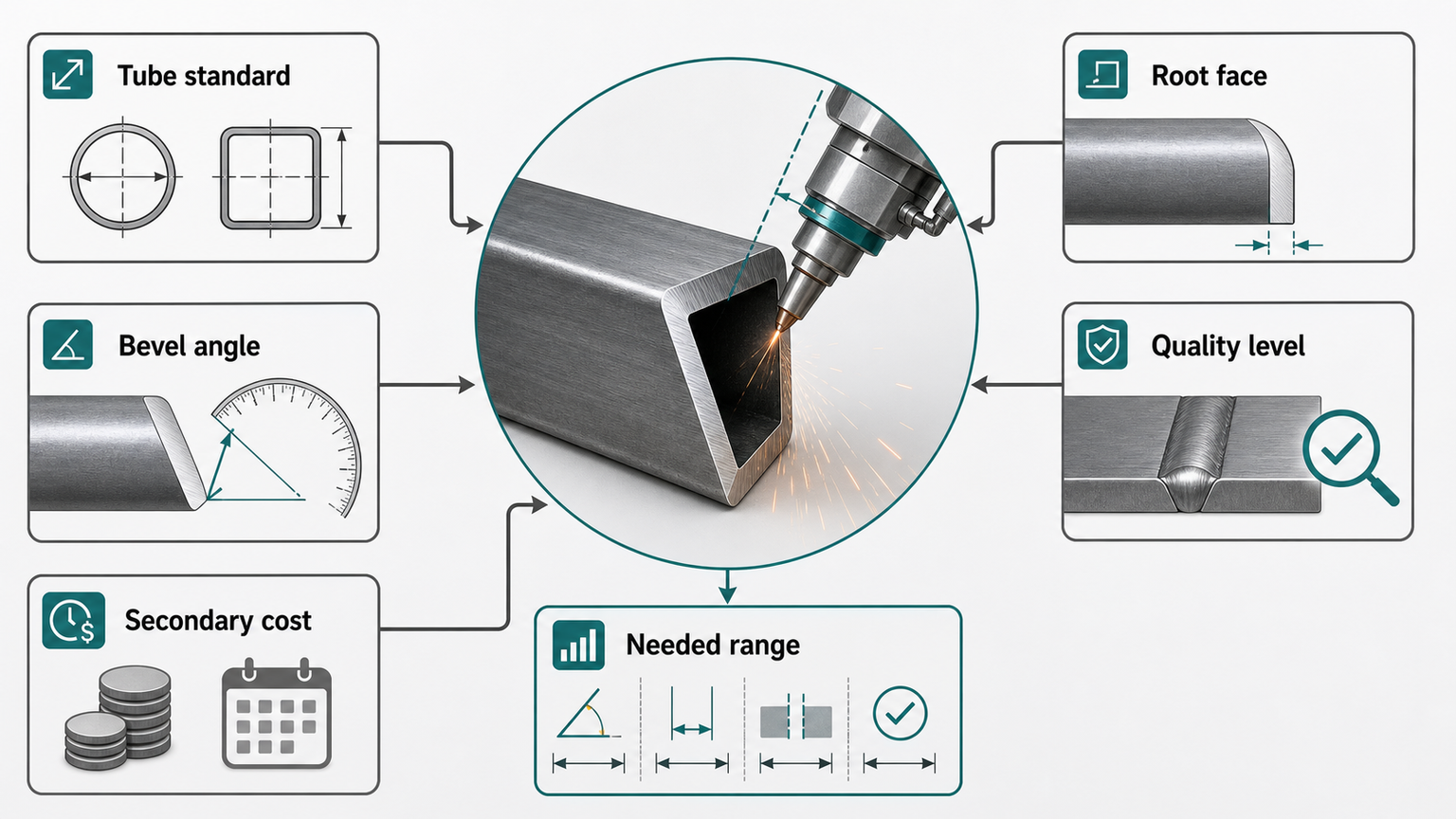
Our five-axis P-Pro bevel tube laser runs a bevel angle adjustable from 0° to 60° with an angle error of ≤±0.1°, covers tubes from Φ12 to Φ300 mm, and handles wall thickness from 1 to 20 mm in carbon steel, stainless, and aluminum alloy. Treat those as reference figures — chuck capacity, laser power, and the final configuration are confirmed from your tube data during the RFQ. Then test the machine against your own tube profiles with sample cuts.
| Spec / parameter | What to look for | Typical range |
|---|---|---|
| BNL P-Pro bevel capability | Our five-axis P-Pro cuts the bevel on the laser, so parts come off ready to weld. Reference figures — final configuration is confirmed from your tube data during the RFQ. | Bevel 0–60° adjustable; angle error ≤±0.1°; Φ12–Φ300 mm; wall 1–20 mm; carbon steel, stainless, aluminum alloy. |
| Stainless mechanical tubing basis | ASTM A554 covers welded stainless steel mechanical tubing for ornamental, structural, exhaust, and other applications. It includes round, square, rectangular, and special shapes. | Confirm the exact size and wall-thickness scope against the current ASTM A554 edition your project cites. |
| Austenitic stainless service tubing basis | ASTM A269/A269M covers seamless and welded austenitic stainless steel tubing for general service. | Use ASTM A269/A269M when the project calls for austenitic stainless service tubing. |
| Carbon structural tube basis | ASTM A500 is a common US specification for cold-formed welded and seamless carbon steel structural tubing in round, square, and rectangular shapes. | Use ASTM A500 / A500M when the project calls for US carbon structural tubing. |
| European hollow-section basis | EN 10210 and EN 10219 are common European hollow-section standards. EN 10219 covers cold-formed welded structural hollow sections of non-alloy and fine grain steels. | Use EN 10210 for hot-finished hollow sections and EN 10219 for cold-formed welded hollow sections. |
| Weld imperfection quality level | ISO 5817:2023 covers quality levels for imperfections in fusion-welded joints in steel, nickel, titanium, and their alloys, except beam welding. | Quality levels B, C, and D; B is the highest requirement. |
| Material thickness for ISO 5817 use | Check the thickness scope and the covered joint types in the current ISO 5817:2023 edition before you apply a quality level. | Use the scope stated in the edition your project cites. |
| Weld-prep geometry | The WPS or drawing controls groove shape, bevel edge, root face, and fit-up requirements. | Use the actual WPS/drawing values. Do not use a universal bevel angle. |
| Machine capability to verify | The supplier should prove bevel capability, programmable bevel types, software support, collision control, and accuracy on your profiles. | Verify by sample cutting your tube drawings before purchase. |
Here is what BNL Laser actually builds and supports. We design, build, and service laser tube cutters and automatic punching machines in-house, including the 5-axis P-Pro bevel machine for weld-prep geometry. We serve metal tube processing, furniture and sanitary ware, automotive and motorcycle parts, and educational and institutional facility equipment manufacturing. We are ISO-certified, we hold 30+ patents, and we support 4,000+ customer applications.
But ISO certification does not prove a bevel angle, a tolerance, or weld quality. It supports a quality-management claim. For cutting performance, ask for model-specific specs and sample cuts.
How do you match the option to your use case?
You match the option by separating simple profile cutting from true weld-prep cutting, then choosing the lowest-complexity machine that removes a real bottleneck.
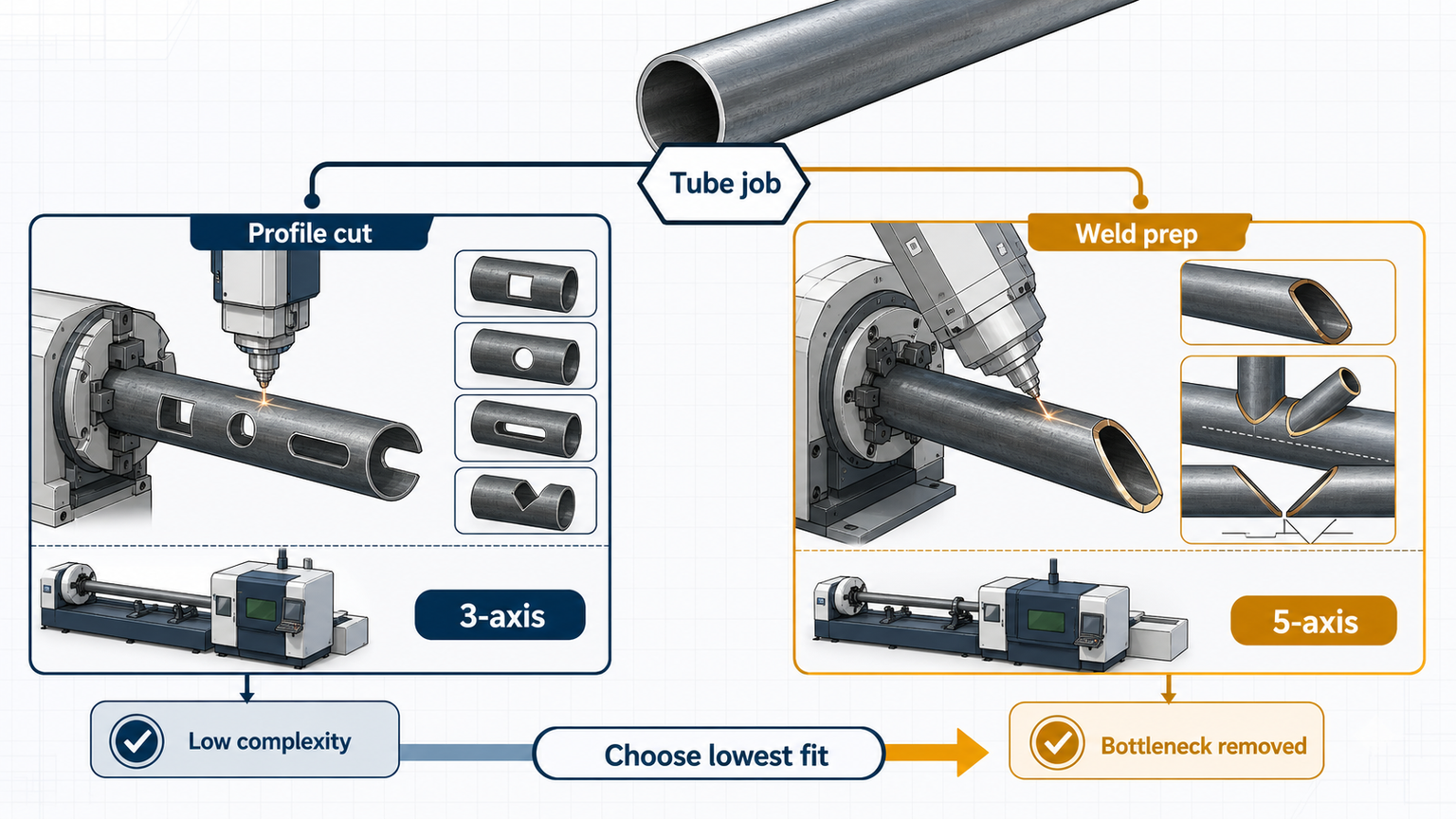
I like simple buying logic because it protects budgets. A plant manager wants throughput. A production engineer wants fit-up and repeatability. A procurement officer wants risk control and total cost clarity. The right machine has to answer all three.
| If your situation looks like this | Choose this direction | Why it fits |
|---|---|---|
| Most parts need square cuts, holes, slots, and non-beveled profiles | Evaluate a straight 2D tube laser | You do not need bevel-cutting complexity when the drawing does not require bevel or groove prep. |
| Many parts need bevel edges, groove edges, branch contours, or angled tube ends | Evaluate bevel-cutting capability | The machine may remove manual grinding, milling, sawing, or plasma bevel prep from the route. |
| Your weld symbols or WPS control groove preparation tightly | Evaluate bevel software and sample-cut proof | The WPS defines welding variables, and procedure qualification records support common code systems such as AWS, ASME, and ISO. |
| You produce furniture or sanitary ware tube parts | Compare profile cutting, appearance needs, and stainless tube standards such as ASTM A554 | ASTM A554 is common for stainless mechanical tubing where appearance, mechanical properties, or corrosion resistance matter. |
| You produce automotive or motorcycle tube parts | Check repeatability, part mix, and current secondary prep time | The decision depends on how many parts need compound weld-prep geometry and how much labor you spend after cutting. |
| You produce educational or institutional facility equipment | Check destination market standards and structural requirements | ASTM A500, EN 10210, EN 10219, AWS D1.1, or local standards may affect the project. |
| You have high labor cost but low bevel-prep volume | Start with process timing before machine selection | A bevel-capable machine only makes sense when it removes enough secondary work to justify the added capability. |
We build our machines to make complex laser technology simple to run. Our drawing-free Easy-Cut control cuts operator training from weeks down to about a single day. I have seen this matter most when a factory depends on a few skilled operators. If only one person can run the process, the machine is not the only bottleneck.
Still, training speed does not replace due diligence. If you need bevel cutting, ask us or any supplier to show the exact bevel functions, software workflow, collision control, and sample cut results on your tube profile.
What should you check before you commit and on the supplier?
You should check the supplier’s local support, documented machine capability, standards fit, training plan, spare parts path, and sample-cut proof before you commit.
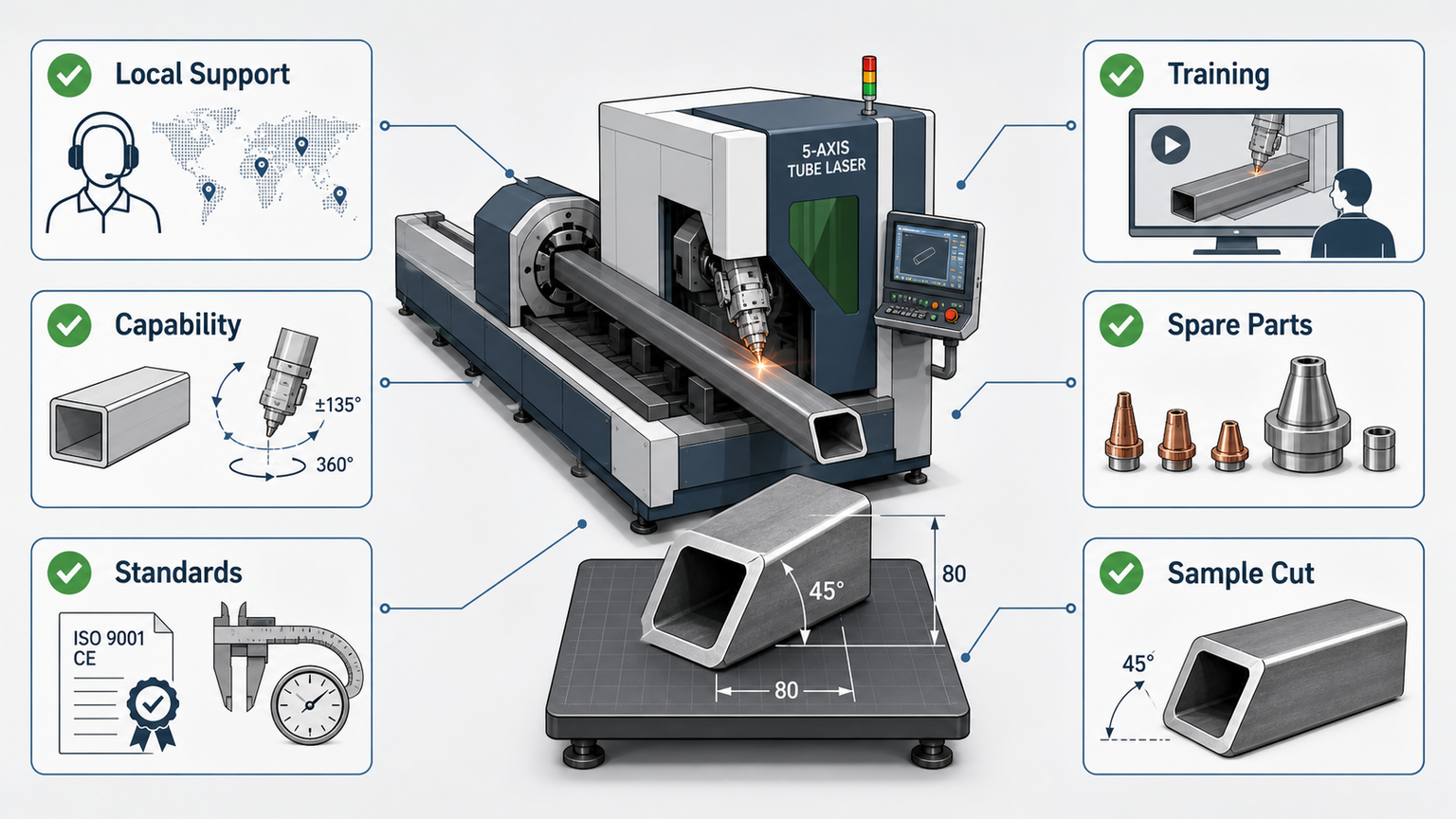
A buying mistake often starts with a vague RFQ. I would rather receive a demanding RFQ than a short one. A clear RFQ saves both sides from guessing.
Part drawings and WPS: Send drawings, weld symbols, tube sizes, material standards, and the WPS where available. Ask the supplier to identify which cuts are square profile cuts and which cuts need bevel or groove preparation.
Sample cutting: Request sample cuts on your own tube profiles. Include the hardest branch contour, angled end, or groove-prep part. Ask for measured results instead of only photos.
Machine capability: Ask for model-specific bevel angle capability, tube diameter range, wall-thickness range, chuck capacity, laser power, positioning accuracy, repeatability, software functions, and collision-control method.
Standards and market: For US structural steel work, check AWS D1.1 / D1.1M. For US structural stainless work, check AWS D1.6 / D1.6M. For Europe, check EN 10210 or EN 10219 where hollow sections apply. For international weld quality levels, check ISO 5817:2023.
Tube material basis: Confirm ASTM A500 / A500M for US carbon structural tubing, ASTM A554 for stainless mechanical tubing, ASTM A269/A269M for austenitic stainless service tubing, EN 10210 for hot-finished hollow sections, or EN 10219 for cold-formed welded hollow sections.
Japan and China projects: Confirm applicable JIS or GB/T welding and tube standards in the project documents. Pull the exact GB/T or JIS codes from the project documents — they control the requirement, not a supplier's assumption.
Training: Ask how long operators need before they can run normal production parts. We design for simple operation — with drawing-free programming, most teams move from weeks of training down to a single day.
After-sales and spare parts: Ask who services the machine in your region, which spare parts sit locally, and how the supplier handles remote diagnosis.
Warranty and lead time: Ask for written warranty terms, delivery lead time, installation scope, and acceptance criteria. Procurement needs those points before it can compare total cost.
Customization: Ask what the supplier can customize in feeding, unloading, software workflow, or fixture approach. Do not assume every bevel tube laser handles every profile the same way.
We design, build, and service our machines in-house, so we can discuss application fit from the machine structure through service. But I still want the RFQ to carry the real production data. The best technical answer comes from your drawings, not from a generic spec sheet.
What mistakes do buyers most often make?
Buyers most often overbuy for “5-axis,” undercheck the WPS, and forget to measure the manual work they want to remove.
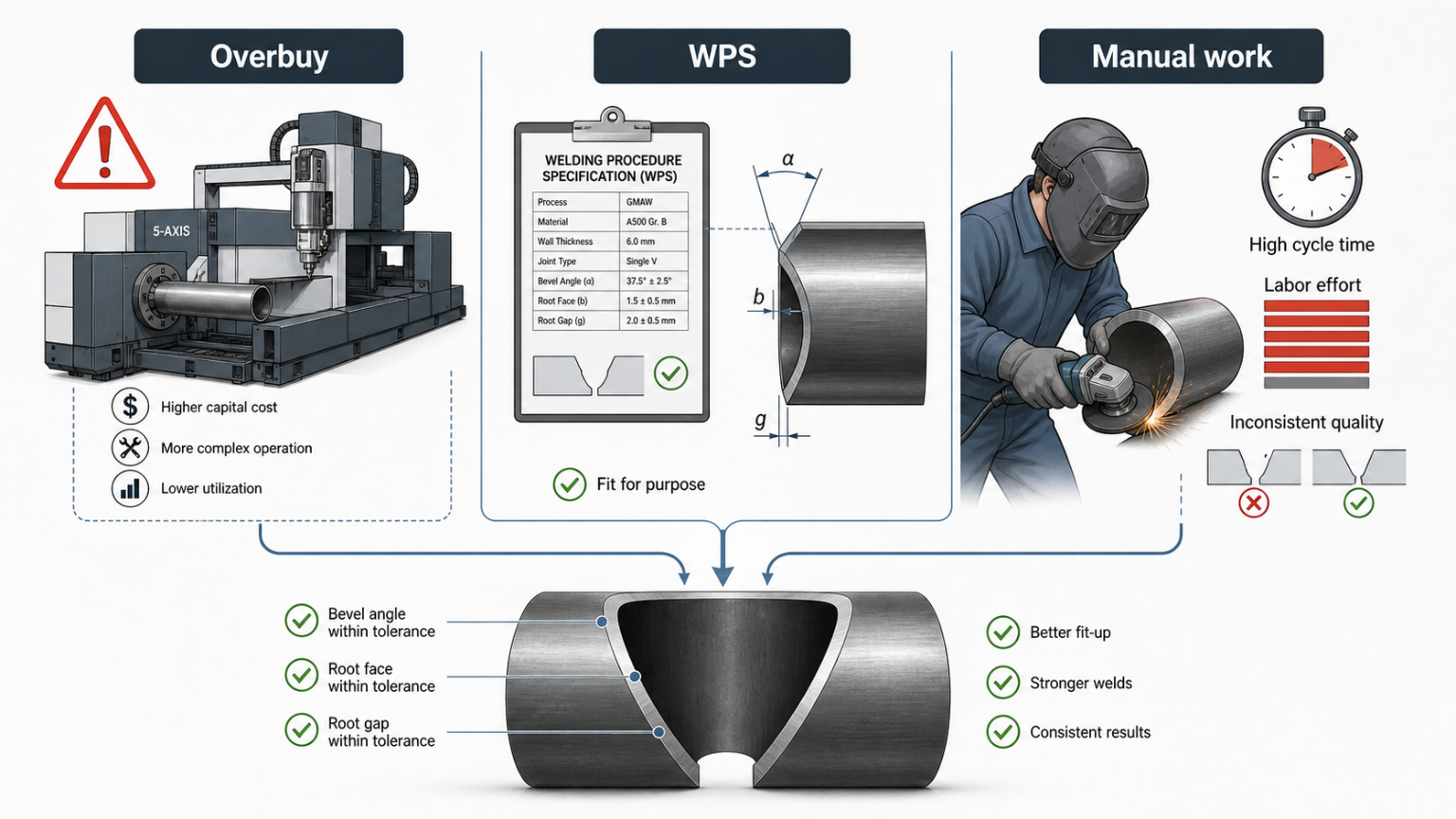
They buy the axis count instead of the weld-prep result.
A 5-axis label does not automatically confirm bevel capability, programmable bevel types, software support, collision control, or accuracy on your tube profiles. Ask for proof on your drawings.They ignore the WPS and welding symbols.
The WPS controls welding variables, and common code systems use procedure qualification records. The cutting machine must support the geometry that the WPS and drawing require.They assume every beveled tube part needs the same bevel angle.
Bevel angles, root gaps, land dimensions, and groove geometry vary by material, wall thickness, weld process, qualification code, WPS, and joint type. Do not use a universal value.They skip the secondary-operation time study.
The strongest business case comes from the time now spent on grinding, milling, sawing, or plasma bevel prep. Measure that work before you calculate ROI.They treat certification as cutting proof.
We are ISO-certified, but ISO certification itself does not state bevel angle, cutting accuracy, weld quality, or payback. Ask for machine-specific data and sample cuts.
Conclusion
You need a bevel-cutting tube laser when your drawings or WPS require enough bevel, groove, branch-contour, or angled-end weld prep to justify removing manual secondary operations. If your parts mainly need square cuts, holes, slots, and simple non-beveled profiles, a straight 2D tube laser may be the better business choice. I would make the decision from part mix, WPS requirements, secondary-operation time, tube standards, and supplier sample-cut proof.
If you want a practical evaluation, send your tube data for a real configuration with your tube drawings, material standard, WPS notes, and current prep route, and we can help you check whether bevel-cutting capability belongs in the RFQ.
— Eric Liu, General Manager, BNL Laser