

Tube lasers make motorcycle frame and chassis tubes by cutting repeatable tube ends, mitres, coped joints, slots, holes, tabs, and weld-prep bevels before bending, fixturing, and welding. They reduce manual sawing, drilling, grinding, layout work, and rework because the tube comes off the machine closer to the shape your welder and fixture need. I do not treat a tube laser as a frame design tool. I treat it as a preparation tool that gives your design, WPS, fixture, and inspection plan a more repeatable part.
How does tube laser cutting fit into motorcycle frame production?
Tube laser cutting fits between tube stock preparation and welding: it turns raw tube into repeatable frame or chassis parts with the right end profiles, holes, slots, and bevels.
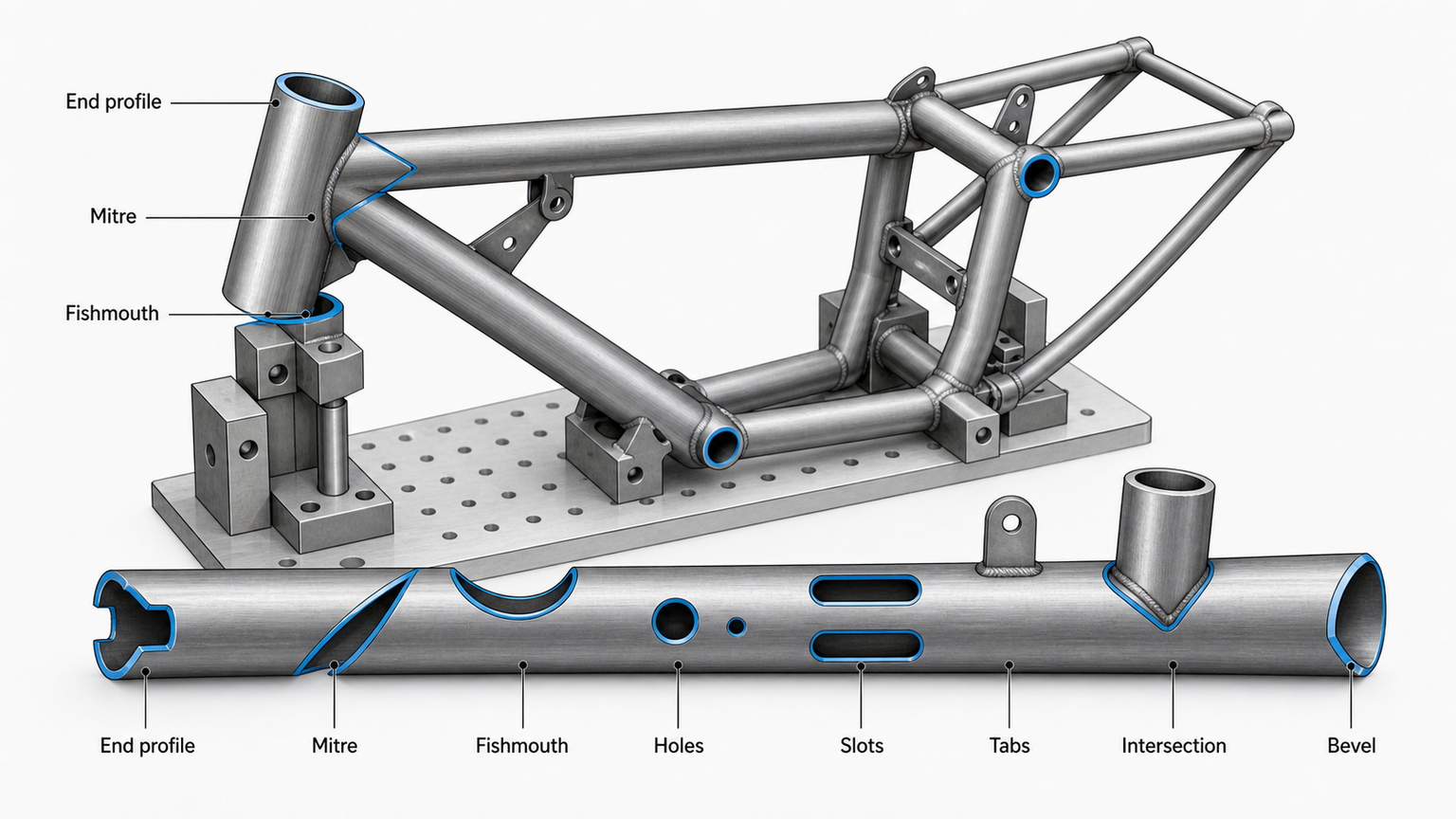
On a motorcycle frame line, your team may need straight cuts, angled cuts, fishmouth joints, cross-tube intersections, plug-weld holes, bracket slots, drain holes, access holes, locating tabs, and bevels. A tube laser can put many of those features into one programmed operation.
The practical flow looks like this:
- You define the tube and part requirement. Your drawing, material standard, OD, wall thickness, part length, hole locations, slot sizes, bevel requirement, and inspection plan matter more than a machine brochure.
- We check the tube against the machine range. For example, our Q16/Q16Y reference range covers round tube from φ8-φ165 mm and square tube to 165 x 165 mm, with repeatability of ±0.05 mm.
- The operator programs the part at the machine. Our Easy-Cut control lets the operator create tube parts on-screen without a CAD step or a separate programmer.
- The machine cuts the features in sequence. It can cut the end profile, holes, slots, and other geometry before the tube leaves the chuck.
- Your team checks fit-up in the fixture. The real decision point is not whether the cut looks clean on a table. It is whether the tube joint fits the welding fixture and meets your inspection plan.
- You approve the sample before production. In our sales workflow, we cut a free real sample on your own material and give a cycle-time estimate before you decide.
I started BNL Laser because I did not want to sell a machine I could not fix myself. On the factory floor, I have seen a small wrong assumption cause bigger trouble than a small machine error. A tube that looks simple can still carry a bracket slot, a drain hole, and a coped joint that must all line up after bending.
What motorcycle frame and chassis features can a tube laser cut?
A tube laser can cut the tube geometry that prepares motorcycle frame parts for accurate fixture fit and welding: end profiles, mitres, fishmouths, holes, slots, tabs, intersections, and bevels.
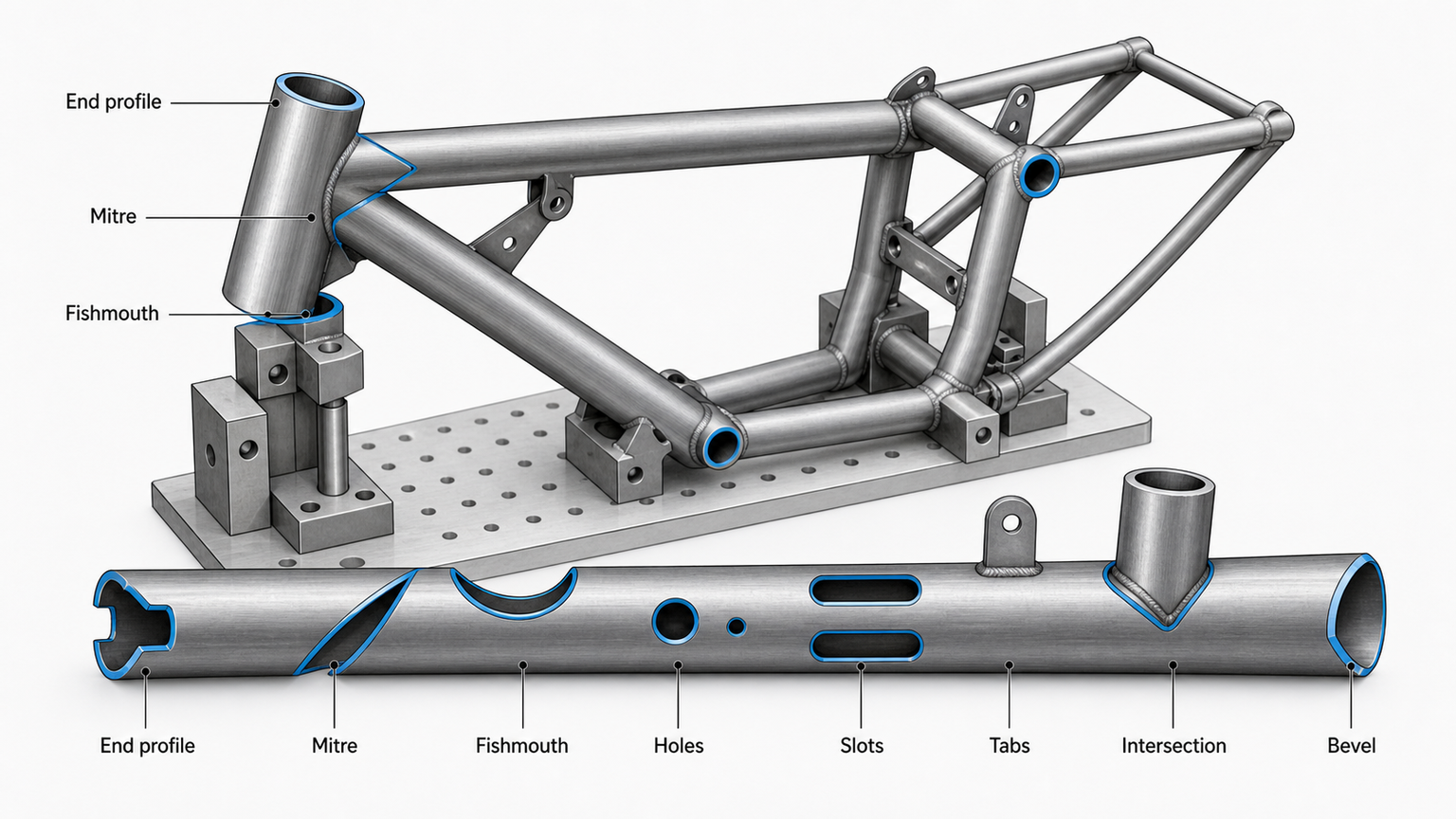
The biggest value comes when one tube has several features. Manual work becomes slow when your operator must saw the tube, mark a hole, drill it, deburr it, and grind the end until it fits another tube. A tube laser does those features from one program, so your operator spends less time correcting the same part by hand.
Common tube-lasered motorcycle features include:
| Feature | Where buyers use it | Why it matters |
|---|---|---|
| Mitred end cut | Angled frame tube joints | Helps the tube meet another tube at the fixture angle |
| Fishmouth or coped joint | Cross-tube intersections | Improves tube-to-tube contact before welding |
| Bracket slot | Mounting tabs and welded brackets | Helps fixture location and repeat assembly |
| Plug-weld hole | Reinforcement and sleeve areas | Gives the weld team a prepared weld access point |
| Drain or access hole | Frame tubes and subframe tubes | Supports drainage, coating, or tool access when the design requires it |
| Locating tab | Repeat assembly features | Reduces layout work at the welding station |
| Weld-prep bevel | Structural or thicker tube weldments | Prepares the edge for the welding procedure |
For bevel work, our P-Pro 5-axis bevel tube laser cuts adjustable bevel angles from 0-60°, with angle error ≤±0.1°. Its reference range covers φ12-φ300 mm tube, 1-20 mm wall, in carbon steel, stainless steel, and aluminum. That does not replace your welding qualification, but it gives your weld team a prepared edge instead of a hand-ground edge.
Which tube laser machine type should a motorcycle parts factory consider?
A motorcycle parts factory should choose the tube laser by tube size, wall thickness, part length, floor space, loading method, bevel need, and production volume.
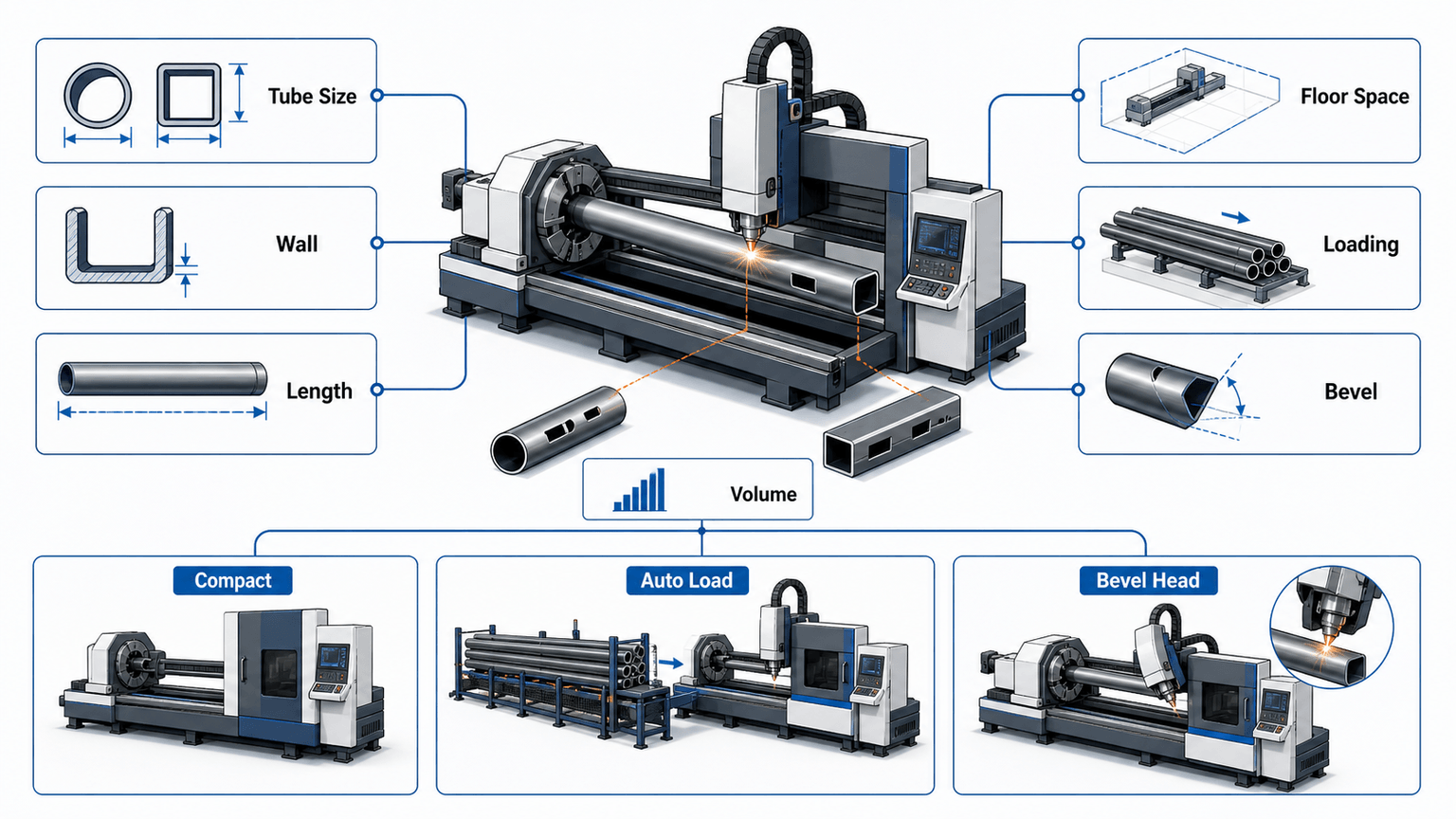
I usually start with your tube list, not with the machine model. If your work is small thin-wall exhaust tube, you should not buy the same configuration as a shop cutting heavier structural tube. If your floor is tight, footprint matters. If your volume is high, automatic loading and unloading matter.
Here is how I would narrow the choice from our BNL Laser range:
| Machine series | Reference capability | Where it fits motorcycle work |
|---|---|---|
| Q Series | 1500-6000 W; Q12/Q12Y round φ12-φ120 mm, square to 120 x 120 mm; Q16/Q16Y round φ8-φ165 mm, square to 165 x 165 mm; repeatability ±0.05 mm | General motorcycle and metal tube work with a broad tube mix |
| Q Series Y models | Short-tail design reduces tube remnant to ≥45 mm, compared with ≥80-220 mm standard | Shops that cut many short parts and care about tail scrap |
| M Series | Φ8-Φ85 mm tube; 0.2-3 mm wall; part length 1-6000 mm; cutting accuracy ≤±0.1 mm on parts ≤500 mm and ≤±0.2 mm on 500-1200 mm parts | Small-diameter precision tube, moto parts, thin-wall exhaust tube |
| X12Y | Dual-front-chuck short-body machine; 1500-3000 W; Φ10-100 mm; footprint 3.1 x 1.48 x 1.4 m; remnant about 100 mm | Tight floors and compact tube cutting cells |
| X12Y-2 | 12-metre long-stock model | Longer structural stock |
| X12Y-3 | Mobile/on-site unit | Cutting near material or worksite constraints |
| P-Pro | 5-axis bevel tube laser; φ12-φ300 mm; 1-20 mm wall; 0-60° bevel | Weld-prep bevels for exhaust and structural weldments |
| L-PurePro | 1500-12000 W liquid-cooling tube cutting line with automatic loading and unloading | High-volume, low-labor production |
| B-NexBeam | 1500-12000 W side-mounted tube laser for square, round, rectangular, oval, I-beam, channel, and angle steel | Structural profiles and constrained layouts |
We build single- and dual-front-chuck machines. If a supplier claims every motorcycle factory needs a more complex chuck layout before they have seen your tube data, I would slow down and ask for a sample cut first.
What materials and standards matter for motorcycle tube laser parts?
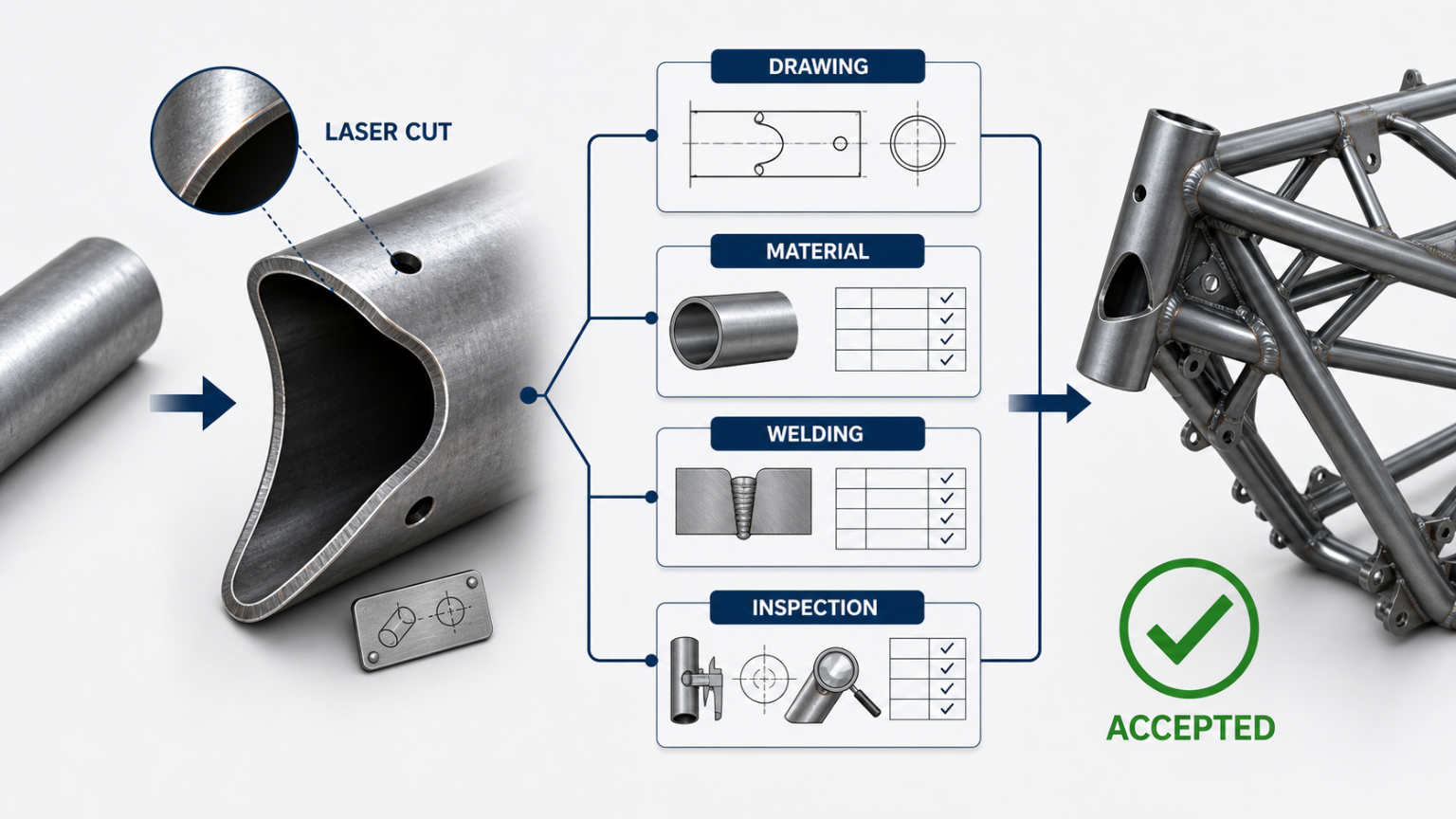
The material standard matters because the tube laser prepares geometry, but the drawing, material spec, welding procedure, and inspection plan control whether the finished frame or chassis part is acceptable.
There is no one universal motorcycle frame tube material. OEMs and parts makers may specify mild steel, HSLA steel, chromoly or other alloy steel, stainless steel for some parts, or aluminum alloys depending on the model, market, and homologation path.
Your RFQ should name the tube standard where possible. These are examples a buyer may specify:
| Buyer market | Tube or material standard | What it covers |
|---|---|---|
| US | ASTM A513/A513M-2025 | ERW carbon/alloy mechanical tubing, including round, square, rectangular, and special shapes |
| US | ASTM A519/A519M | Seamless carbon/alloy mechanical tubing, hot- or cold-finished |
| US | ASTM B221 | Aluminum/alloy extruded bars, rods, wire, profiles, and tubes |
| Europe | EN 10305 series | Precision steel tubes, including seamless, welded cold drawn, welded cold sized, and square/rectangular variants |
| Europe | EN 10219 | Cold-formed welded structural hollow sections and tolerances |
| Europe | EN 755 series | Aluminum/alloy extruded rod/bar, tube, and profiles |
| China | GB/T 8162-2018 | Seamless steel tubes for structural purposes |
| China | GB/T 6892-2023 | Wrought aluminum/alloy extruded profiles for general engineering |
| Japan | JIS G 3445:2025 | Carbon steel tubes for machine structure |
| Japan | JIS H 4080:2023 | Aluminum/alloy extruded and cold-drawn tubes |
| Global drawings | ISO 9013:2017 / EN ISO 9013:2017+A1:2024 | Thermal cut classification and geometrical quality tolerances, including laser cuts |
Assist gas also matters. We commonly use nitrogen when a clean, oxide-free edge is needed on stainless steel or aluminum before welding. Oxygen can help carbon steel cutting, but it can leave oxide that some weld procedures require you to clean.
If your drawing references ISO 9013, use it correctly. ISO 9013:2017 covers classification and geometrical product specifications for thermal cuts, including laser cuts, in material thickness from 0.5 mm to 32 mm when the drawing or delivery document references the standard. It classifies cut quality. It does not qualify the welded motorcycle frame.
What problems does tube laser cutting solve on the shop floor?
Tube laser cutting mainly solves labor-heavy preparation, inconsistent manual fit-up, repeated layout work, tail scrap, and slow changeover between tube parts.
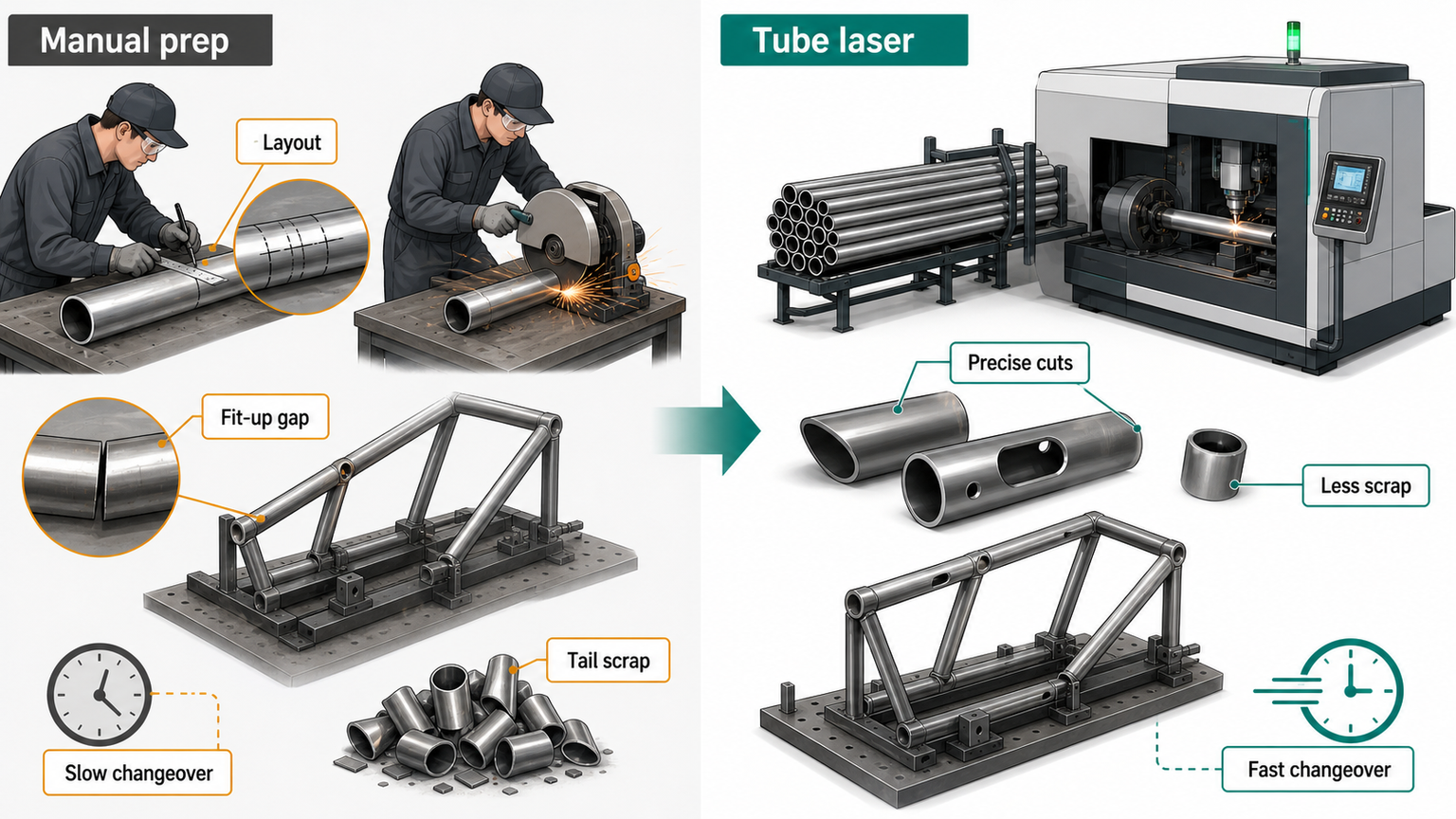
On many floors, the hidden cost is not the saw. It is the chain of work after the saw: mark, drill, notch, grind, test in the fixture, correct, and deburr. That work depends on skilled hands, and skilled hands are expensive.
A tube laser helps most when your parts have:
- Several features on one tube. End cut, slot, hole, and tab geometry can come from one program.
- Repeated fixture-fit problems. Repeatable end profiles and hole locations reduce correction work before welding.
- Short parts with costly remnants. Our Q Series Y short-tail models reduce tube remnant to ≥45 mm, compared with ≥80-220 mm standard.
- Small-tube precision needs. Our M Series cuts φ8-φ85 mm tube with 0.2-3 mm wall, and it fits small-diameter moto and thin-wall exhaust tube work.
- Limited operator programming skill. Easy-Cut lets your operator program at the machine without a CAD step, and we reduce training from weeks to about one day.
But I tell buyers when not to buy, too. If your motorcycle tube work is low volume, simple straight cuts, and your manual process already meets your fixture and inspection needs, a tube laser may wait. Send us the part first. We can cut a real sample, estimate cycle time, and let your own production data decide.
How do you know tube-lasered motorcycle parts are done right?
You know tube-lasered motorcycle parts are done right when the cut geometry repeatedly fits the welding fixture, meets the drawing, supports the WPS, and passes the inspection plan.
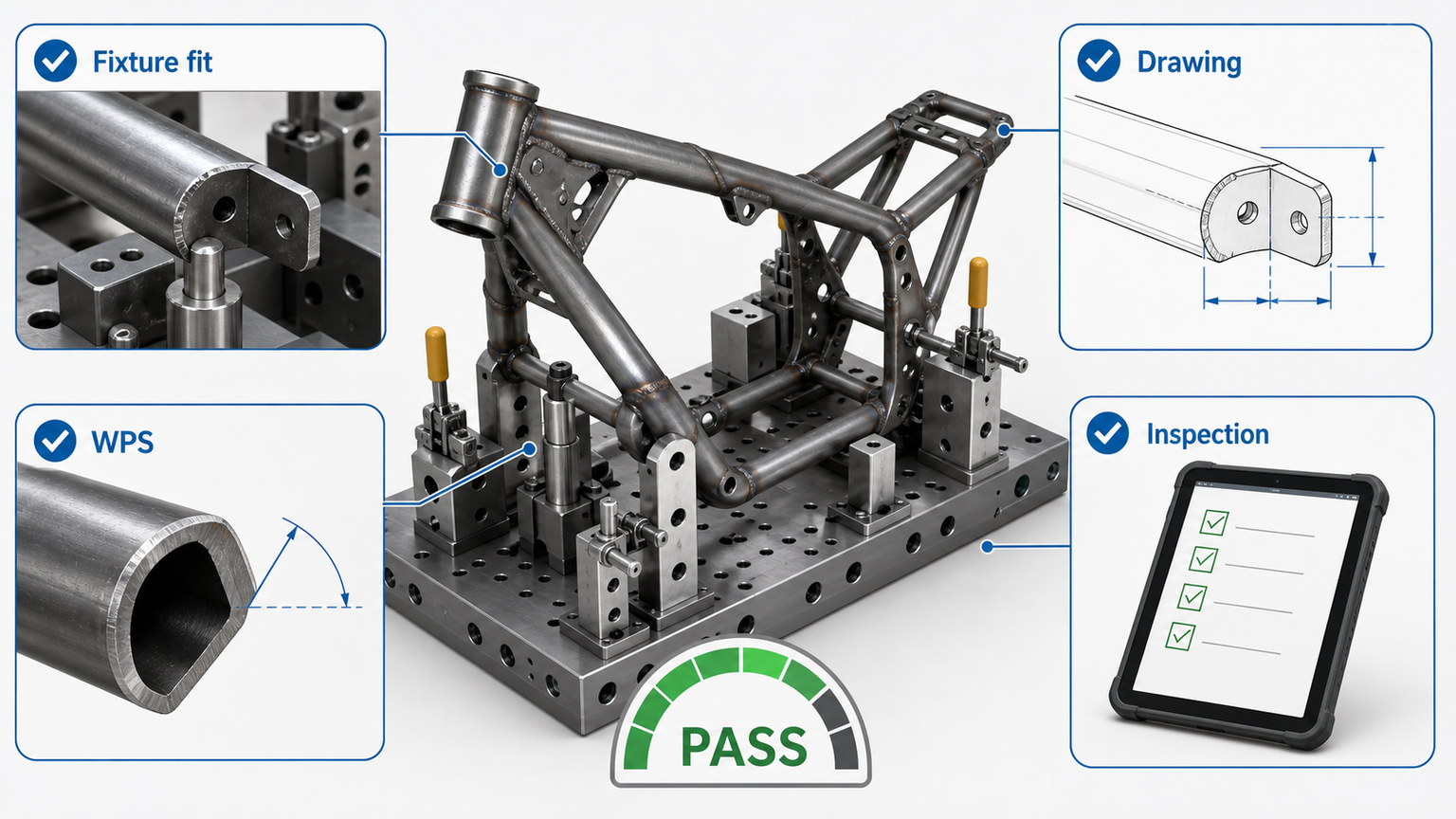
The key decision metric is weld fit-up at the tube joint. You should check end-profile accuracy, hole and slot location, bevel angle, and repeatability. There is no universal motorcycle frame fit-up number that I can honestly give every buyer. Your drawing, WPS, inspection plan, and sample approval should define it.
Use this approval checklist before you buy a machine or release production:
- Check the real tube. Do not approve only from catalog tube. Use your actual material, coating condition if relevant, OD, wall thickness, and length.
- Measure the joint fit. Put the cut tube in your welding fixture and check contact, gap, and alignment against your own drawing.
- Check hole and slot location. Confirm bracket slots, plug-weld holes, drain holes, and access holes against the fixture and inspection method.
- Check bevels when welding needs them. For P-Pro work, confirm the bevel angle and weld-prep shape against your WPS.
- Check edge condition before welding. Confirm whether the assist gas and edge condition match your weld procedure and cleaning requirement.
- Keep compliance separate. Tube laser cutting does not replace qualified welding, material traceability, fatigue validation, or vehicle-level compliance.
In the United States, NHTSA defines a motorcycle at 49 CFR 571.3 and states that on-road motorcycles must comply with applicable FMVSS and carry the required certification label. That is vehicle compliance. A tube laser helps make repeatable tube geometry, but the frame or chassis design owner remains responsible for strength, durability, welding, inspection, and homologation.
Laser safety also belongs in the buying discussion. OSHA identifies ANSI Z136.1 as a source for laser safe-use requirements and recommendations. When you plan a tube laser cell, your team should treat guarding, fume extraction, operator training, and written safety rules as part of the machine decision, not as an afterthought.
Conclusion
Tube lasers make motorcycle frame and chassis production more repeatable by cutting tube ends, holes, slots, copes, tabs, and bevels before welding. The machine does not make a frame stronger by itself; it gives your welding fixture and inspection plan more consistent parts to work with.
Send us your tube drawing, material standard, OD, wall thickness, and target part length, and my engineer will reply within one business day with the right configuration path and a real sample-cut plan.
— Eric Liu, General Manager, BNL Laser