

Verify ISO 9001 and CE marks by checking the real documents, the live databases, and the exact machine scope before you pay a deposit. I do not treat a logo on a brochure as proof. In our factory work at MZBNL, I ask buyers to verify the legal supplier name, factory address, certificate scope, declaration details, and conformity route because those details decide whether a machine claim is useful or only decorative.
What does ISO 9001 certification actually prove?
ISO 9001 certification proves that an external certification body audited the supplier’s quality management system, not that one machine model passed CE, laser safety, electrical safety, or performance testing. ISO says ISO itself does not issue certificates, and ISO 9001 is the only standard in the ISO 9000 family that organizations can certify to.
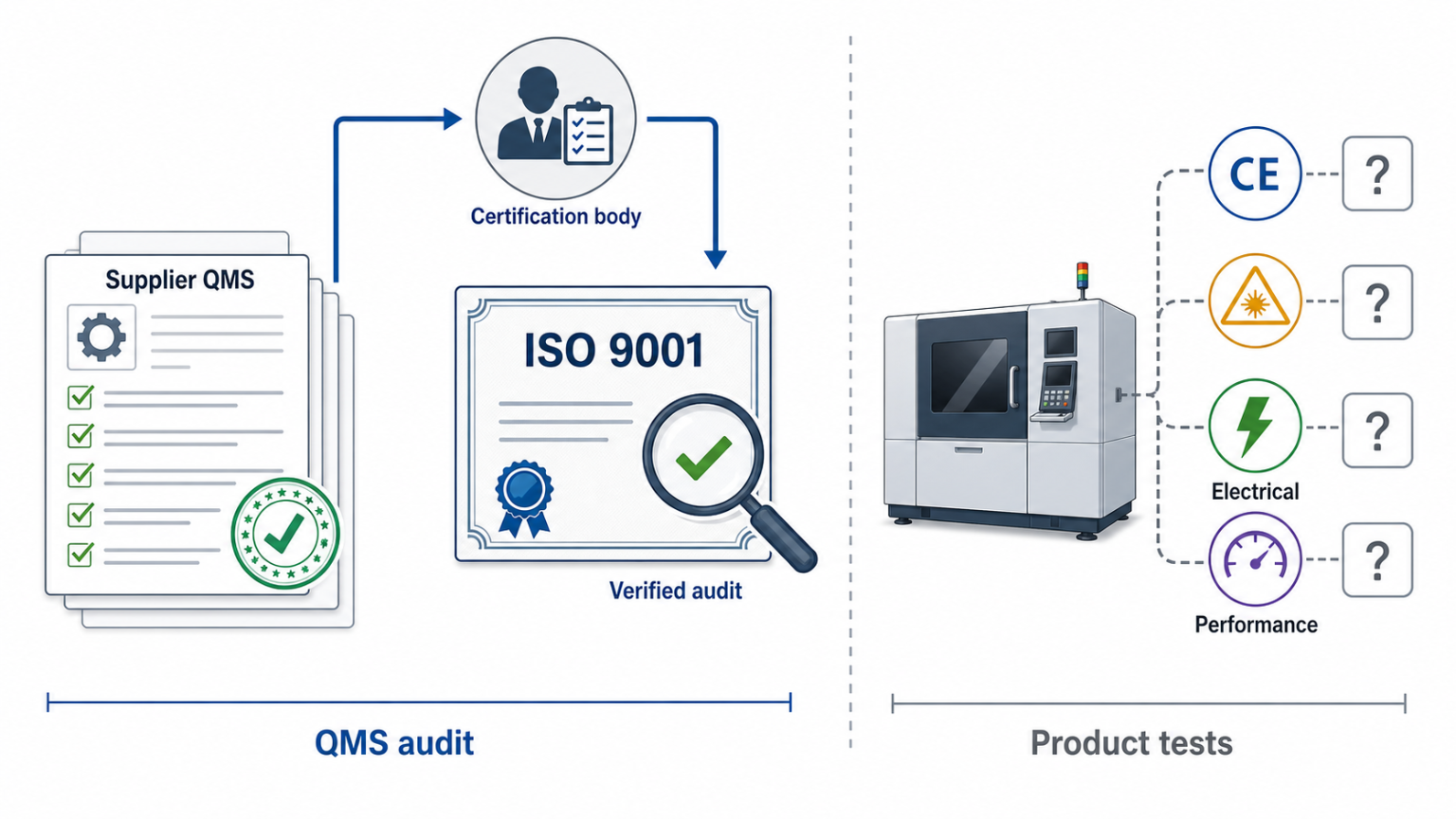
I see buyers mix these points often. An ISO-certified supplier may have a structured quality process, but you still need machine-specific evidence for the equipment you plan to buy.
For a machine supplier, I would check:
| What to check | What it should show |
|---|---|
| Supplier legal name | Same legal entity as the seller or manufacturer |
| Factory address | Same site that builds the machine |
| Certificate scope | Manufacturing or relevant machinery activity |
| Certification body | Real body, preferably accredited |
| Expiry/status | Active at the time of purchase |
How do I verify an ISO certificate is real?
Verify an ISO certificate by checking the certificate number, certification body, accreditation body, scope, site address, and live status through IAF CertSearch or direct confirmation with the issuing body. ISO recommends using IAF CertSearch or contacting the certification body, accreditation body, or IAF directly.
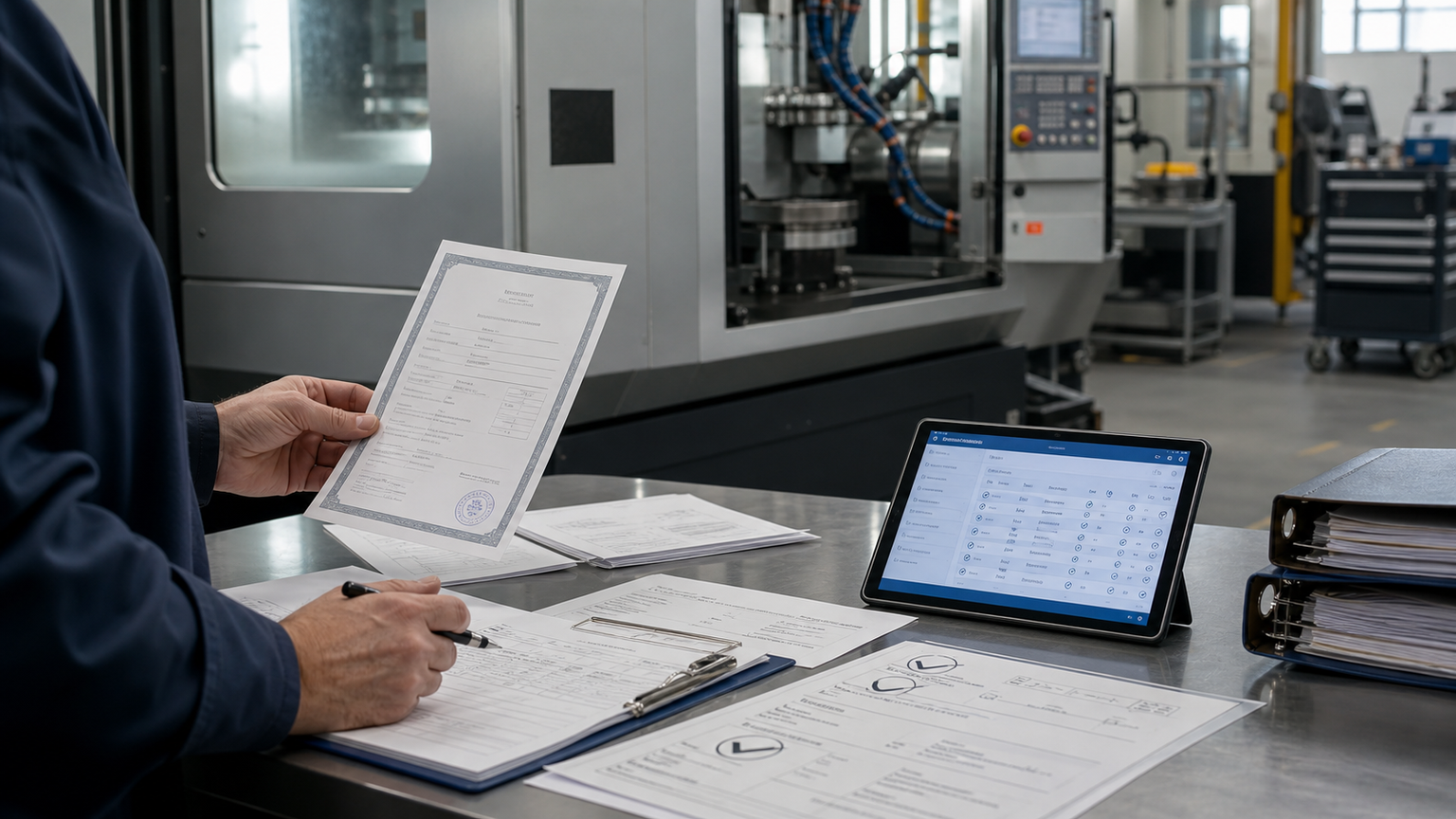
I would not stop at a PDF. I would match the name and address on the certificate to the proforma invoice, business license, and factory you are auditing.
Use this simple sequence:
- Ask for the ISO certificate PDF.
- Check the supplier legal name and factory address.
- Check the certificate number and expiry date.
- Confirm the certification body exists.
- Confirm whether that certification body is accredited.
- Verify live status through IAF CertSearch or direct confirmation.
MZBNL is ISO-certified, and I still believe buyers should verify certificates this way. Good suppliers should be comfortable with this process.
Does “certified by ISO” mean anything?
No, “certified by ISO” is the wrong phrase because ISO says it does not perform certification or issue ISO certificates. A supplier can be certified to an ISO standard by an external certification body, but ISO itself is not the certifier.
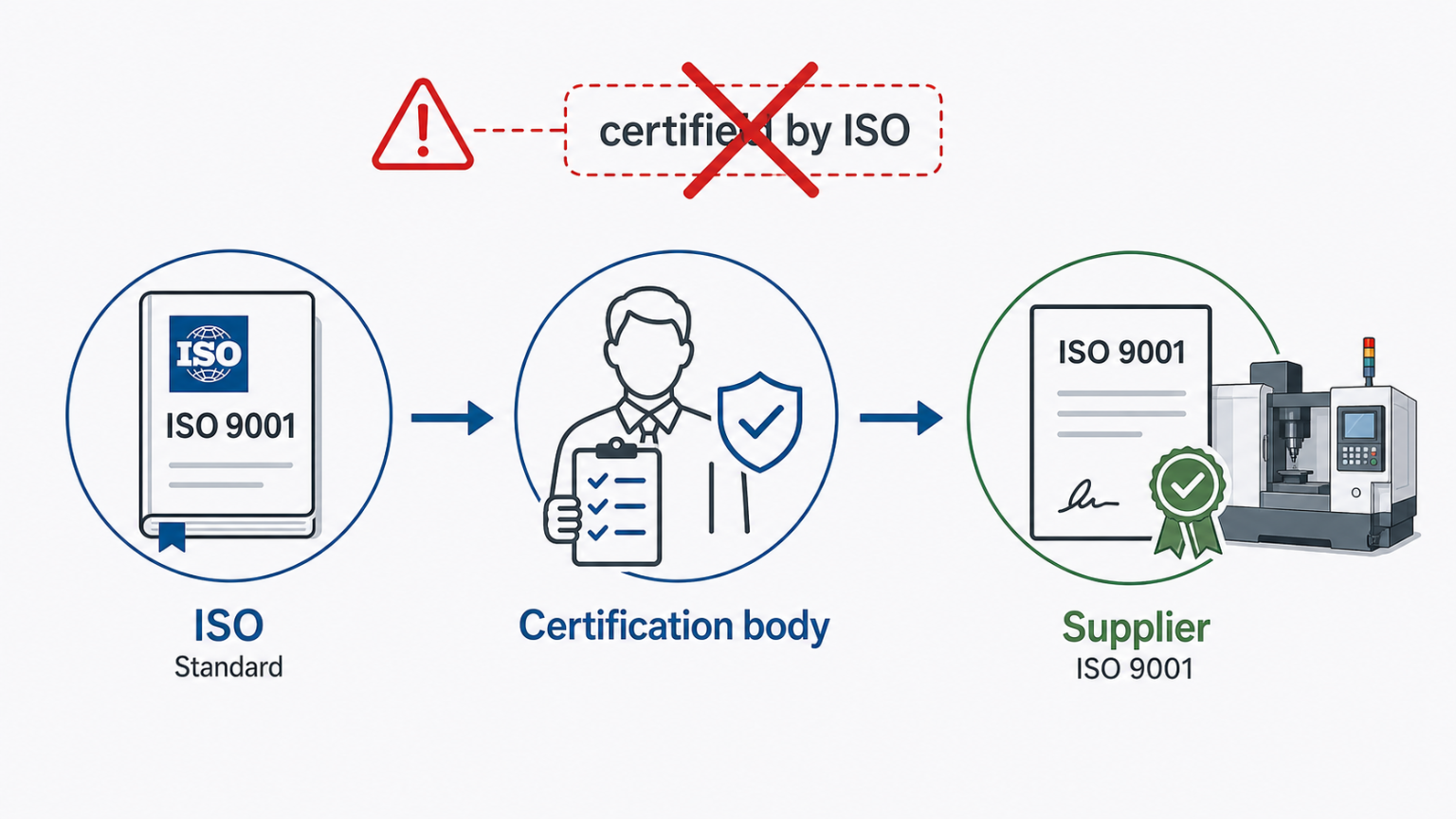
This wording matters because procurement teams use it to separate careful suppliers from careless claims. If a sales page says “certified by ISO,” I would ask for the actual certificate and check who issued it.
A better wording is:
- “Certified to ISO 9001 by [certification body]”
- “ISO-certified,” if the exact standard and document are supplied during RFQ
- “Quality management system certified to ISO 9001:2015,” only if the certificate proves that exact standard
At BNL Laser (Foshan Mingzhou Intelligent Equipment Co., Ltd.), our manufacturing is ISO-certified — and I'd rather you didn't take that sentence on faith either. Ask us for the certificate during your RFQ, then check the standard, the scope and the company name on it the same way this article teaches you to check everyone else's.
What does a CE mark on machinery actually mean?
A CE mark means the manufacturer declares that the product meets the legal requirements for CE marking and can be sold in the European Economic Area. The European Commission says CE marking also applies to products made outside the EU and sold in the EEA.
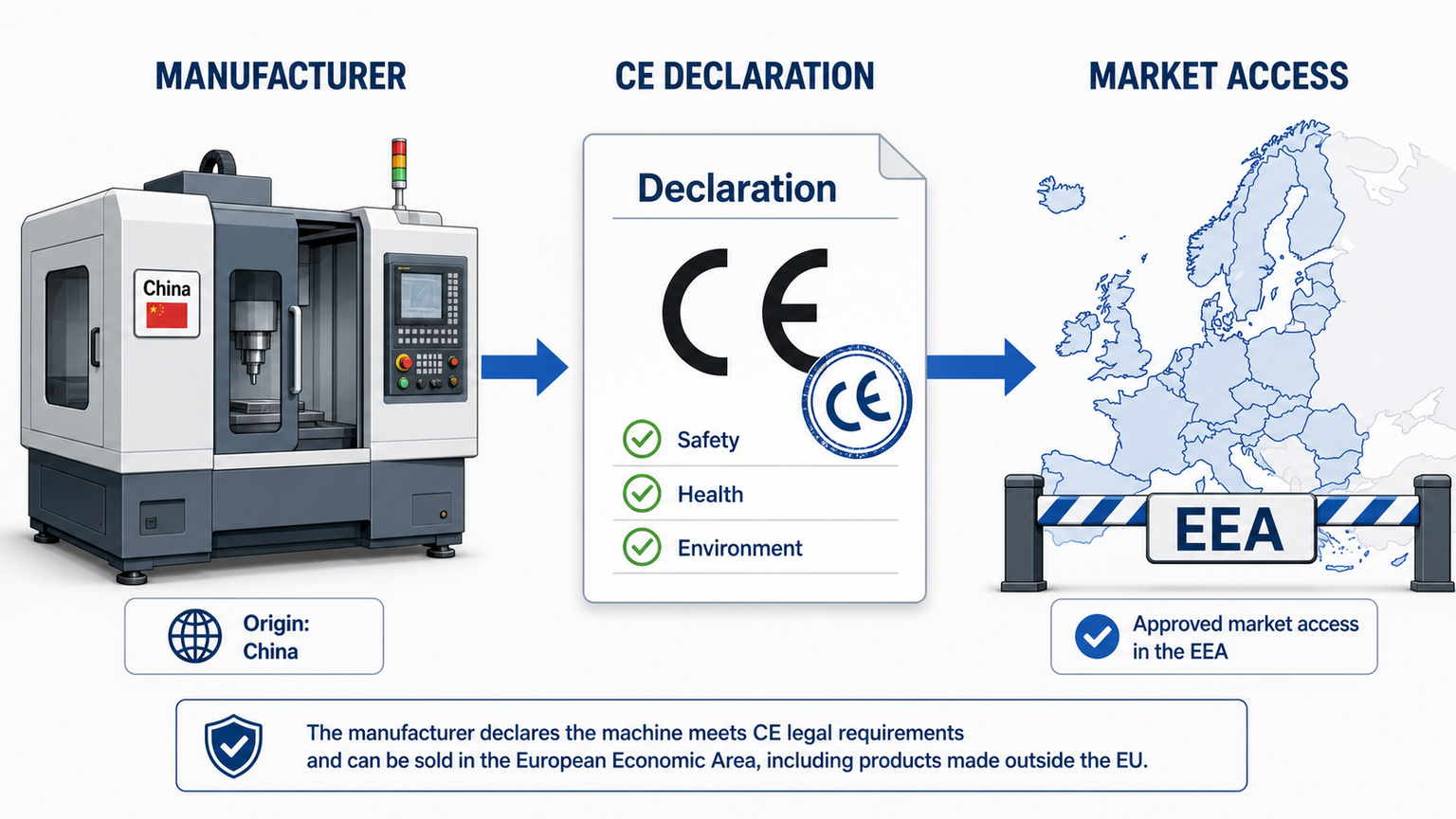
CE is not a quality award. The European Commission also says CE marking is not proof that the EU or another authority approved the product as safe, and it does not show product origin.
For machinery, the serious document is the EC or EU Declaration of Conformity. Under Machinery Directive 2006/42/EC, the manufacturer must ensure essential health and safety requirements are met, prepare the technical file, provide instructions, carry out conformity assessment, draw up the declaration, and affix CE marking.
What CE documents should I request before buying a machine?
Request the Declaration of Conformity, technical file evidence, risk assessment evidence, instructions, and any test reports that support the CE claim for the exact machine configuration. For machinery under Directive 2006/42/EC, the declaration and technical file are central compliance records.

I would ask for documents tied to the machine model, serial number, configuration, and destination market. A generic certificate image does not answer enough questions.
| Document or record | What I would check |
|---|---|
| EC/EU Declaration of Conformity | Manufacturer name/address, machine identification, applicable directives, standards, signatory, date |
| Technical file evidence | Drawings, control design, electrical design, risk assessment, conformity evidence |
| Instructions | Safe installation, operation, maintenance, and warnings |
| Test reports | Electrical, EMC, laser, guarding, or other tests where applicable |
| Notified body evidence | Body number, task scope, and NANDO status if a notified body is claimed |
Directive 2006/42/EC also requires the original EC Declaration of Conformity to be kept for at least 10 years from the last date of manufacture. The technical file must also be available to competent authorities for at least 10 years after manufacture, or after the last unit for series manufacture.
Does every CE-marked machine need a notified body?
No, every CE-marked machine does not automatically need a notified body under Machinery Directive 2006/42/EC. For many machinery categories not listed in Annex IV, the conformity assessment route can be internal checks on manufacture.
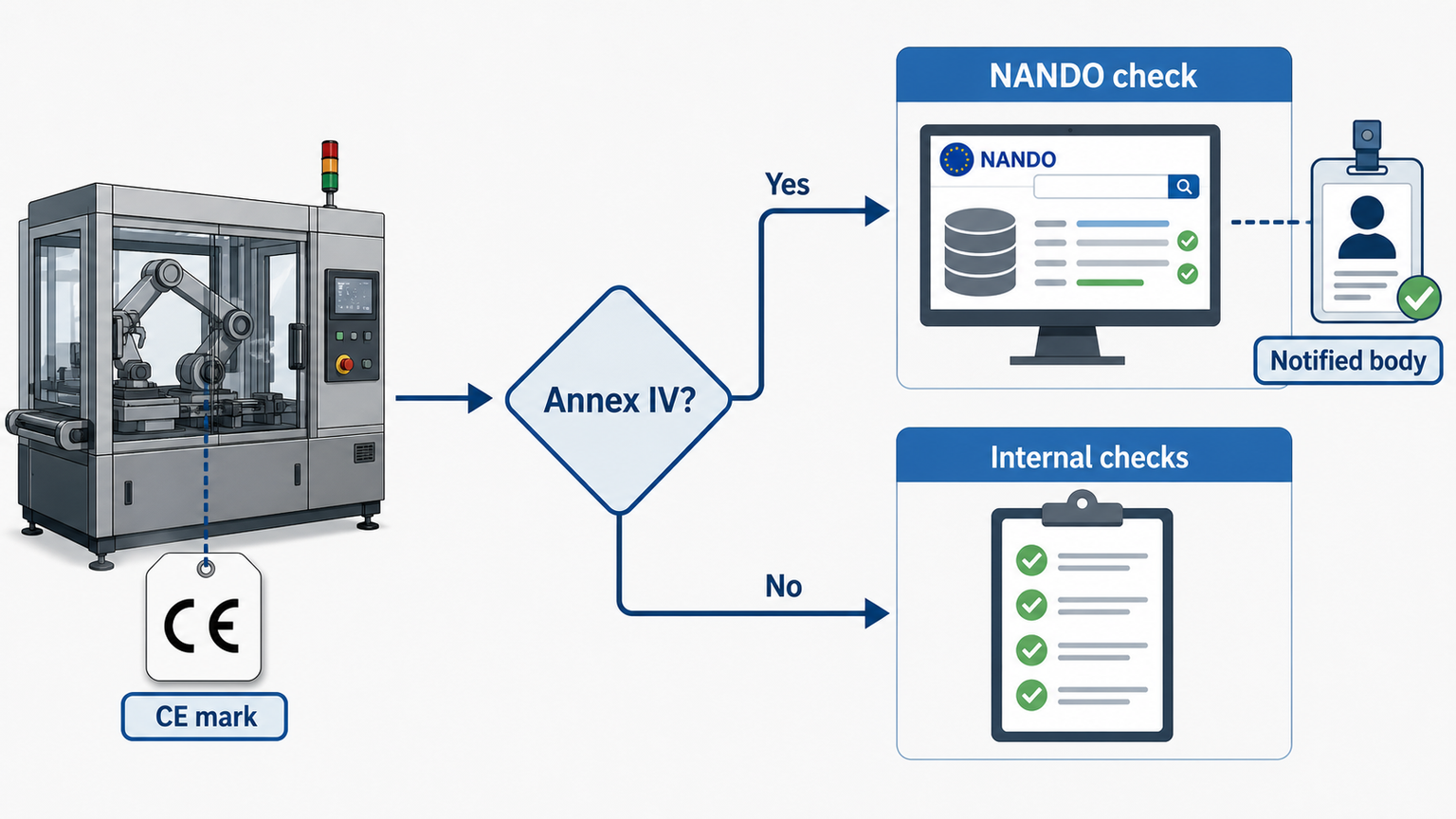
This is a common procurement misunderstanding. A missing notified body number does not always prove a CE mark is fake. But a supplier that claims notified body involvement must prove the body is real and notified for the correct legislation and task.
Check this before you accept a notified body claim:
| Claim | What to verify |
|---|---|
| “Notified body tested it” | Body legal name and 4-digit number |
| “Notified body approved it” | Exact EU legislation and task scope in NANDO |
| “CE certificate issued” | Whether the machine category and conformity route require that body |
| “Number after CE mark” | Whether full quality assurance under Article 12 applies |
The European Commission’s NANDO database lists notified bodies, their identification numbers, and the tasks for which they are notified. A real number alone is not enough if the body is not notified for the relevant machinery procedure.
Which safety standards should buyers ask about for laser tube cutters and punching machines?
Buyers should ask how the supplier addresses machinery risk assessment, safety control systems, and electrical equipment using standards such as ISO 12100:2010, ISO 13849-1:2023, and IEC 60204-1:2016 where applicable. These standards do not replace the CE legal process, but they help structure the technical review.
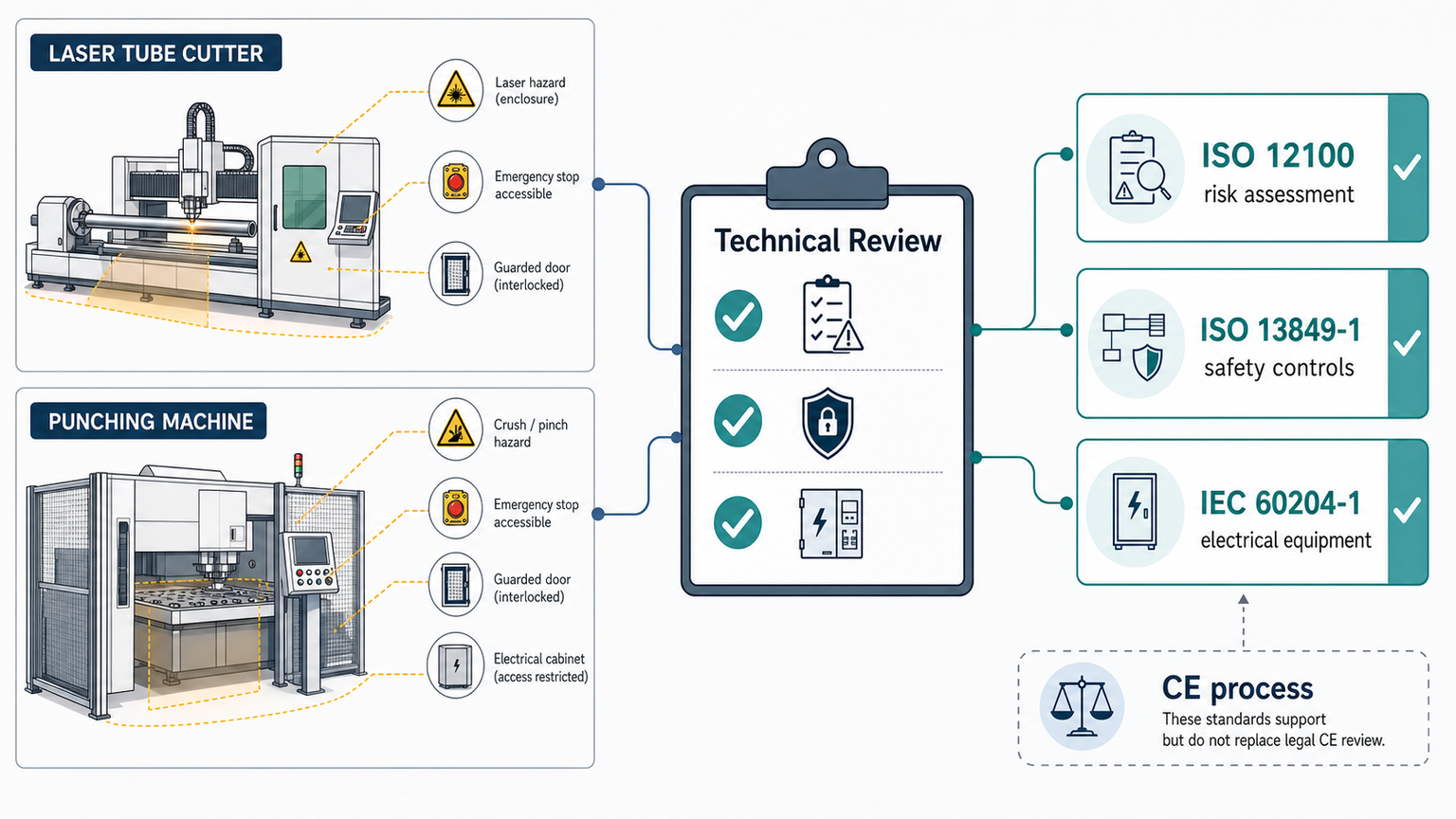
MZBNL builds laser tube cutters for cutting and processing metal tube, and automatic punching machines for automatic punching. In both machine types, I want the safety discussion to be specific, not only a brochure statement.
| Area | Public standard to ask about | Buyer check |
|---|---|---|
| Risk assessment | ISO 12100:2010 | Hazard identification, risk estimation, risk reduction records |
| Safety controls | ISO 13849-1:2023 | Required Performance Level and achieved Performance Level for safety functions |
| Electrical equipment | IEC 60204-1:2016 | Electrical design, protective bonding, emergency stop/control circuits, documentation |
Exact applicable legislation can vary by machine configuration. A laser tube cutter or punching machine may also need evidence for EMC, electrical, laser, guarding, RoHS, or other requirements depending on design and market.
What are the red flags of a fake or weak ISO or CE claim?
The biggest red flags are missing legal names, mismatched addresses, expired certificates, unverifiable certificate numbers, vague CE declarations, and notified body numbers that do not match NANDO scope. I also get cautious when a supplier refuses to share the declaration or says “CE approved by Europe” without documents.
On the factory floor, I have learned that weak paperwork often appears with weak process control. It does not always mean the machine is bad, but it means the buyer has more risk to clear before payment.
| Red flag | Why it matters | Practical fix |
|---|---|---|
| Supplier name differs across documents | You may not know who made the machine | Ask for legal entity mapping |
| Factory address missing | Scope may not cover the real manufacturing site | Match certificate to factory audit |
| ISO certificate expired | Status may no longer be active | Verify live status |
| CE declaration has no machine ID | Document may not apply to your machine | Request model and serial identification |
| No applicable directive listed | Declaration may be incomplete | Ask for corrected declaration |
| Notified body number cannot be matched | Claim may be irrelevant or false | Check NANDO by number, legislation, and task |
| “ISO issued certificate” wording | ISO does not issue certificates | Ask who the certification body is |
How should procurement compare two Chinese machine suppliers?
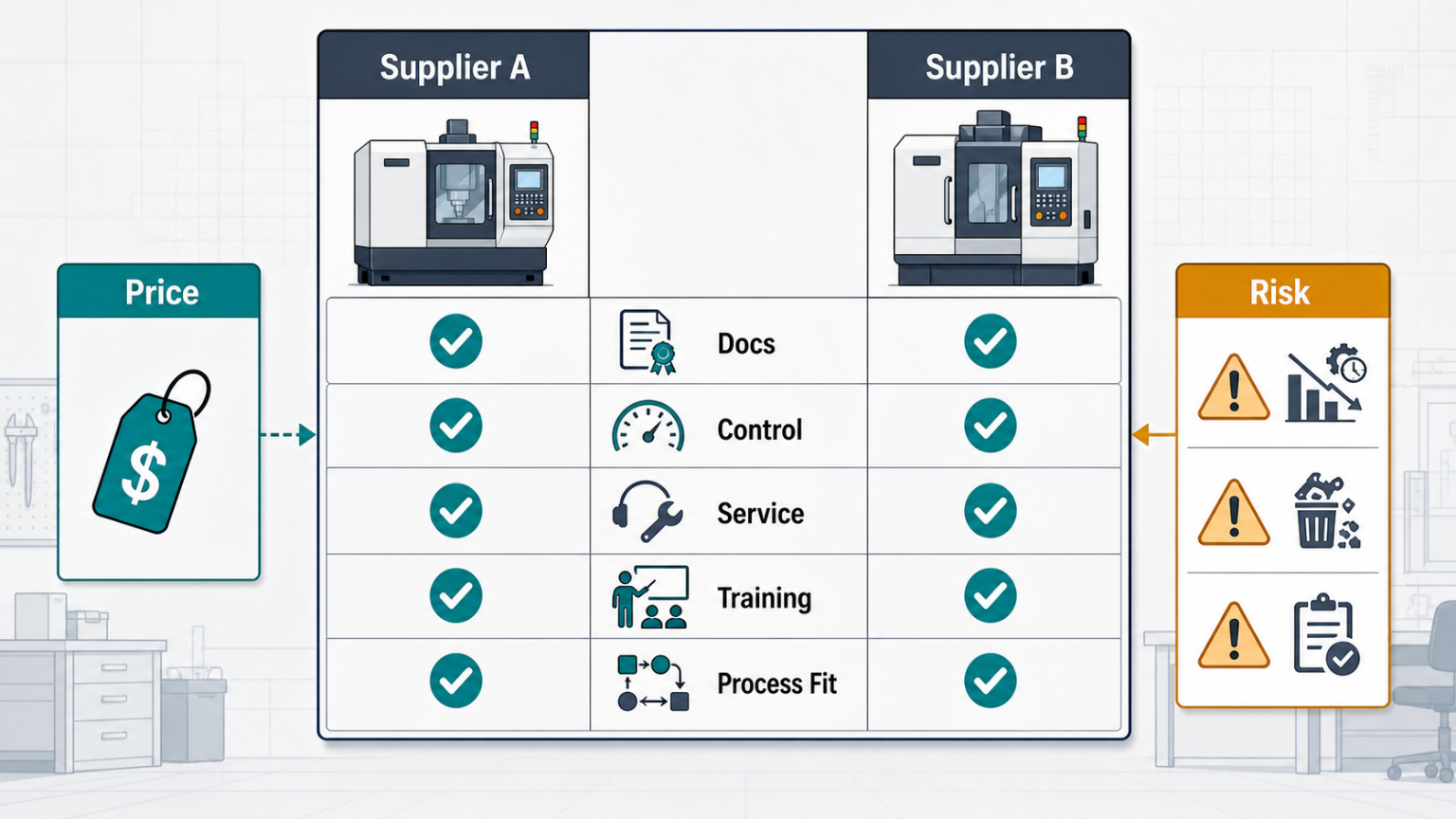
Procurement should compare suppliers by verified documents, manufacturing control, service responsibility, operator training burden, and fit for the actual production process. Price matters, but a low purchase price can lose value if the machine creates training delays, downtime, waste, or compliance risk.
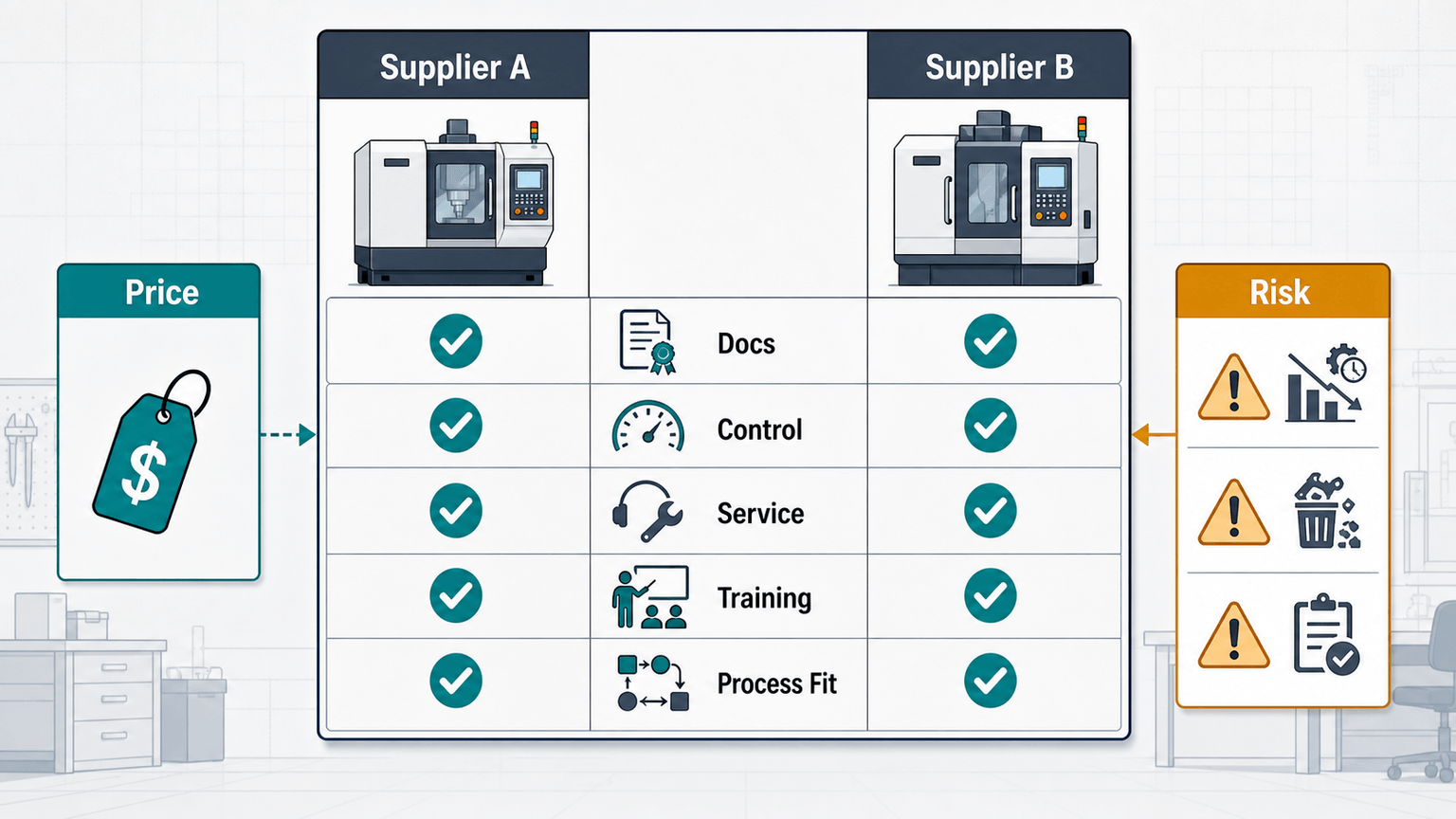
At MZBNL, we handle R&D, manufacturing, and servicing in-house since 2010. We hold 30+ patents and serve 4,000+ customer applications globally. We also design our machines so operators can move from weeks of training down to a single day.
Use a short RFQ checklist:
- Legal identity: Confirm the seller, manufacturer, and factory address.
- ISO proof: Request the certificate and verify live status.
- CE proof: Request the Declaration of Conformity and supporting technical evidence.
- Machine fit: Define tube type, punching pattern, production flow, labor target, and precision need.
- Training: Ask how long operators need before they can run real production.
- Service: Ask who supports installation, maintenance, and troubleshooting.
- Compliance scope: Ask which directives, standards, reports, and documents apply to your configuration.
I would not ask only, “Do you have CE?” I would ask, “Please send the declaration, applicable directives, standards used, conformity route, and supporting test evidence for this exact machine.”
How will EU machinery rules change in 2027?
Regulation (EU) 2023/1230 repeals Machinery Directive 2006/42/EC with effect from 20 January 2027 and applies from 20 January 2027, with some provisions applying earlier. Buyers should check which legal framework applies at the time the machine is placed on the EU market.
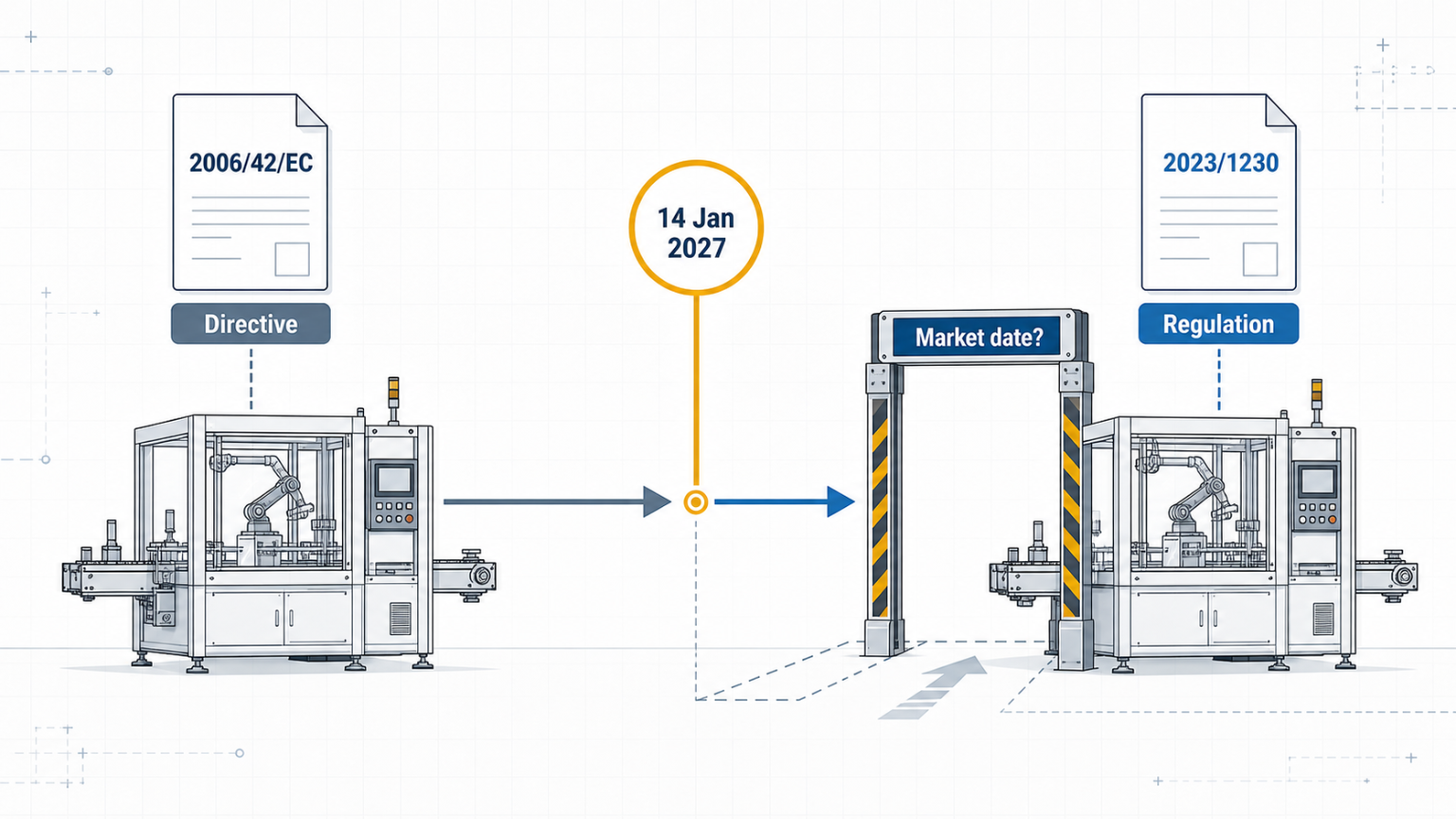
This date matters for long purchasing projects. A machine ordered, built, shipped, and placed on the market across the transition period may need careful document review.
I would ask the supplier three direct questions:
- Which machinery law applies to this shipment date and market entry date?
- Which declaration format will you provide?
- Which technical file evidence supports the declaration?
Do not rely on old templates without checking the delivery timeline. Certificate validity and legal requirements can change after publication.
Conclusion
A real ISO 9001 or CE claim survives document review, database checks, and machine-specific questions. I trust a supplier more when the paperwork matches the factory, the legal entity, the machine configuration, and the buyer’s market.
If you are comparing laser tube cutters or automatic punching machines, send us your required documents list with the RFQ, and we will help your team review the right evidence before you decide.