

For stainless steel handrail and balustrade fabrication, the right laser tube cutter depends first on your tube range and production pattern, not on laser power alone. If your shop cuts many common round and square rail tubes, I usually start with the Q Series. If your work is small, thin-wall, and space is tight, I look at the M Series or X12Y. If your parts need weld-prep bevels, I move the discussion to P-Pro.
What should you decide first?
You should decide your tube size, stainless grade, daily volume, accuracy need, floor limits, and destination-market compliance before you ask for a machine quote.
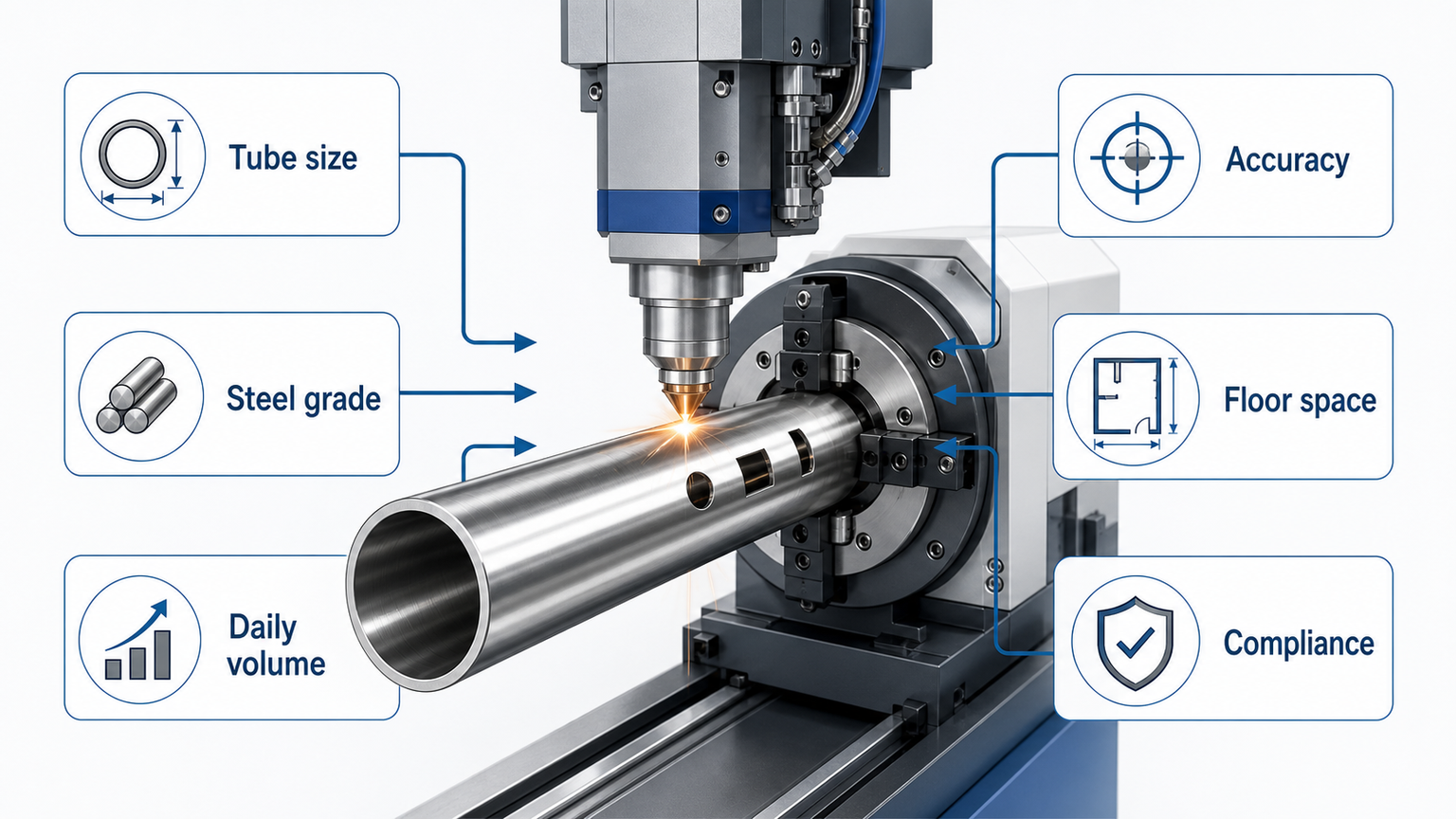
A handrail shop can waste money in two directions. You can buy too small and fight the machine every week. Or you can buy too much machine and tie up cash that should stay in your business.
Here is the first decision table I use with buyers.
| factor | why it matters | how to assess yours |
|---|---|---|
| Tube size and shape | The chuck range decides what the machine can hold and rotate accurately | List round OD, square size, rectangular size, wall thickness, and longest stock length |
| Stainless grade and exposure | Outdoor, coastal, pool, and chloride areas need stronger corrosion screening | Compare 304, 316, and 316LN by PREN; FHWA lists about 18 for 304, 24 for 316, and 26 for 316LN |
| Production volume | Volume decides whether manual handling, automatic loading, or automatic loading and unloading makes sense | Count parts per shift, tube changes per day, and repeat orders per month |
| Cut features | Holes, slots, miters, saddle cuts, and notches decide control and accuracy needs | Send drawings, photos, or sample parts; our Easy-Cut control can program parts on-screen without a CAD step |
| Weld preparation | Beveled joints need a different cutting head and motion system | If you need 0-60 degree bevels, check P-Pro instead of a standard straight-cut tube laser |
| Floor space | A long loader or full line may not fit a small shop | Measure machine zone, loading zone, unloading zone, forklift path, and service clearance |
| Labor target | The machine should remove real handling, marking, sawing, drilling, and deburring work | Track current labor hours per batch and scrap from wrong marks or wrong angles |
| Destination compliance | Rail systems and industrial laser equipment must meet local rules | Check project handrail rules, laser safety expectations, and buyer-required standards before order |
For U.S. accessible handrail projects, ADA section 505.7.1 gives circular gripping surfaces as 1 1/4 in. to 2 in. outside diameter, about 32-51 mm. That does not define every handrail in the world, but it gives a useful buying reference. Your tube laser should handle that common OD range cleanly if you make handrails for U.S. projects.
For material, I treat PREN as a screening tool, not a guarantee. Surface finish, heat tint, weld cleanup, chloride level, cleaning chemicals, and maintenance still matter. But if your rail goes near salt air, pool water, or wet cleaning chemicals, the 316 family usually deserves a serious look before you choose 304 only for price.
Which specs actually matter, and what range do you need?
The specs that matter most are tube range, wall thickness, repeatability, part accuracy, remnant length, chuck load, automation level, bevel ability, assist gas setup, and safety compliance.
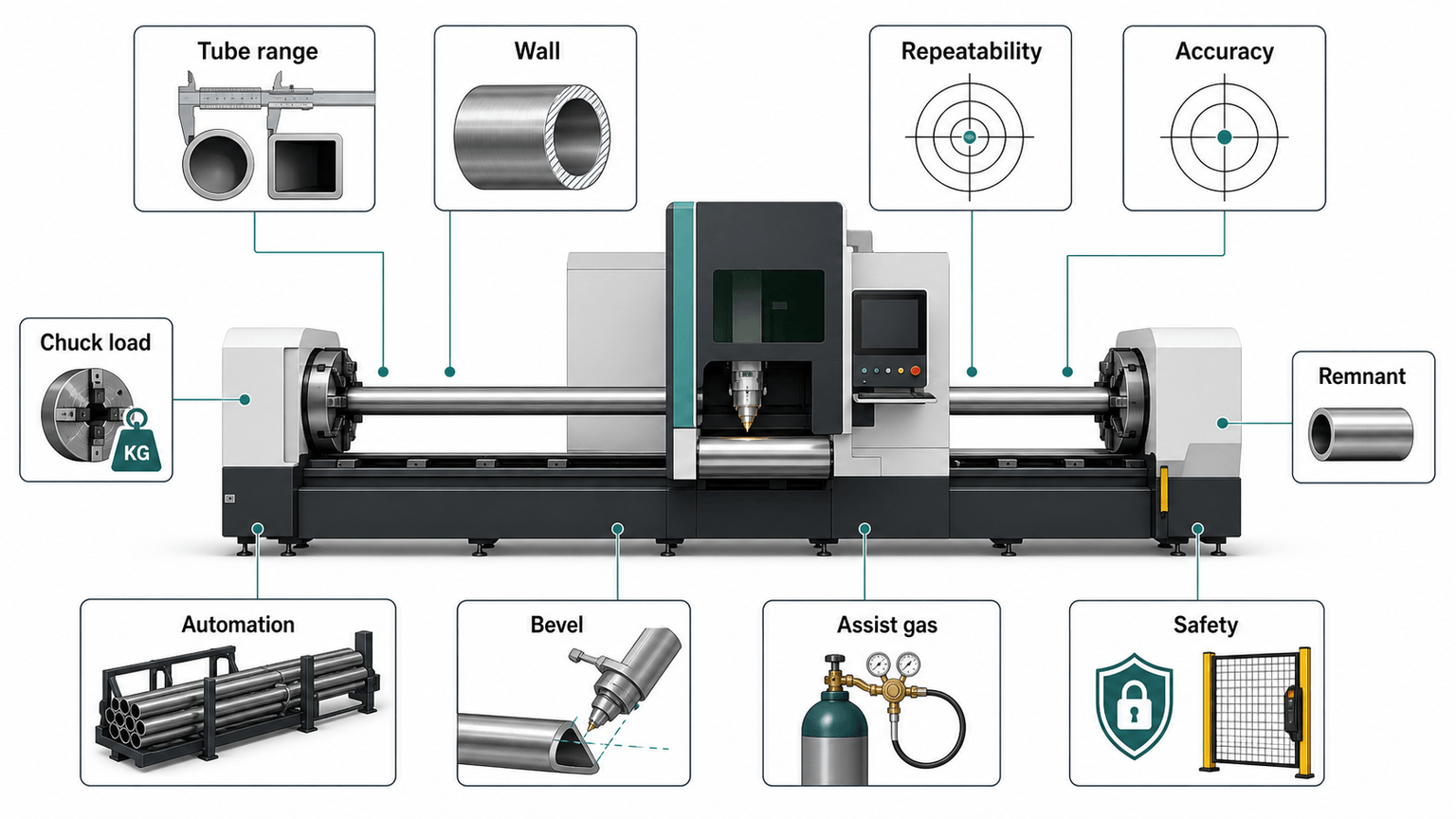
I see many buyers ask only for laser power. Power matters, but it does not solve wrong chuck size, poor loading, long tail waste, or weak support.
Use this table as a practical first filter.
| spec / parameter | what to look for | typical range |
|---|---|---|
| Laser power | Match power to stainless thickness, feature density, and production target | BNL Laser tube models range from 1500 W to 12000 W by series |
| Round tube capacity | Must cover your smallest and largest rail tube OD | M Series Φ8-Φ85 mm; Q12 Φ12-Φ120 mm; Q16 Φ8-Φ165 mm; P-Pro Φ12-Φ300 mm |
| Square tube capacity | Must cover posts, frames, and square balustrade members | Q12 to 120x120 mm; Q16 to 165x165 mm |
| Wall thickness | Must match real tube wall, not only catalog OD | M Series 0.2-3 mm; P-Pro 1-20 mm |
| Repeatability | Important for hole alignment, brackets, and repeat batches | Q Series repeatability ±0.05 mm |
| Part cutting accuracy | Important for short precision tube and visible assembly fit | M Series ≤±0.1 mm on parts ≤500 mm; ≤±0.2 mm on 500-1200 mm |
| Positioning accuracy | Important for slots and repeat holes | M Series positioning ±0.1 mm |
| Remnant length | Shorter tail reduces stainless waste | Q12Y/Q16Y short-tail remnant ≥45 mm; standard remnant ≥80-220 mm; X12Y remnant about 100 mm |
| Chuck load | Heavier tube needs a stronger chuck system | Q12 100 kg; Q16 200 kg |
| Stock length | Long stock needs the right loading and support layout | M Series part length 1-6000 mm; X12Y-2 is a 12-metre long-stock model |
| Footprint | Small shops need a machine that fits the actual floor | X12Y footprint 3.1x1.48x1.4 m |
| Bevel cutting | Needed for weld-prep joints | P-Pro bevel angle 0-60 degrees adjustable; angle error ≤±0.1 degree |
| Assist gas for stainless | Nitrogen or argon helps produce oxide-free edges | Nitrogen (or argon); exact pressure dialed in at the sample cut |
| Laser safety | Enclosure, interlocks, procedures, and training must fit the country and factory | ISO 11553-1:2020 and ANSI Z136.1-2022 are useful reference standards |
For stainless handrail tube, I usually discuss nitrogen assist early. Fusion cutting of stainless commonly uses nitrogen or argon as inert assist gas. The right pressure depends on your wall thickness, so we dial it in on the sample cut rather than read it off a chart. The purpose is a clean, oxide-free edge with less rework.
TWI also makes a practical point: clean, dross-free laser-cut edges in 3 mm stainless need high-pressure gas and effective gas delivery. On the factory floor, this means nozzle condition, beam alignment, focus, gas quality, and setup discipline matter as much as the machine nameplate.
How do you match the option to your use case?
Choose Q Series for mixed handrail shops, M Series for compact small-tube precision work, X Series for tight floors or special site needs, P-Pro for bevels, and L-PurePro for high-volume low-labor production.
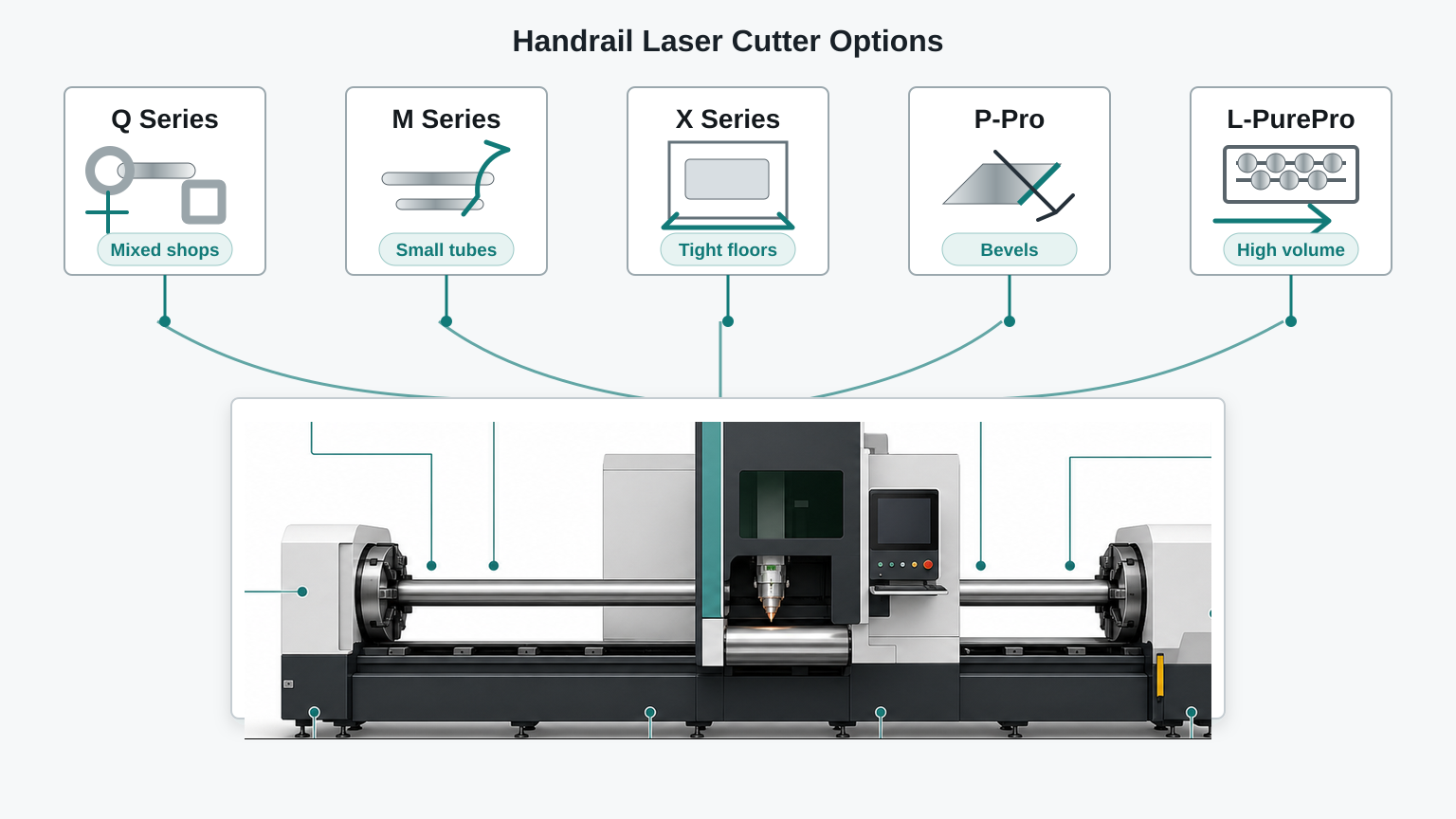
I do not believe in one universal machine for every stainless handrail buyer. A small stair-rail shop and a high-volume balustrade factory have different problems.
| if your situation is... | choose this BNL Laser option | why it fits |
|---|---|---|
| You cut common round and square stainless rail tube in a general fabrication shop | Q12 or Q12Y | It covers round tube φ12-φ120 mm and square tube to 120x120 mm, with ±0.05 mm repeatability |
| You need broader tube range or a heavier mixed shop setup | Q16 or Q16Y | It covers round φ8-φ165 mm and square to 165x165 mm, with 200 kg chuck load |
| Stainless material cost is a major issue and you want shorter tail waste | Q12Y or Q16Y | The short-tail models cut remnant down to ≥45 mm, compared with ≥80-220 mm standard |
| You cut small-diameter thin-wall stainless tube for rail, furniture, sanitary, or motorcycle parts | M12 or M12Y | It covers Φ8-Φ85 mm, 0.2-3 mm wall, with compact precision for smaller parts |
| Your floor is tight and you still need a tube laser | X12Y | It uses a short-body double-chuck layout, Φ10-100 mm range, and a 3.1x1.48x1.4 m footprint |
| You process 12-metre stock | X12Y-2 | It is the long-stock model for 12-metre material |
| You need mobile or on-site cutting | X12Y-3 | It is the mobile/on-site unit |
| Your stainless parts need weld-prep bevels | P-Pro | It cuts 0-60 degree bevels, with angle error ≤±0.1 degree, on Φ12-Φ300 mm tube |
| You run high-volume repeat production and want lower handling labor | L-PurePro L90-L350 | It supports 1500-12000 W with automatic loading and unloading |
| You cut structural profiles as well as rail tube | B-NexBeam B90-B350 | It cuts square, round, rectangular, oval, I-beam, channel, and angle steel |
If you mainly cut 32-51 mm round handrail tube, do not automatically buy the largest range. A smaller, well-matched machine can be the right call if your wall thickness, part length, and loading volume fit. I tell buyers this often because a machine that fits your real tube list will make more money than a bigger catalog number that slows your operator down.
If your operators do not use CAD every day, control matters. Our drawing-free Easy-Cut control lets the operator program parts on-screen at the machine. We built it because many factories have good operators but no spare CAD programmer. In many shops, training drops from weeks to about a single day.
If you fabricate visible stainless rail, also think about secondary work. Laser cutting is a contact-free thermal cutting process, so the tool does not wear against the tube like a saw blade or punch. But stainless still needs the right gas, alignment, and process setup if you want clean edges and less grinding.
What to check before you commit — and on the supplier?
Before you commit, check the sample cut, written configuration, service path, spare parts, warranty terms, safety design, import requirements, and whether the supplier is the real factory.
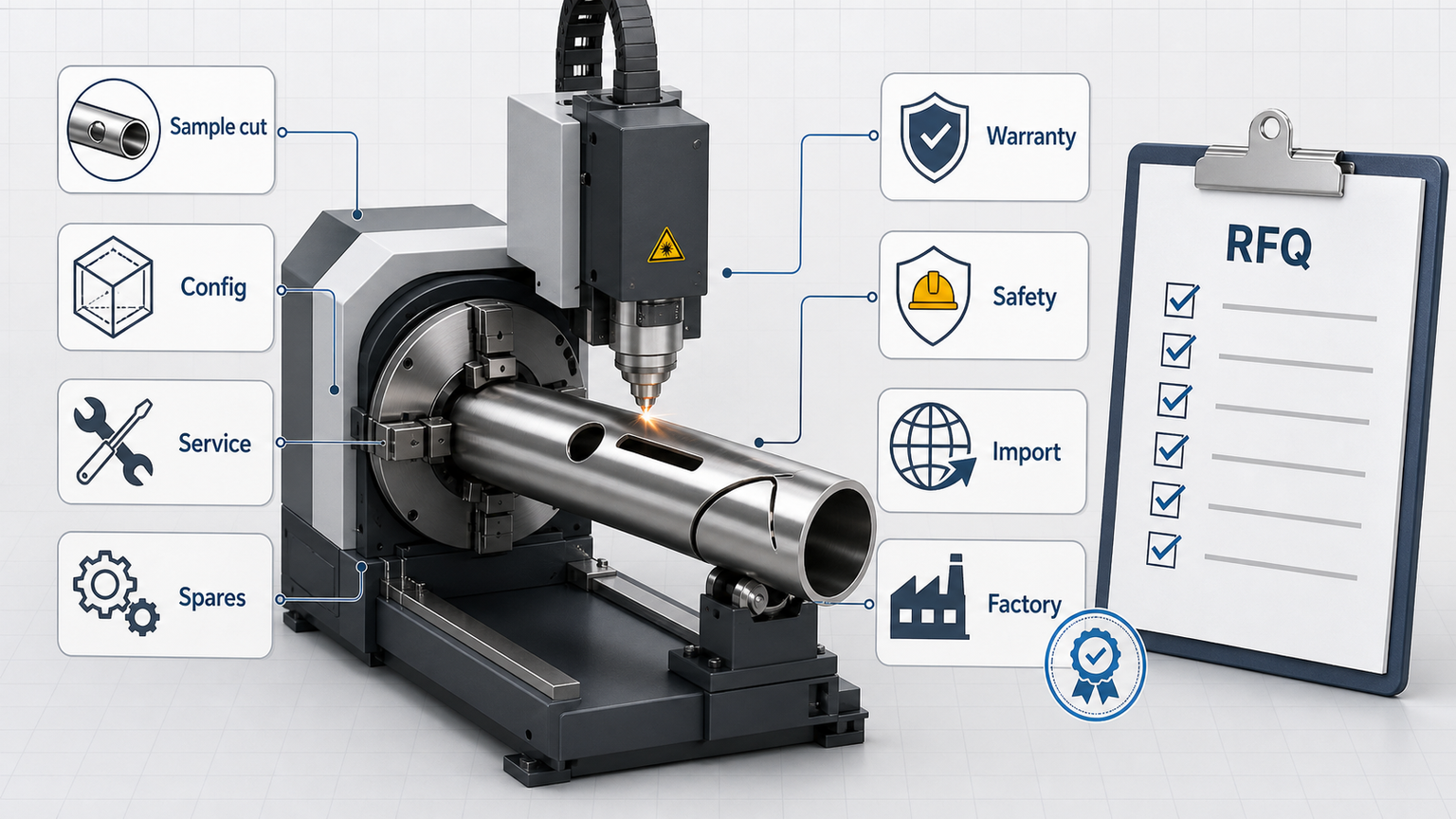
A good RFQ should make the risk smaller. It should not force you to guess.
Use this checklist before you send a deposit:
- Tube data: Send OD, shape, wall thickness, grade, finish, stock length, part length, hole pattern, and monthly volume. A photo of your current part rack helps more than a long speech.
- Material standard: For U.S. ornamental or mechanical stainless tube, ASTM A554 is a common reference. It covers welded stainless mechanical tubing for ornamental, structural, exhaust, and other applications, including round, square, rectangular, and special shapes.
- Regional tube standard: For Europe, EN 10296-2 covers welded circular stainless steel tubes for mechanical and general engineering purposes. For China, GB/T 12770-2025 is the current national recommended standard for welded stainless steel tubes for mechanical structures and became effective on 2026-03-01. For Japan, JIS G 3446:2017 covers stainless tubes for machine and structural purposes.
- Sample cut: Ask us to cut your real tube, not only a factory demo tube. We provide a free real sample cut with a cycle-time estimate from your material.
- Assist gas plan: For stainless, ask how the machine will use nitrogen or argon fusion cutting, and ask what gas pressure and nozzle setup your tube needs.
- Edge quality: Check dross, heat tint, burr, hole shape, and fit-up. Do not judge only the first photo; ask for close-ups of the cut edge and holes.
- Automation level: Decide whether automatic loading is enough, or whether you need automatic loading and unloading. Labor saving only counts when it removes real handling steps on your floor.
- Remnant control: Ask the supplier to state expected tail remnant in writing. On Q12Y and Q16Y, our short-tail reference is ≥45 mm.
- Software and training: Ask whether your operator can program at the machine. With our Easy-Cut control, the operator does not need a separate CAD step for common tube parts.
- Power supply: Our standard build is three-phase 380 V 50 Hz, and we configure voltage and power for your country during the RFQ. Ask for it in writing.
- Safety: Ask how the machine design and procedures address laser-radiation hazards. ISO 11553-1:2020 applies to laser processing machines, and ANSI Z136.1-2022 gives U.S. safe-use guidance for lasers, including Class 4 controls.
- Destination certification: Tell the supplier your import country and project market early. If your buyer needs SASO/SABER, ESMA, SNI, CE-related documents, or other local paperwork, confirm the exact requirement before production.
- Warranty: Ask for warranty scope in writing. The document should state covered parts, exclusions, service-response terms, and who pays for travel or shipping if service is needed.
- Spare parts: Ask for a consumables and service-parts list. For our machines, we supply genuine nozzles, lenses, sensors, protection mirrors, ceramic rings, and other service parts.
- After-sales support: Ask who answers the service line. At BNL Laser, the service line reaches the engineers who built the machine.
- Factory verification: Ask for a live video tour of the Foshan floor, including machining, assembly, and test bays. Ask for our ISO certificate during the RFQ, and check that the company name matches Foshan Mingzhou Intelligent Equipment Co., Ltd.
- Payment name: Pay only the manufacturer's own corporate account under the same legal company name. If a supplier asks you to wire a different company name, walk away.
I started BNL Laser in 2010 because I did not want to sell a machine I could not fix myself. That rule still shapes how I read inquiries. If your tube data points to a simpler machine, I will say that before we quote a larger one.
What mistakes do buyers most often make?
The most common mistakes are buying by laser power alone, ignoring stainless grade and assist gas, underestimating remnant waste, skipping a real sample cut, and failing to verify the factory.
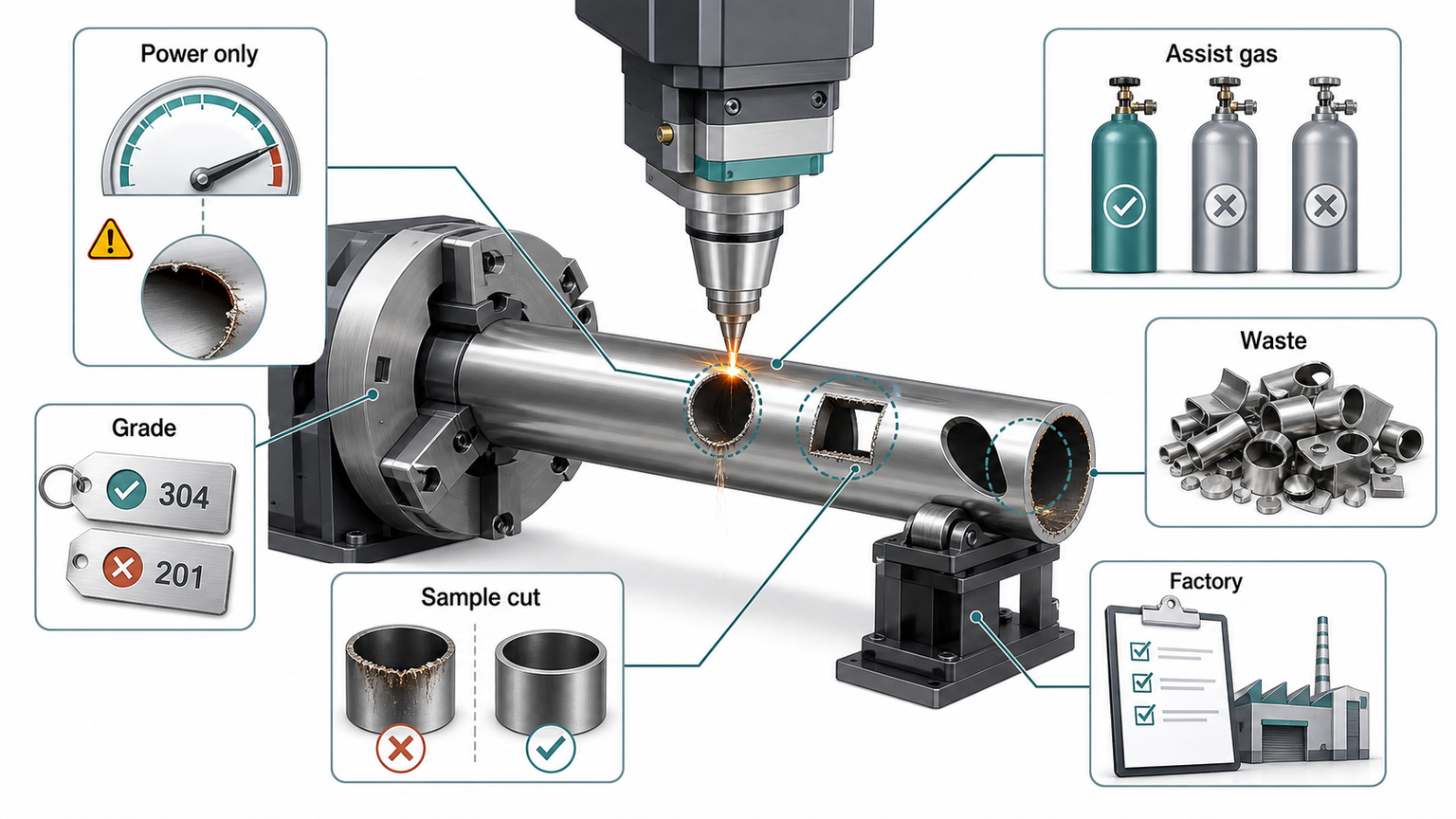
Here are the mistakes I see most often from the factory floor.
Buying power instead of process: A higher watt number does not fix poor gas delivery, wrong chuck range, weak loading, or bad programming. For stainless, nitrogen or argon fusion cutting and stable setup matter because they help produce clean, oxide-free edges.
Treating 304 and 316 as the same decision: FHWA PREN values show why this is risky. Type 304 is about 18, Type 316 is about 24, and Type 316LN is about 26. PREN does not guarantee field life, but it helps you compare pitting resistance before you quote an outdoor, coastal, pool, or chloride-exposed job.
Ignoring the tail remnant: Stainless tube is not cheap. If your batches include many short parts, remnant length can become a real cost. That is why our Q12Y and Q16Y short-tail machines matter for shops that cut repeated handrail components.
Skipping the real sample cut: A showroom cut does not prove your part. Send your tube, your wall thickness, your grade, and your hole pattern. We will cut the sample and return a cycle-time estimate so you can calculate with your own labor and material cost.
Forgetting local handrail rules: OSHA construction guardrails require top rails at 42 in. ±3 in. above the walking or working level, and the top rail must withstand at least 200 lb / 890 N applied near the top edge. That rule is not a universal building-code substitute, so your engineer or local authority must confirm the rule for your project.
The machine can make accurate cuts, but it cannot correct a wrong specification. Good stainless handrail work starts with the tube grade, the project rule, the cut design, and the weld cleanup plan.
Conclusion
For most stainless steel handrail and balustrade shops, I start the selection with Q Series, then move to M Series, X Series, P-Pro, or L-PurePro only when the tube data and production target point there.
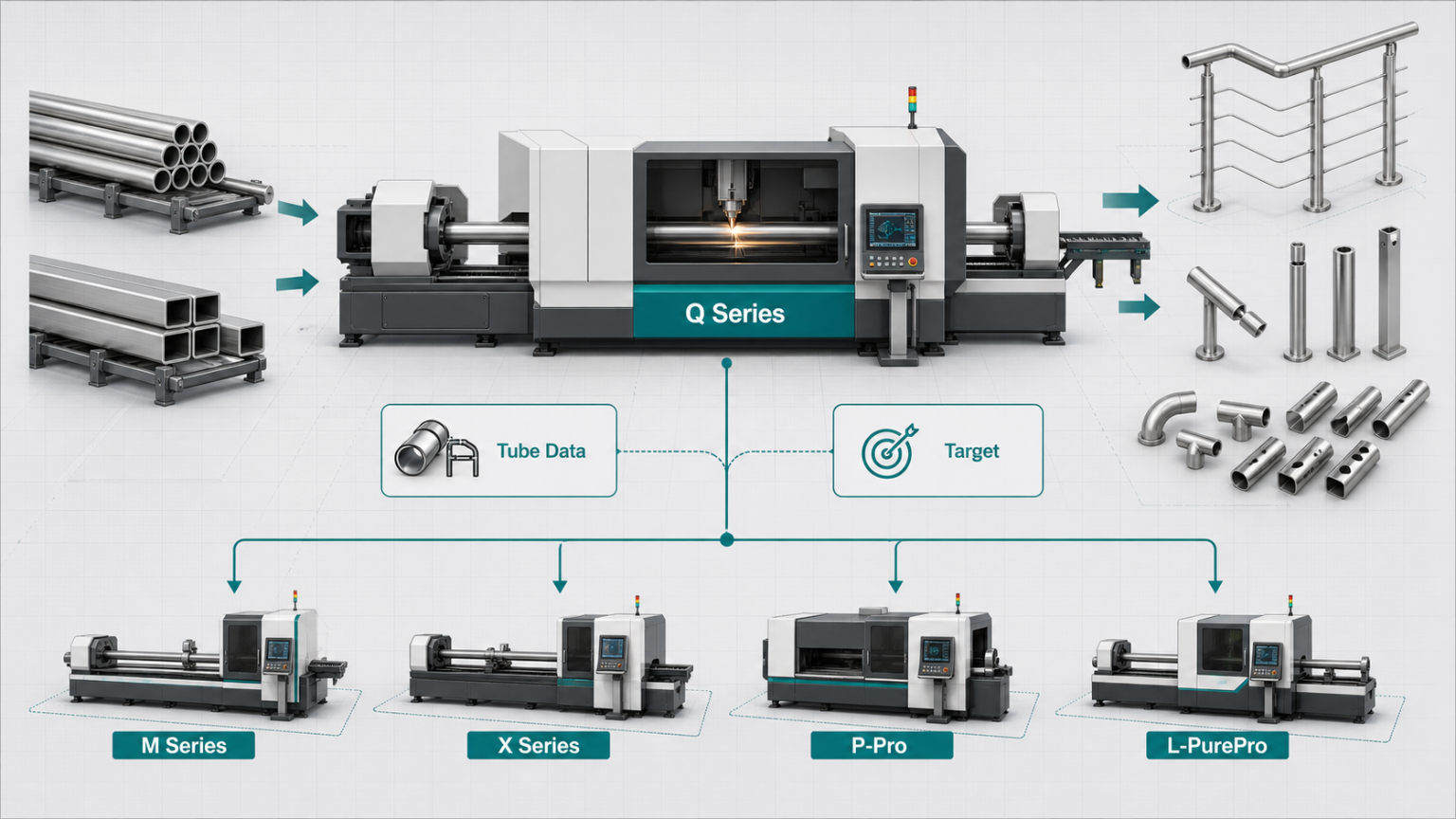
If you cut a broad mix, Q12/Q12Y or Q16/Q16Y usually gives the right balance. If you cut small thin-wall tube in a compact shop, M Series or X12Y may make more sense. If you need bevels, look at P-Pro; if you need high-volume lower-labor production, look at L-PurePro.
Send us your tube size, wall thickness, stainless grade, part drawing or photo, and target volume, and my engineer or I will reply within one business day with the machine fit and sample-cut next step.
— Eric Liu, General Manager, BNL Laser