

Laser tube cutting is the standard for fitness and gym equipment frames because it combines cut length, holes, slots, coped ends, miters, tabs, and bevels in one repeatable CNC process. That matters because a gym frame only goes together well when every tube repeats: the weld fixture closes, bolt holes line up, robotic welding stays stable, and powder-coated parts still fit after finishing.
I see this problem often on the factory floor. A buyer sends us a tube frame that looks simple, but the old route uses sawing, drilling, punching, milling, hand marking, and deburring. One tube passes through many hands. A tube laser removes many of those steps, so your operator controls the part at one machine and your production team measures the result instead of chasing errors downstream.
How does laser tube cutting work for fitness equipment frames?
A tube laser cuts the profile, holes, slots, miters, copes, and weld-prep features while the tube rotates and feeds through CNC chucks.
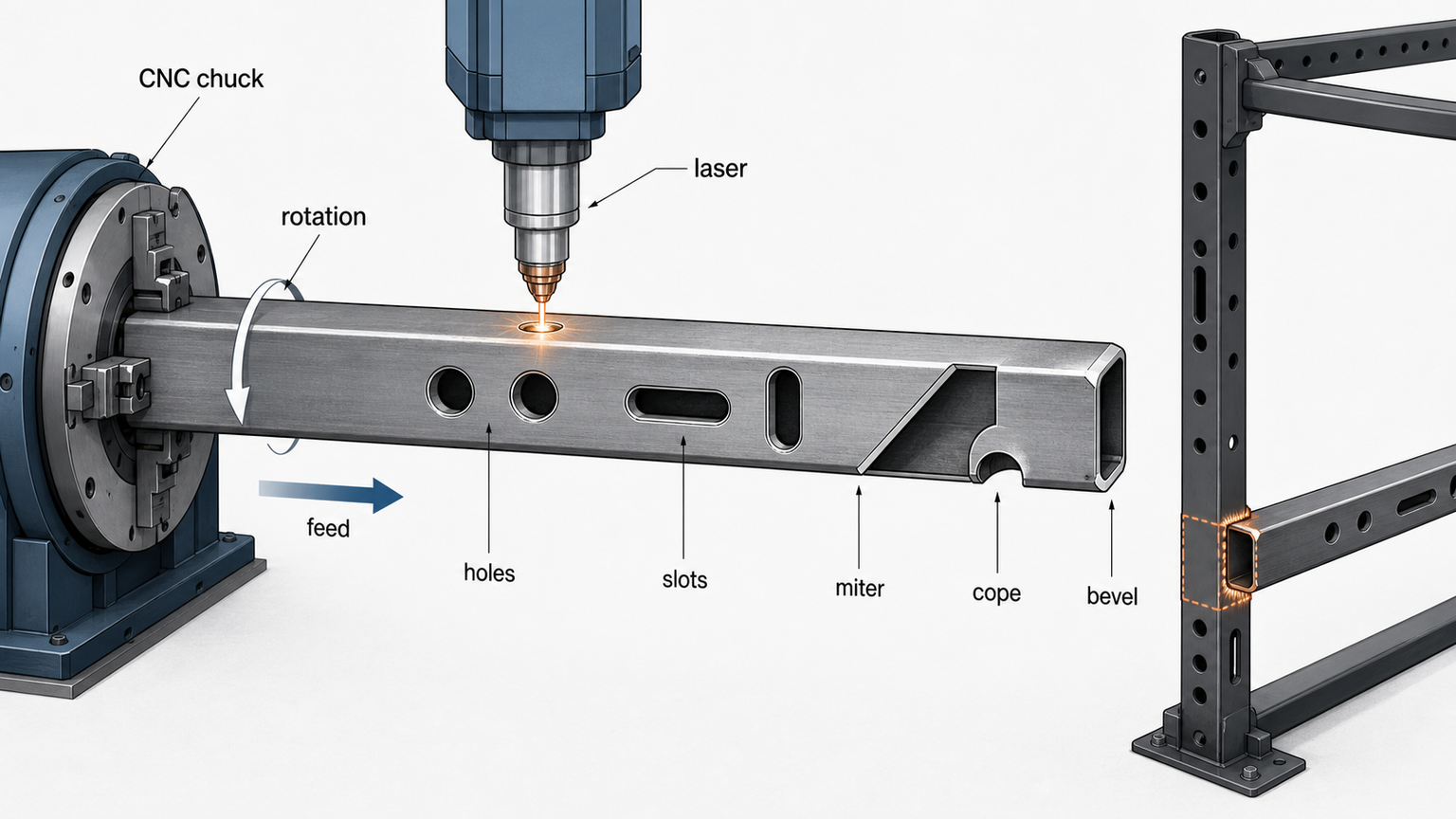
For fitness equipment, the key is not only a clean cut. The key is repeatable fit-up. A treadmill frame, power rack, bench, bike handle, selectorized strength frame, or institutional training unit may use round, square, rectangular, or special tube. If the hole position moves, the assembly team feels it immediately.
A normal workflow looks like this:
- Your team defines the tube shape, outside size, wall thickness, material, part length, hole pattern, slot pattern, miter, cope, and bevel need.
- We review the tube data and part drawing or sample.
- We choose the chuck, loading method, laser power range, and support setup.
- We cut a real sample on your own material.
- We time the sample cut and inspect the part.
- You compare the laser route with your current sawing, drilling, punching, notching, milling, and deburring route.
- We issue the configuration, quote, warranty, and service-response terms in writing.
At BNL Laser, our drawing-free Easy-Cut control lets the operator program many tube parts on-screen at the machine, with no CAD step and no separate programmer. We use this because many factories do not have enough CAD-trained operators. In our factory, a new operator can usually train on the control in about a single day.
For the buyer, the practical question is simple: can your operator cut the frame part correctly every shift without waiting for a programmer?
What frame problems does laser tube cutting solve?
Laser tube cutting solves the repeated frame problems that come from moving tube parts between saws, drills, punches, notchers, milling machines, fixtures, and manual layout.
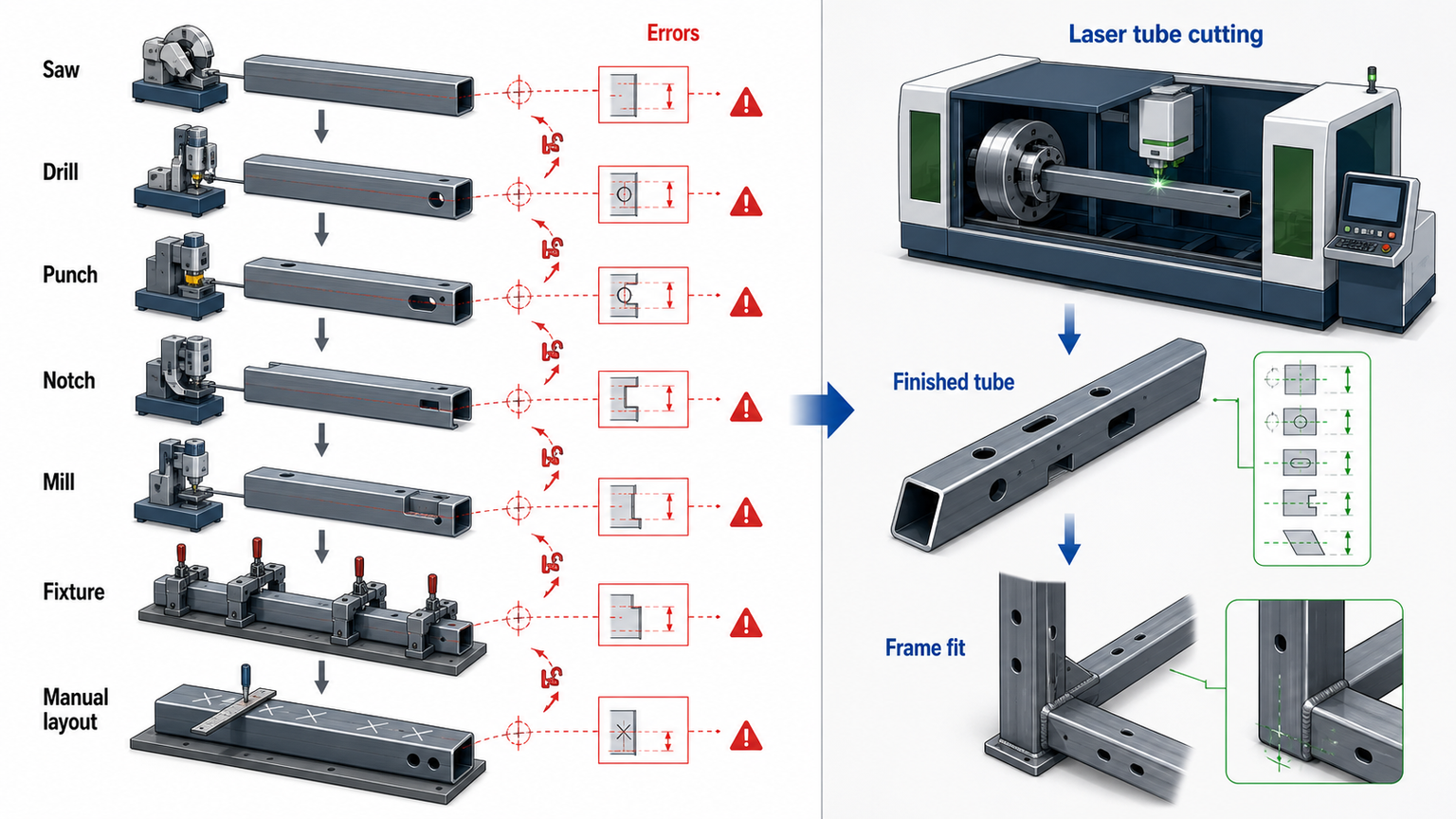
Fitness equipment frames punish small errors. A 1 mm hole shift may slow assembly. A poor cope may open a weld gap. A burr inside a tube end may interfere with an insert, plug, or adjustment pin. A wrong miter can make a rack stand out of square.
Laser tube cutting helps because one CNC program controls the tube features in one handling path.
| Production problem | What happens on the floor | What the tube laser changes |
|---|---|---|
| Long routing | Tubes move through sawing, drilling, punching, notching, and deburring | One CNC process cuts many features |
| Fit-up drift | Weld fixtures need force or rework | Length, holes, slots, copes, and miters repeat from program control |
| Hole mismatch | Bolts, pins, and adjustment holes do not line up | Hole and slot position stay tied to the same tube datum |
| High labor cost | Operators mark, clamp, move, and deburr parts many times | One trained operator can run more of the tube process |
| Tail scrap | Standard remnants waste material | Q Series Y short-tail models can cut tube remnant down to >=45 mm |
| Tight floor space | Separate machines consume space | Compact models such as X12Y use a 3.1 x 1.48 x 1.4 m footprint |
The mistake I warn buyers about is buying only for maximum laser power. Power matters, but frame production often lives or dies on chuck control, tube support, remnant length, loading, software, and service. If the machine cannot hold the tube, index the part, and repeat the hole pattern, more watts will not fix the frame.
Which machine parameters should a fitness equipment buyer check?
You should check repeatability, finished-part tolerance, tube size range, wall range, remnant length, loading method, bevel capability, and verified sample-cut cycle time.
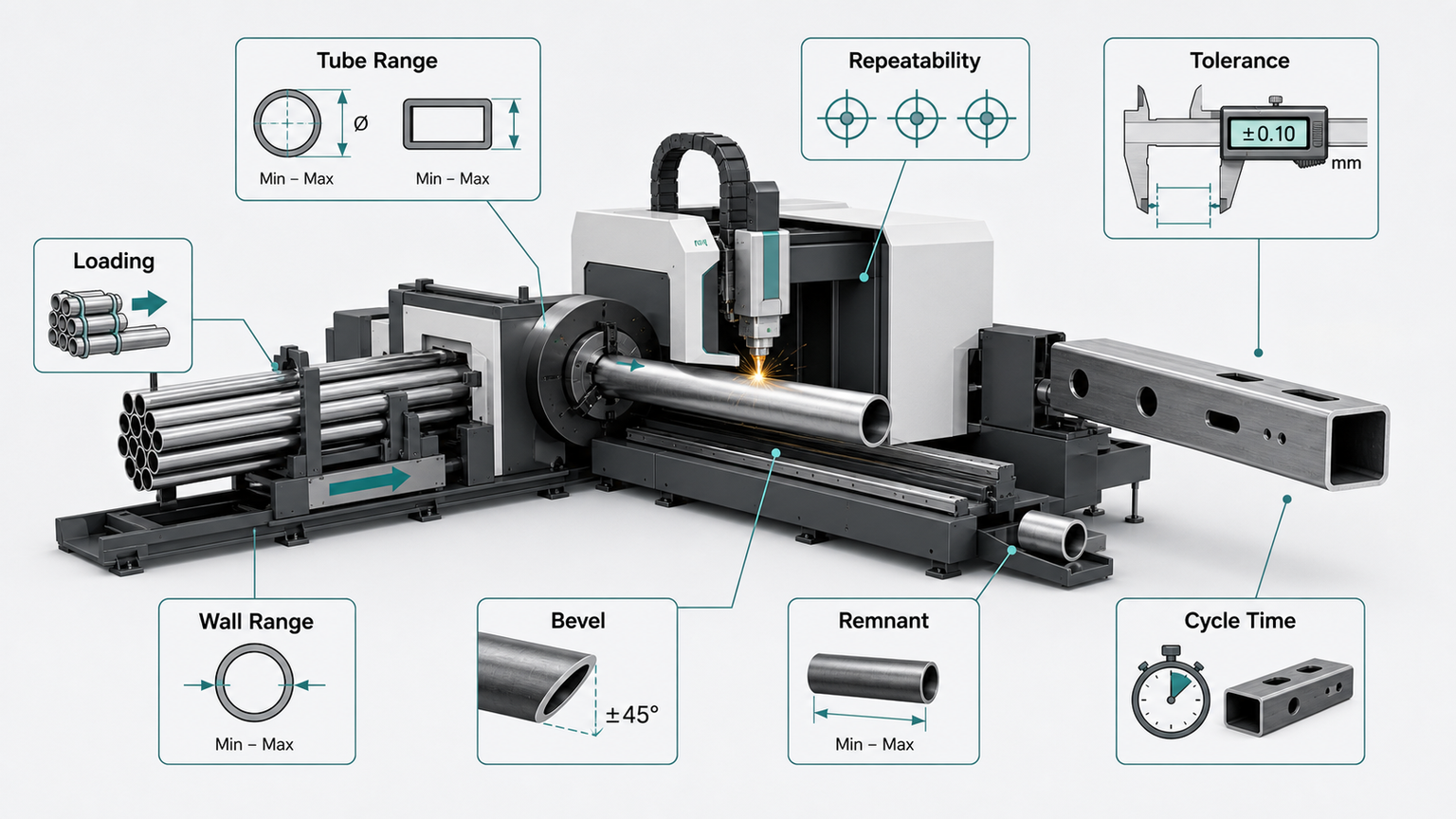
Do not start with a catalog photo. Start with your tube list. Send the real tube data: round, square, rectangular, or profile; outside dimensions; wall thickness; material grade; part length; hole density; slot geometry; annual volume; and whether you weld manually or with robots.
Here are the reference BNL Laser figures I would use to narrow the machine choice before the RFQ.
| Machine series | Reference cutting range | Key buyer metric | Good fit |
|---|---|---|---|
| Q12 / Q12Y | Round phi12-phi120 mm; square to 120 x 120 mm | Repeatability +/-0.05 mm; Q12 chuck load 100 kg | General fitness frame tube mix |
| Q16 / Q16Y | Round phi8-phi165 mm; square to 165 x 165 mm | Repeatability +/-0.05 mm; Q16 chuck load 200 kg | Larger mixed tube production |
| M12 / M12Y | Tube phi8-phi85 mm; wall 0.2-3 mm; part length 1-6000 mm | Cutting accuracy <=+/-0.1 mm on parts <=500 mm; <=+/-0.2 mm on 500-1200 mm parts | Small precision tube, handles, supports, thin-wall parts |
| X12Y | Tube phi10-100 mm | Dual-front-chuck short body; 1500-3000 W; about 100 mm remnant | Tight floors |
| X12Y-2 | 12-metre long stock | Long-stock support | Long structural members |
| X12Y-3 | Mobile/on-site unit | Bring the cut to the material | Site or distributed production work |
| P-Pro | Tube phi12-phi300 mm; wall 1-20 mm | 5-axis bevel; 0-60 degrees adjustable; angle error <=+/-0.1 degrees | Weld-prep bevels and structural weldments |
For higher-volume production, I look at automation. Our L-PurePro line covers L90-L350, uses 1500-12000 W, and includes automatic loading and unloading. Our B-NexBeam line covers B90-B350, also 1500-12000 W, and cuts square, round, rectangular, oval, I-beam, channel, and angle steel.
The final configuration should come from your tube data during the RFQ. We normally reply within one business day, then cut a free real sample on your material with a cycle-time estimate. That timed sample gives procurement a better number than a brochure speed.
Which tube materials and standards matter for gym equipment frames?
Fitness frame buyers should match the tube laser process to the tube material standard, the finished equipment safety standard, and the thermal cut quality requirement.
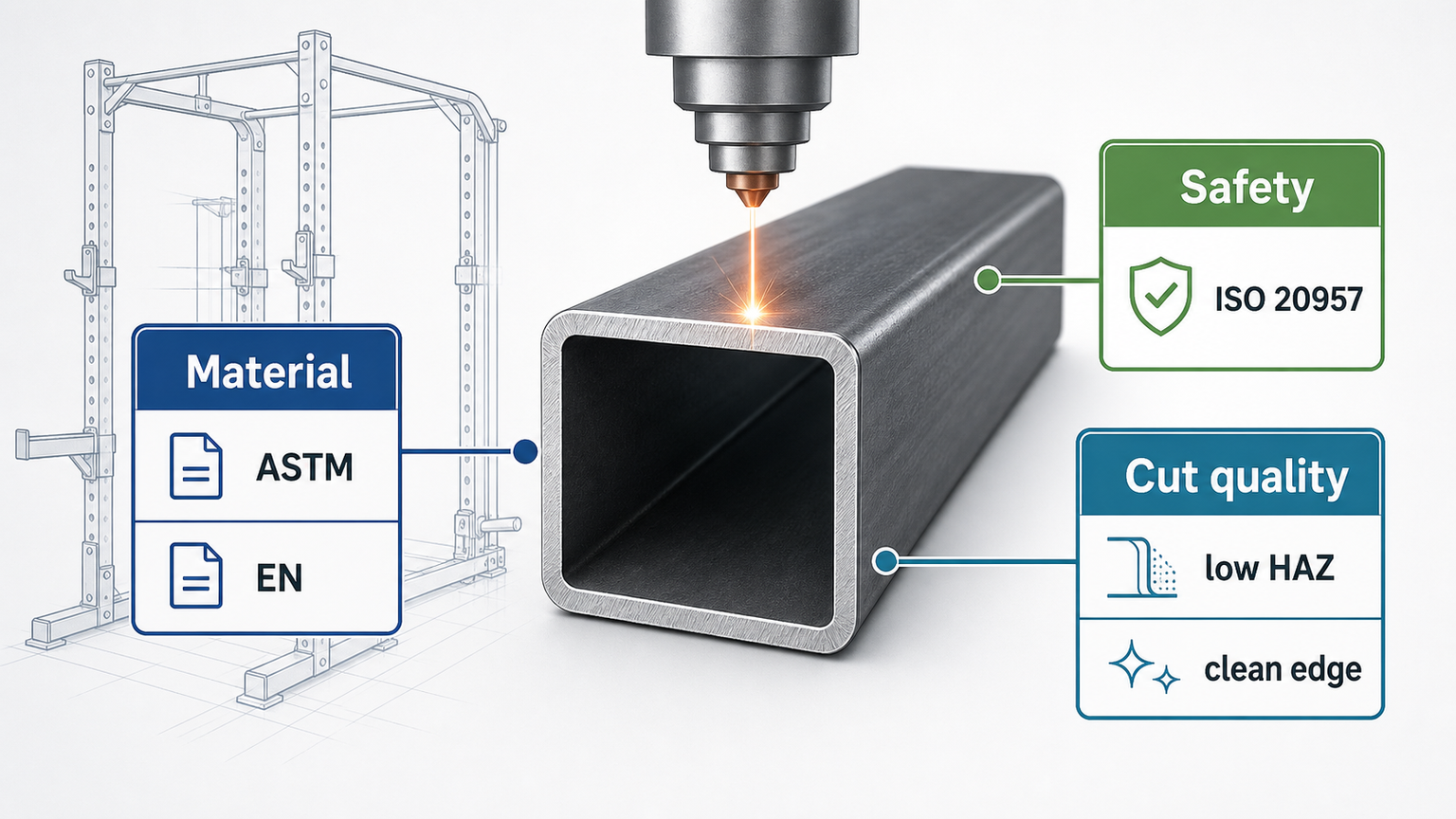
Laser cutting does not make a gym product compliant by itself. Compliance depends on the finished equipment design, testing, guarding, labeling, documentation, material selection, weld quality, and assembly. But laser cutting can help your team hold the tube geometry that those designs require.
For cut quality, ISO 9013:2017 classifies thermal cuts and gives geometrical product specifications and quality tolerances for oxyfuel, plasma, and laser cutting from 0.5 mm to 32 mm material thickness. For machine safety, ISO 11553-1:2020 specifies laser radiation safety requirements for laser processing machines, and OSHA identifies Class 4 lasers as immediate eye and skin hazards from direct or reflected beams.
| Buyer need | Standard | Why it matters |
|---|---|---|
| Global / EU indoor fitness equipment | ISO 20957-1:2024 / EN ISO 20957-1:2024 | General safety requirements, test methods, and classification |
| EU strength equipment | EN ISO 20957-2:2024 | Additional requirements for stationary strength training equipment |
| US indoor fitness equipment | ASTM F2276-23 | Design and manufacture requirements, including edges, tube ends, guarding, locking means, and loading |
| China stationary training equipment | GB 17498.1-2008 | Current general safety requirements and test methods |
| China future indoor stationary training equipment | GB/T 17498.1-2026 | Issued 2026-03-31 and scheduled for implementation on 2027-10-01 |
| Thermal cut quality | ISO 9013:2017 + Amd 1:2024 / EN ISO 9013 | Cut classification and tolerance language |
| Laser machine safety | ISO 11553-1:2020 | Laser processing machine safety requirements |
For tube supply, common standards include ASTM A513 for electric-resistance-welded carbon and alloy mechanical tubing, ASTM A500/A500M for carbon structural tubing, ASTM A554 for welded stainless mechanical tubing, EN 10219 for cold-formed structural hollow sections, EN 10305 for precision tubes, GB/T 6728-2017 for cold-formed hollow sectional steel, GB/T 3094-2012 for cold-drawn shaped steel tubes, JIS G 3445:2025 for carbon steel machine-structure tubes, and JIS G 3466:2025 for square and rectangular structural tubes.
If you cut stainless steel or aluminum frame parts, nitrogen assist gas helps displace oxygen at the cut zone and can produce a clean, oxide-free, weld-ready edge. The exact gas purity, pressure, and flow should come from your material, wall thickness, cut geometry, nozzle, and sample cut.
How do you know the tube laser is doing the job right?
You know the process works when sample parts meet your fit-up tolerance, repeat across a batch, and reduce downstream routing without creating new welding or assembly problems.
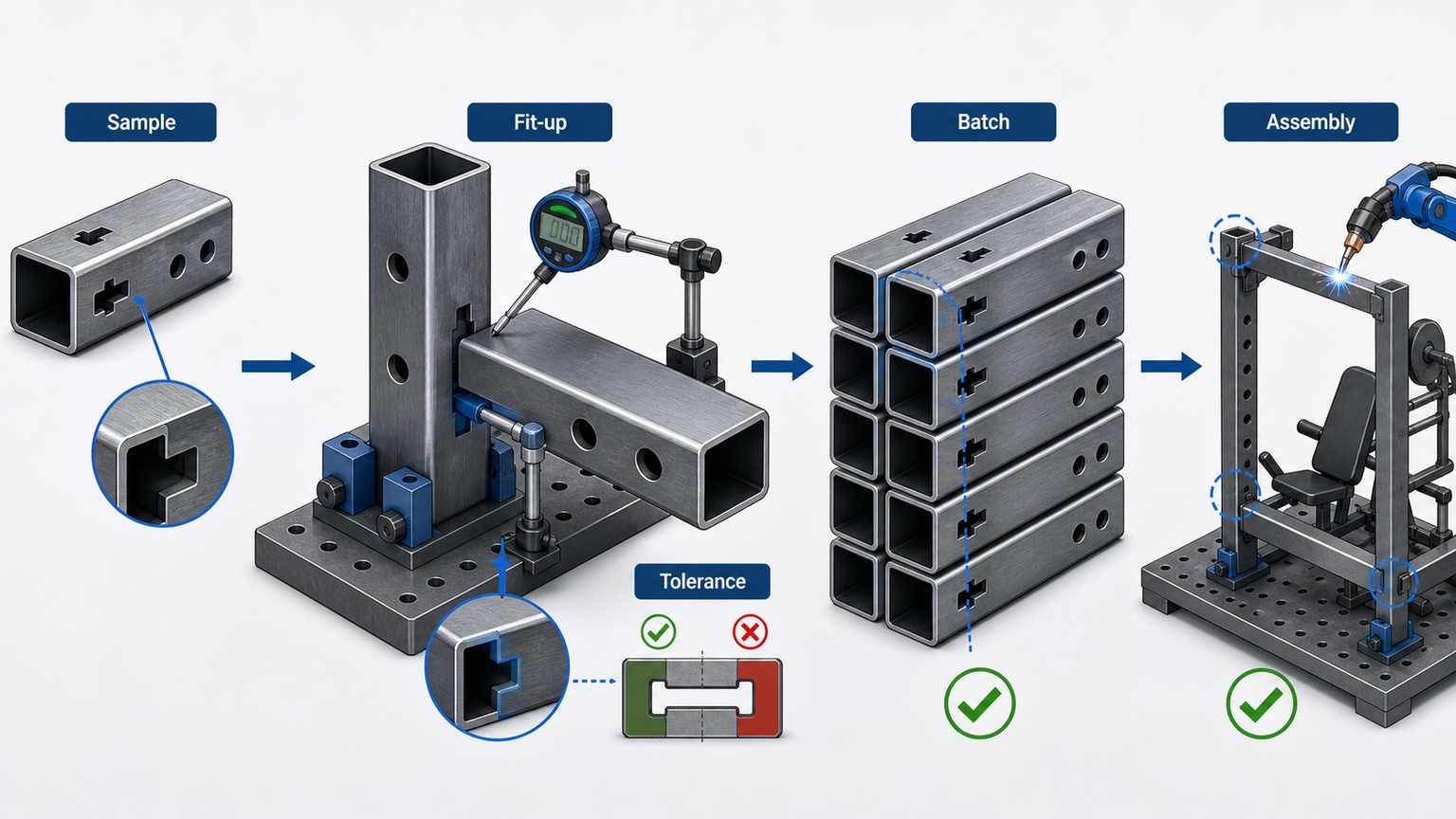
I ask buyers to bring one real part, not the easiest one. Choose a tube with holes, slots, a miter or cope, and a feature that normally causes rework. If your product uses bevel weld prep, include that too.
Use this sample-cut checklist:
- Cut length: Measure the finished part against your drawing and welding fixture need.
- Hole position: Check bolt holes, pin holes, and adjustment holes against the same datum your assembly team uses.
- Slot position: Test slots with the real mating part, not only calipers.
- Coping and miter: Place the tube into the fixture and check the weld gap.
- Bevel geometry: For bevel parts, confirm the angle and root condition before welding.
- Edge condition: Check burr, dross, oxide, and heat effect where it matters for welding, inserts, plugs, and powder coat.
- Cycle time: Time the real cut on your tube and compare it with your current routing.
- Remnant: Measure tail scrap because material cost often hides inside the last tube length.
- Operator workflow: Ask whether your normal operator can load, call the program, adjust, and inspect without outside programming support.
For BNL Laser machines, I would match the proof to the model. On Q Series, I would focus on +/-0.05 mm repeatability and remnant control, especially on Q12Y or Q16Y. On M Series, I would check the small-tube accuracy figure: <=+/-0.1 mm on parts up to 500 mm and <=+/-0.2 mm on 500-1200 mm parts. On P-Pro, I would check bevel angle control from 0-60 degrees and angle error <=+/-0.1 degrees.
How should you choose a tube laser supplier?
Choose a supplier by proving the factory, proving the sample, and proving the service path before you discuss the final price.
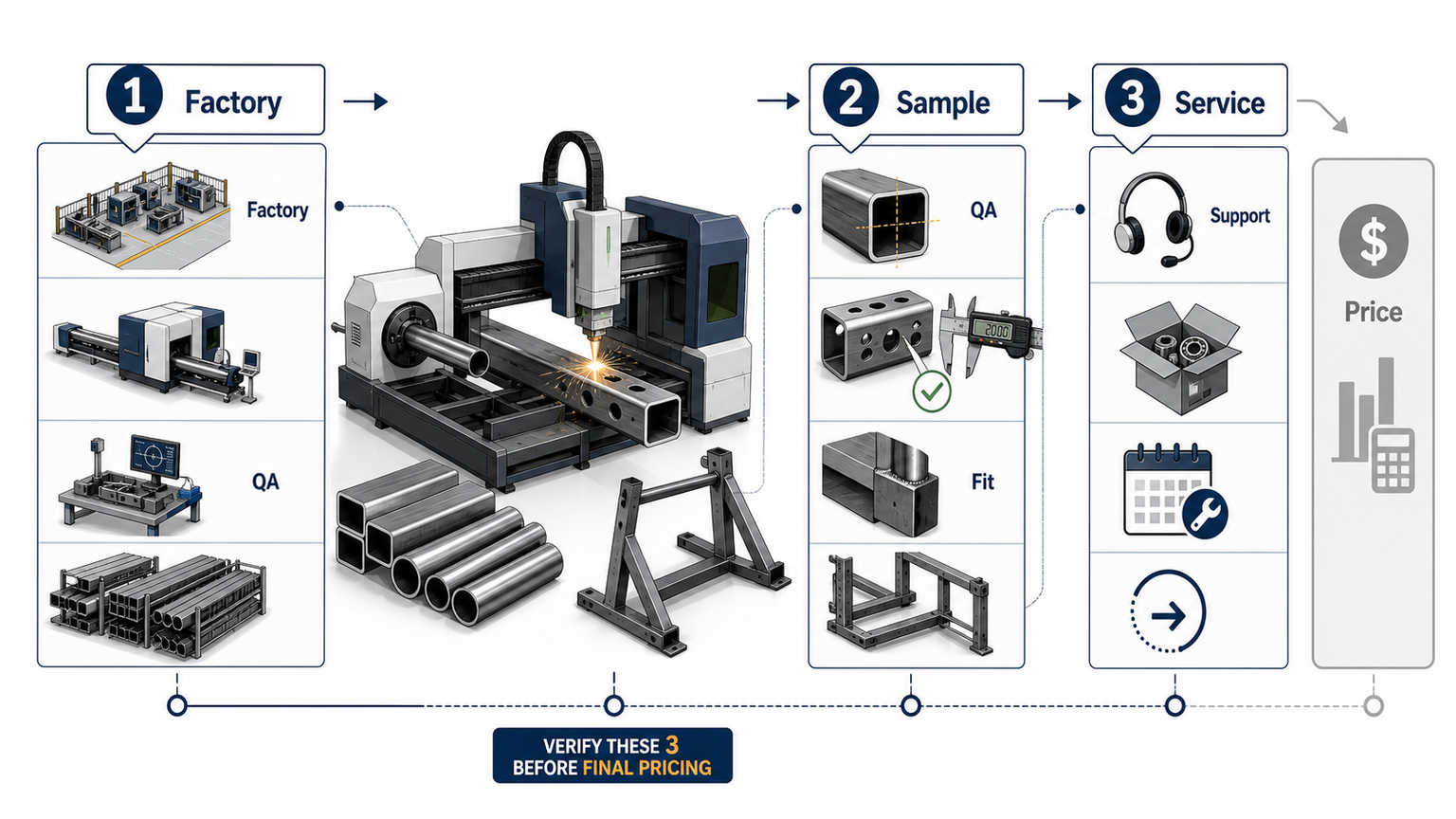
I started BNL Laser in Foshan in 2010 because I did not want to sell a machine I could not fix myself. We do our own R&D, assembly, manufacturing, and service. Tube lasers are the factory focus, not a side product next to sheet machines.
A serious buyer should check every supplier the same way:
- Ask for a live video tour of the machining, assembly, and test bays.
- Ask for the ISO certificate during the RFQ and check that the scope and company name match Foshan Mingzhou Intelligent Equipment Co., Ltd.
- Confirm that payment goes to the manufacturer’s own corporate account under that exact company name.
- Ask for public patent records if the supplier claims its own technology.
- Ask the supplier to run your tube spec on camera during the call.
- Ask for the configuration, warranty, and service-response terms in writing.
- Ask who answers the service line after installation.
We have 30+ patents and core technologies on public record and 4,000+ customer applications worldwide, but I still prefer the sample cut as the real test. A buyer should not need to believe a sales sentence. Your tube should prove the machine.
Our standard build is three-phase 380 V 50 Hz, and we configure voltage and power for the buyer’s country during the RFQ. We confirm that in writing because electrical assumptions cause avoidable delays.
Conclusion
Laser tube cutting became the standard for fitness and gym equipment frames because it gives production teams a repeatable way to cut length, holes, slots, copes, miters, tabs, and bevels in one CNC process. The real buying metric is not a headline speed; it is fit-up tolerance, finished-part quality, remnant control, operator workflow, and verified sample-cut cycle time on your own tube.
Send us your tube size, wall thickness, material, drawing or sample photo, and target volume, and my engineer will help you choose the machine by cutting a real sample first.
— Eric Liu, General Manager, BNL Laser